
Am I Lesbian Quiz
How the Scales are Structured
Who Usually Takes This Test?
See How You Compare
Below is a preview of how scores are typically distributed across each scale.
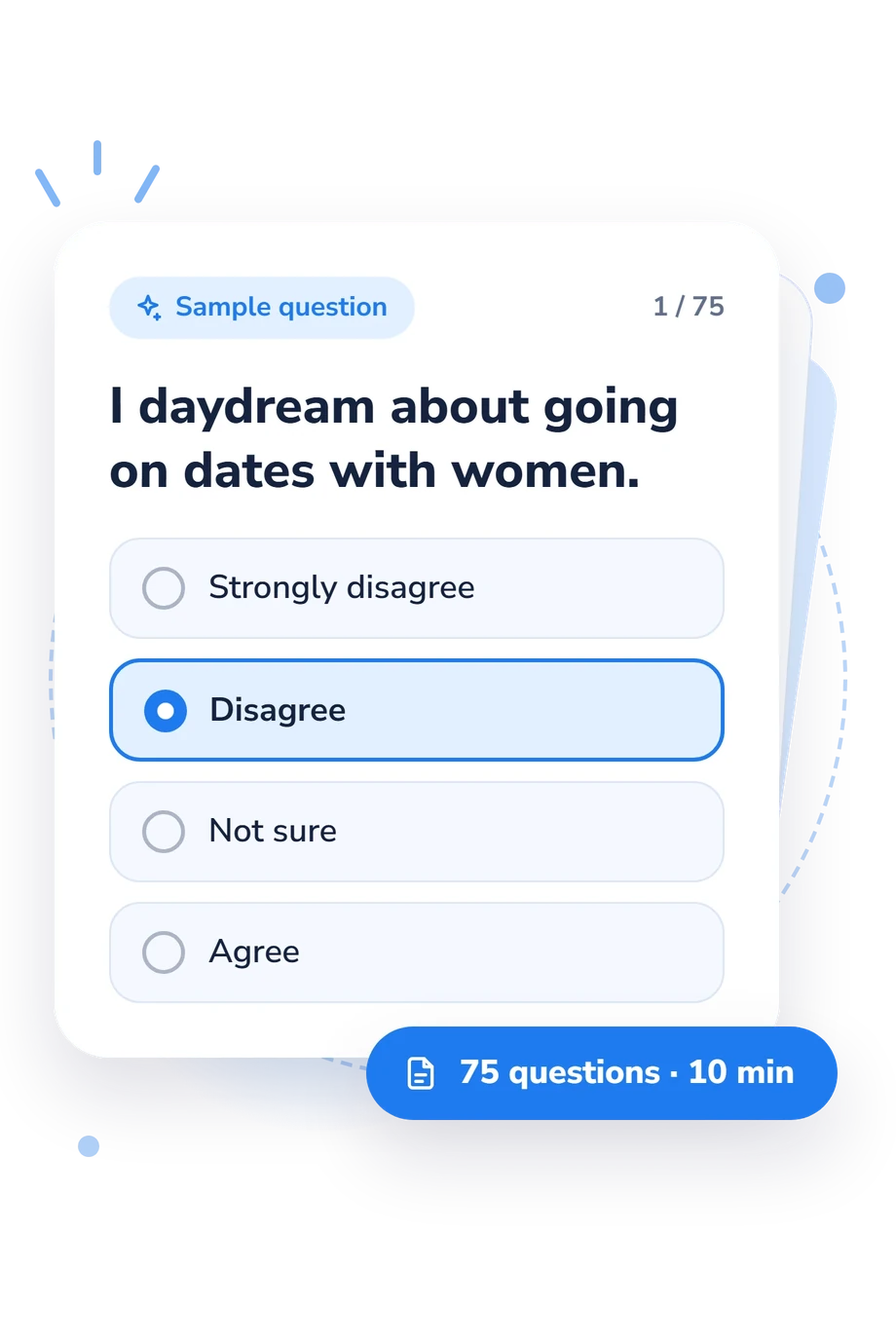
Example Questions From the Test
- Strongly disagree
- Disagree
- Not sure
- Agree
- No sense at all
- A small sense
- A moderate sense
- A clear sense
- Strongly disagree
- Disagree
- Not sure
- Agree
Am I Lesbian Quiz - Description and methodology of the test
For anyone sorting through feelings about attraction, identity, or possible next steps, the Am I Lesbian Quiz offers a private framework for reflection. It helps you compare recurring patterns in attraction to men and women with your comfort around naming those experiences, without requiring an immediate label. As a lesbian test, it is most useful when approached with curiosity rather than pressure.
What This Assessment Explores
It explores romantic or sexual attraction toward men and women alongside comfort with identity language. Items touch on dates, fantasies, physical appeal, and reactions to labels.
The three displayed scales separate attraction patterns from label readiness:
- Attraction to Men (0-30) measures consistent, frequent attraction; higher scores reflect clearer, more persistent attraction. Low 0-10, Moderate 11-20, High 21-30.
- Attraction to Women (0-30) measures consistent, frequent attraction; higher scores reflect clearer, more persistent attraction. Low 0-10, Moderate 11-20, High 21-30.
- Label Comfort & Readiness (0-20) measures ease with labels and readiness for next steps; higher scores reflect greater clarity and confidence. Exploring Privately 0-7, Mixed Readiness 8-14, Clear & Ready 15-20.
For someone using this lesbian quiz, the pattern can show whether attraction feels clearer than identity language or vice versa. It supports private reflection for people questioning, exploring, or clarifying.
Methodology and Evidence Base
Statements cover attraction, fantasies, behavior, uncertainty, labels, and possible next steps. Representative items use graded choices such as Strongly disagree to Agree; readiness items range from Not at all ready to Very ready. This self-report format allows uncertainty.
Responses form three thematic totals; exact item weighting is not stated. Higher attraction scores indicate more frequent, clearer, and more persistent attraction, while higher readiness scores indicate greater ease with labels and next steps. Although some may approach this questionnaire as a gay test for girls, the profile is broader than one identity verdict.
Sell (1996) provides the main multidimensional reference for sexual orientation. Klein, Sepekoff, and Wolf (1985) support a dynamic, multi-aspect view, while Cass (1979) helps frame identity development and uncertainty. Together, these sources provide context rather than proof of direct adaptation or standardization.
Because this online questionnaire has no published norms or validated clinical cutoffs, results are descriptive and may shift with current context, social pressure, mood, memory, and self-awareness. An Am I Lesbian test result is a present-moment profile to revisit as your understanding changes.
- Sell, Randall L. (1996). The Sell Assessment of Sexual Orientation: Background and Scoring. Journal of Gay, Lesbian, and Bisexual Identity, 1(4), 295-310. 10.1007/BF03372244
- Klein, Fritz, Barry Sepekoff, and Timothy J. Wolf (1985). Sexual orientation: A multi-variable dynamic process. Journal of Homosexuality, 11(1-2), 35-49. 10.1300/J082v11n01_04
- Cass, Vivienne C. (1979). Homosexual identity formation: A theoretical model. Journal of Homosexuality, 4(3), 219-235. 10.1300/J082v04n03_01
Updated: