
What Type of Girl Are You Quiz
How the Scales are Structured
Who Usually Takes This Test?
See How You Compare
Below is a preview of how scores are typically distributed across each scale.
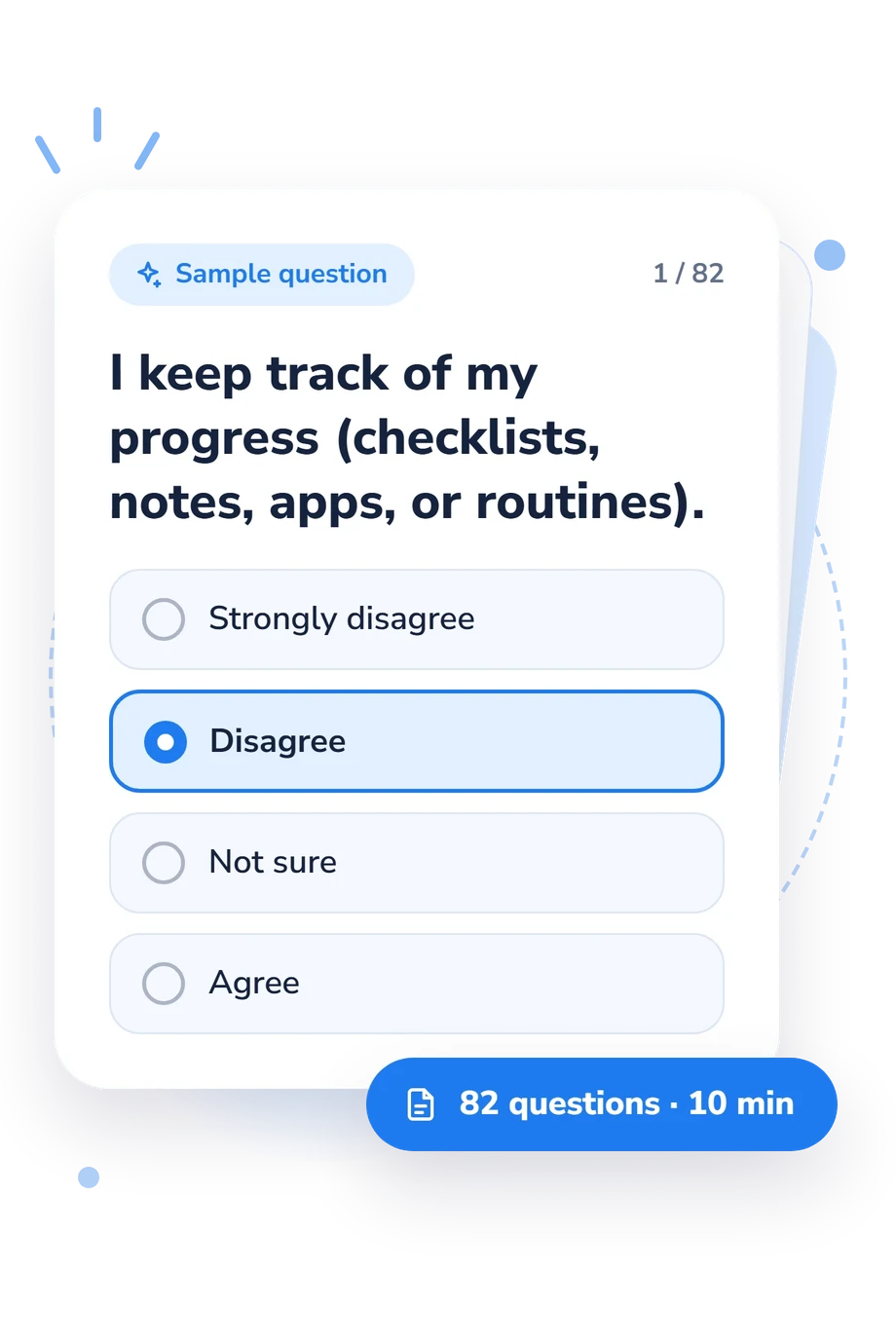
Example Questions From the Test
- Strongly disagree
- Disagree
- Not sure
- Agree
- Strongly disagree
- Disagree
- Not sure
- Agree
- Strongly disagree
- Disagree
- Not sure
- Agree
What Type of Girl Are You Quiz - Description and methodology of the test
People who find broad personality labels too simple may use this questionnaire to compare their everyday tendencies across several familiar situations. The What Type of Girl Are You Quiz gives readers a concise profile for considering which responses feel most like them and where their habits differ. Readers using this what kind of girl are you quiz can use that comparison without reducing themselves to one fixed category.
What the Questionnaire Measures
Three dimensions organize the profile around goals, closeness, and social stimulation. The items touch on planning, persistence, emotional openness, directness, sociability, and activity preferences. The profile suits readers examining everyday tendencies and their combinations. The what type of girl am i quiz gives readers a way to compare these dimensions rather than receive one label.
The displayed scales are:
- Goal Drive: 0-30 shows how motivated, structured, and persistent you are in pursuing goals; Go-with-the-Flow 0-10 is flexible, Balanced Drive 11-20 is moderate, and Highly Driven 21-30 is ambitious.
- Relationship Approach: 0-30 shows your pace and directness in closeness; Reserved & Slow-to-Open 0-10 is cautious, Balanced & Selective 11-20 is measured, and Direct & Fast-to-Connect 21-30 is expressive.
- Social Energy: 0-30 shows outward sociability and stimulation-seeking; Low 0-10 is calm and solo-oriented, Moderate 11-20 is mixed, and High 21-30 is outgoing and group-oriented.
Methodology and Scientific Basis
The questions use four agreement responses-Strongly disagree, Disagree, Not sure, and Agree-to record how much you agree with each statement. Responses form three dimension scores mapped to the displayed bands; the questionnaire does not specify how many points each option contributes.
Conceptual overlaps with the Big Five Inventory-2 (Soto & John, 2017) include conscientiousness in goal-related content and extraversion in social-energy content. Goal-persistence items resemble persistence in grit research by Duckworth and colleagues (2007), while relationship content echoes cautious versus direct closeness in attachment research by Fraley, Waller, and Brennan (2000). These comparisons do not show that this questionnaire measures the same constructs or was validated against those instruments, and they do not make it an adaptation of them.
The result is a snapshot of self-reported tendencies shaped by mood, recent experiences, context, and self-awareness. Someone using the what kind of girl am i quiz in these situations can treat it as a prompt for comparison, not an unchanging identity. The questionnaire has no stated population norms or reliability estimates, and its result bands are descriptive rather than clinical cutoffs.
- Soto, Christopher J., & John, Oliver P. (2017). The next Big Five Inventory (BFI-2): Developing and assessing a hierarchical model with 15 facets to enhance bandwidth, fidelity, and predictive power. Journal of Personality and Social Psychology, 113(1), 117-143. 10.1037/pspp0000096
- Fraley, R. Chris, Waller, Niels G., & Brennan, Kelly A. (2000). An item response theory analysis of self-report measures of adult attachment. Journal of Personality and Social Psychology, 78(2), 350-365. 10.1037/0022-3514.78.2.350
- Duckworth, Angela L., Peterson, Christopher, Matthews, Michael D., & Kelly, Dennis R. (2007). Grit: Perseverance and passion for long-term goals. Journal of Personality and Social Psychology, 92(6), 1087-1101. 10.1037/0022-3514.92.6.1087
Updated: