
ADHD Test for Adults
How the Scales are Structured
Who Usually Takes This Test?
See How You Compare
Below is a preview of how scores are typically distributed across each scale.
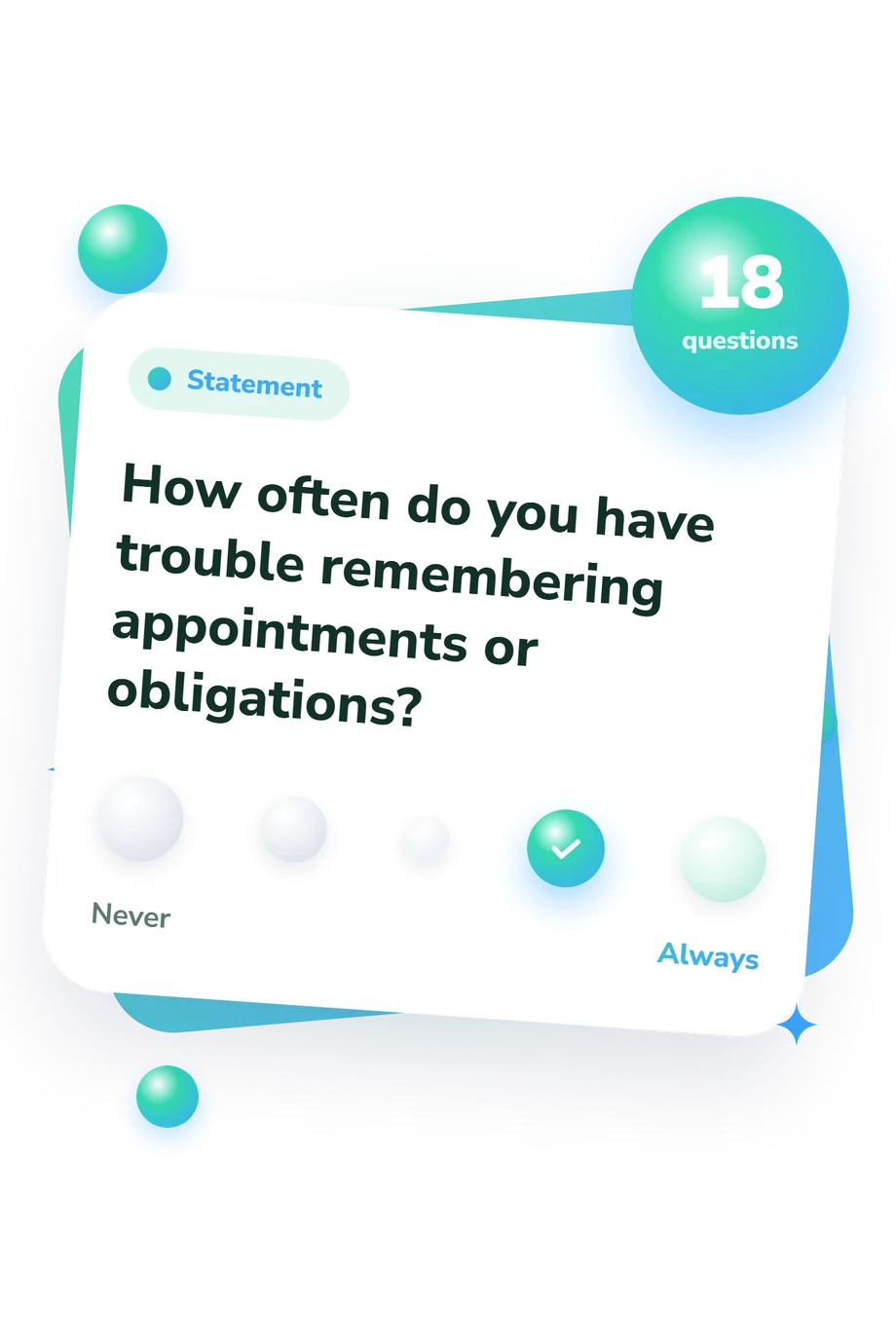
Example Questions From the Test
- Never
- Rarely
- Sometimes
- Often
- Always
- Never
- Rarely
- Sometimes
- Often
- Always
- Never
- Rarely
- Sometimes
- Often
- Always
ADHD Test for Adults - Description and methodology of the test
For adults wondering whether recurring problems with focus, organization, restlessness, or impulse control deserve closer attention, this adhd test for adults offers a structured self-report starting point. An ADHD quiz for adults can help organize everyday examples into a profile of symptom patterns, giving the respondent clearer language for reflection and for a later conversation with a qualified professional.
What This Assessment Explores
The questions examine everyday attention and activity patterns, including organization, task completion, forgetfulness, sustained concentration, distractibility, restlessness, excessive movement, interrupting, and waiting. They describe recurring situations rather than judging motivation or character.
Results separate the main symptom areas as follows:
- ADHD Diagnostic Scale: 0-6 summarizes the primary adult ADHD screening profile; Low symptoms 0-3 and Elevated symptoms 4-6 are the displayed bands.
- Inattention: 0-40 reflects concentration, forgetfulness, and reduced attention; Low 0-13, Moderate 14-26, and High 27-40 are the displayed bands.
- Hyperactivity: 0-32 reflects impulsivity, motor activity, and difficulty remaining seated; Low 0-10, Moderate 11-21, and High 22-32 are the displayed bands.
A free adult ADHD test can make these patterns easier to review before deciding what deserves further attention.
Methodology and Evidence Base
Each item uses five frequency choices from Never to Always and asks about a concrete everyday situation. Separate totals summarize endorsed patterns; the displayed ranges do not by themselves show how many points each response contributes.
Its structure is consistent with the WHO Adult ADHD Self-Report Scale (Kessler et al., 2005), a brief adult symptom screener, and its symptom framing follows DSM-IV-TR criteria. Adler and colleagues (2006) examined the ASRS for rating adult ADHD symptoms. These sources support the framework for testing for ADHD in adults, not identical validation results for this online questionnaire.
Interpret the profile across the outputs: one may emphasize attention-related difficulties, another activity or impulsivity, while the screening score summarizes the overall threshold pattern. The bands organize levels and should be read as screening outputs rather than a diagnosis.
The source ASRS has published evidence, but this online format should not be assumed to share its norms or diagnostic performance. Self-report is affected by stress, context, recall, and self-awareness, so an elevated result is best considered alongside developmental history and broader assessment.
- Kessler, Ronald C., Lenard Adler, Minnie Ames, Olga Demler, Stephen Faraone, Eva Hiripi, Mary J. Howes, Robert Jin, Kristina Secnik, Thomas Spencer, T. Bedirhan Ustun, and Ellen E. Walters. The World Health Organization Adult ADHD Self-Report Scale (ASRS): A Short Screening Scale for Use in the General Population. Psychological Medicine. 2005;35(2):245-256. 10.1017/S0033291704002892
- Adler, Lenard A., Thomas Spencer, Stephen V. Faraone, Ronald C. Kessler, Mary J. Howes, Joseph Biederman, and Kristina Secnik. Validity of Pilot Adult ADHD Self-Report Scale (ASRS) to Rate Adult ADHD Symptoms. Annals of Clinical Psychiatry. 2006;18(3):145-148. 10.1080/10401230600801077
- American Psychiatric Association. Diagnostic and Statistical Manual of Mental Disorders, Fourth Edition, Text Revision. Washington, DC: American Psychiatric Association, 2000.
Updated: