
Dirty Mind Test
How the Scales are Structured
Who Usually Takes This Test?
See How You Compare
Below is a preview of how scores are typically distributed across each scale.
Example Questions From the Test
- Strongly disagree
- Disagree
- Not sure
- Agree
- Strongly disagree
- Disagree
- Not sure
- Agree
- Strongly disagree
- Disagree
- Not sure
- Agree
Dirty Mind Test - Description and methodology of the test
For readers curious about their own reactions to double meanings, this dirty mind test offers a structured way to examine a familiar kind of everyday interpretation. It suits people deciding whether a light questionnaire could help them reflect on language, humor, and conversational timing. A dirty mind quiz result gives a focused profile of responses rather than a judgment about the person.
What This Assessment Explores
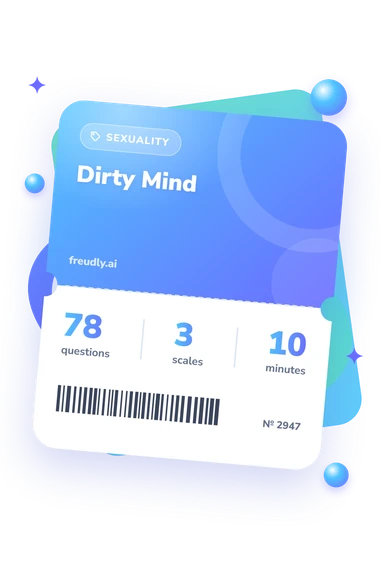
These items examine how people handle wording that may carry sexual meaning. They show whether an ambiguous phrase is read literally or suggestively, how quickly that association appears, and how often a sexual meaning comes first. The result describes language interpretation rather than sexual experience or character. The three displayed dimensions are:
- Literal-Mindedness (0-30) measures preference for direct meanings; bands are Innuendo-leaning (0-10), Balanced (11-20), and Highly literal (21-30).
- Quick-Reaction Innuendo (0-20) measures rapid suggestive associations; bands are Mostly Literal (0-6), Mixed Reads (7-13), and Fast Innuendo (14-20).
- Suggestive Interpretation (0-30) measures how often a sexual meaning comes first; bands are Mostly literal (0-10), Mixed interpretations (11-20), and Strongly suggestive (21-30).
Taken together, the profile shows separate tendencies across the three dimensions without ranking one as most prominent. As a quiz about how dirty your mind is, it organizes these reactions into a profile of ambiguous-language interpretation.
Methodology and Scientific Basis
The questionnaire uses self-report statements about ambiguous phrases, jokes, messages, and rapid exchanges. Items use four agreement choices, moving from disagreement toward agreement; some include Not sure, while others use stronger agreement wording. The format asks for a usual or immediate reaction rather than a performance task.
The result presents three displayed scales with the ranges and bands listed above. It does not state how individual answers are weighted, and validation for this online format is not documented. Considering responses to the ambiguous-language test questions together is more informative than treating one response as decisive.
Geer and Melton (1997) is the closest conceptual reference, examining processing around double-entendre words. Rigoulot, Jiang, Vergis, and Pell (2020) offers related evidence on responses to sexually evocative speech, while Silverman-Watkins and Sprafkin (1983) examined sexual-innuendo comprehension. The questionnaire is conceptually consistent with these works; that relationship alone does not establish validation.
As self-report, answers depend on self-awareness, honesty, context, conversational pace, and perceived reaction speed; mood or situation may shift scores. The profile is a structured snapshot of reported responses to ambiguous language.
- Geer, J. H., & Melton, J. S. (1997). Sexual content-induced delay with double-entendre words. Archives of Sexual Behavior, 26(3), 295-316. 10.1023/A:1024574915201
- Rigoulot, S., Jiang, X., Vergis, N., & Pell, M. D. (2020). Neurophysiological correlates of sexually evocative speech. Biological Psychology, 154, 107909. 10.1016/j.biopsycho.2020.107909
- Silverman-Watkins, L. T., & Sprafkin, J. N. (1983). Adolescents' comprehension of televised sexual innuendos. Journal of Applied Developmental Psychology, 4(4), 359-369. 10.1016/0193-3973(83)90013-8