
Freudly+971 508685814hello@freudly.ai
Freudly
depression

World Assumptions Scale (WAS) Test
Take the online World Assumptions Scale (WAS) Test - AI psychologist FreudlyYou can take World Assumptions Scale (WAS) Testhere. Online version of a simple and accurate psychological test with interpretation.en
Understand how stress or trauma may have shifted core beliefs about safety, fairness, and self worth in about 6 minutes. Pinpoint 32 key belief areas to guide targeted therapy and support recovery from trauma and depression.
Start Online Test
Questions: 326 minutes
08:30
October 2, 2025
October 2, 2025
Material has been updated
October 2, 2025
Material has been published
31,099 views
3,062 completions
2,666 likes
Verified by Daniel Hall
Psychologist with 25 years of experience
Share
Scale Explorer

How the Scales are Structured

example score
5/6
Luck/Fortune (L)
Assesses how strongly a person perceives themselves as generally lucky and favored by circumstances.
Low luck belief
Moderate luck belief
High luck belief
13: Low luck belief | 3.15.1: Moderate luck belief | 5.26: High luck belief
A score of 5 falls in the Moderate luck belief range, suggesting you tend to view yourself as fairly fortunate overall, though not consistently strongly lucky.
example score
3/6
General Belief in the Benevolence of the World (GBitBotW)
Measures overall trust and positive expectations about the surrounding world, integrating beliefs about the benevolence of the world and the kindness of people.
Low trust
Higher trust
13.6: Low trust | 3.66: Higher trust
A score of 3 falls in the Low trust range, suggesting a generally cautious or less positive view of the world's and people's kindness.
example score
3/6
Beliefs About Self-Worth (BASW)
Measures belief in one’s own worth, including self-esteem, sense of significance, self-regulation, and perceived luck.
Low
High
13.5: Low | 3.66: High
A score of 3 falls in the Low range, suggesting reduced confidence in personal value and self-regulation compared with higher scores.
example score
3/6
General Belief in the Meaningfulness of the World (GBitMotW)
Measures how strongly a person believes that the world is governed by meaningful laws rather than random chance.
Low meaningfulness
High meaningfulness
13.5: Low meaningfulness | 3.66: High meaningfulness
A score of 3 indicates a lower tendency to perceive events as meaningfully ordered, with a greater sense that what happens may be arbitrary or hard to explain.
example score
2/6
Benevolence of the World (BotW)
Measures how strongly a person believes the world is generally kind and well-disposed toward them rather than threatening.
Low benevolence
Moderate benevolence
High benevolence
13.4: Low benevolence | 3.55.4: Moderate benevolence | 5.56: High benevolence
A score of 2 falls in the Low benevolence range, suggesting a stronger tendency to perceive the world as unsafe or hostile rather than supportive.
example score
4/6
Benevolence of People (BoP)
Measures how strongly a person believes that people around them are generally kind and act with integrity.
Low trust
Balanced trust
High trust
13.1: Low trust | 3.25: Balanced trust | 5.16: High trust
A score of 4 falls in the Balanced trust range, suggesting a generally cautious but not strongly suspicious view of others’ intentions.
example score
3/6
Justice of the World (JotW)
Measures the extent to which a person believes the world is fair and events follow understandable rules rather than being random and unjust.
Low belief in justice
Moderate belief in justice
High belief in justice
12.9: Low belief in justice | 34.9: Moderate belief in justice | 56: High belief in justice
A score of 3 indicates a moderate belief that the world is generally just and predictable, though this view may not feel fully stable in all situations.
example score
3/6
Controllability of the World (CotW)
Measures how strongly a person believes that life events are predictable and can be influenced through regular patterns or personal actions.
Low controllability
Moderate controllability
High controllability
13.3: Low controllability | 3.45: Moderate controllability | 5.16: High controllability
A score of 3 suggests a low sense of controllability, with events more often perceived as happening unpredictably and being hard to influence.
example score
3/6
Randomness as a Principle (RaaP)
Measures how strongly a person believes that events happen randomly rather than following understandable patterns.
Low randomness
Moderate randomness
High randomness
12.6: Low randomness | 2.74.7: Moderate randomness | 4.86: High randomness
A score of 3 falls in the Moderate randomness range, suggesting you somewhat see events as partly unpredictable while still expecting some regularity.
example score
3/6
Self-Worth (SW)
Assesses how strongly a person feels a sense of self-worth and personal significance.
Low self-worth
Moderate self-worth
High self-worth
13.4: Low self-worth | 3.55.3: Moderate self-worth | 5.46: High self-worth
A score of 3 falls in the Low self-worth range, suggesting a reduced sense of personal value and significance relative to this scale.
example score
4/6
Degree of Self-Control (DoSC)
Measures the extent to which a person believes they can control their actions and influence events.
Low self-control belief
Moderate self-control belief
High self-control belief
13.6: Low self-control belief | 3.75.3: Moderate self-control belief | 5.46: High self-control belief
A score of 4 falls in the moderate range, suggesting a generally present but not fully stable sense of being able to regulate your actions and affect outcomes.
Start Online Test
just completed the test
DATA-BASED USER COHORTS

Who Usually Takes This Test?

After trauma or crisis
44%OF USERS
People who have been through a traumatic event or severe stress and want to understand how it changed their sense of safety, trust, and control.
Low mood and depression
33%OF USERS
Those experiencing depression, hopelessness, or emotional numbness who want to identify destructive beliefs that keep them stuck.
Therapy focus and tracking
23%OF USERS
Clients already in therapy who want a quick check of which core assumptions need attention and how they shift over time.
BASED ON AGGREGATED, ANONYMIZED DATA FROM TENS OF THOUSANDS OF FREUDLY USERS.
Benchmarking

See How You Compare

Once you complete the test, your results are compared with real-world data from people in your country.
Below is a preview of how scores are typically distributed across each scale.
Degree of luck/favorability (Dol)
Average
4.6
Normal range
45.3
min.
1
max.
6
This curve shows how scores are typically distributed.
Once you complete the test, your result will appear on the scale so you can see how you compare.
General Attitude Toward the Kindness of the World (GATtKotW)
Average
3.5
Normal range
2.54.4
min.
1
max.
6
This curve shows how scores are typically distributed.
Once you complete the test, your result will appear on the scale so you can see how you compare.
Belief About One's Own Worth (BAOOW)
Average
2.6
Normal range
1.73.5
min.
1
max.
6
This curve shows how scores are typically distributed.
Once you complete the test, your result will appear on the scale so you can see how you compare.
General Attitude Towards the Meaningfulness of the World (GATtMotW)
Average
3
Normal range
2.33.7
min.
1
max.
6
This curve shows how scores are typically distributed.
Once you complete the test, your result will appear on the scale so you can see how you compare.
The Benevolence of the World (TBotW)
Average
4
Normal range
3.24.8
min.
1
max.
6
This curve shows how scores are typically distributed.
Once you complete the test, your result will appear on the scale so you can see how you compare.
The Kindness of People (TKoP)
Average
3
Normal range
2.43.7
min.
1
max.
6
This curve shows how scores are typically distributed.
Once you complete the test, your result will appear on the scale so you can see how you compare.
Justice of the World (JotW)
Average
4.2
Normal range
3.44.9
min.
1
max.
6
This curve shows how scores are typically distributed.
Once you complete the test, your result will appear on the scale so you can see how you compare.
Controllability of the world (Cotw)
Average
3.3
Normal range
2.54
min.
1
max.
6
This curve shows how scores are typically distributed.
Once you complete the test, your result will appear on the scale so you can see how you compare.
Randomness as a Principle (RaaP)
Average
2.7
Normal range
23.5
min.
1
max.
6
This curve shows how scores are typically distributed.
Once you complete the test, your result will appear on the scale so you can see how you compare.
The Value of the Self (TVotS)
Average
4.2
Normal range
3.54.9
min.
1
max.
6
This curve shows how scores are typically distributed.
Once you complete the test, your result will appear on the scale so you can see how you compare.
Degree of self-control (Dos)
Average
2.3
Normal range
1.72.9
min.
1
max.
6
This curve shows how scores are typically distributed.
Once you complete the test, your result will appear on the scale so you can see how you compare.
Featured On
SAMPLE QUESTIONS

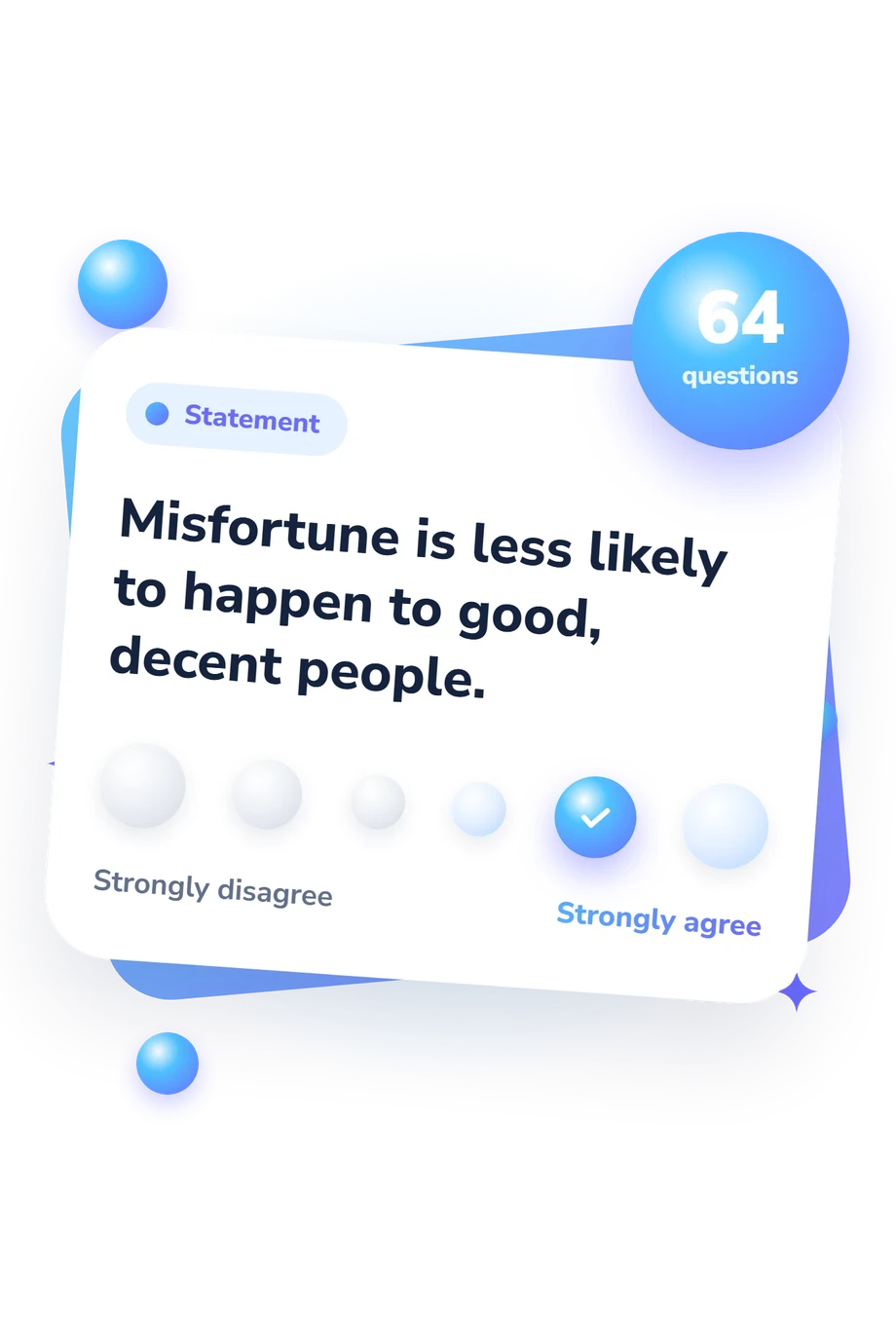
Example Questions From the Test

    • Strongly disagree
    • Disagree
    • Somewhat disagree
    • Somewhat agree
    • Agree
    • Strongly agree
    • Strongly disagree
    • Disagree
    • Somewhat disagree
    • Somewhat agree
    • Agree
    • Strongly agree
    • Strongly disagree
    • Disagree
    • Somewhat disagree
    • Somewhat agree
    • Agree
    • Strongly agree
WHAT THE TEST MEASURES
About This Assessment
Basic Beliefs Scale, WAS Test

World Assumptions Scale (WAS) Test - Symptoms and Signs

depression
irrational beliefs
cbt
ptsd

After exposure to significant stress or trauma, an individual’s core beliefs about the self and the world may shift. The World Assumptions Scale (WAS) is a self-report measure designed to assess foundational assumptions such as perceived benevolence and justice of the world, personal worth, and beliefs about control and predictability. It is commonly used to inform clinical formulation and to support research on cognitive appraisals associated with psychological distress.

Developed by R. Janoff-Bulman, the instrument consists of 32 items and typically takes about 6 minutes to complete. Results from the World Assumptions Scale (WAS) can help identify domains of disrupted assumptions that may be clinically relevant in presentations involving trauma-related symptoms, depression, or adjustment difficulties, and can be used to guide case conceptualization and treatment planning.

Author: R. Janoff-Bulman
Literature: Janoff-Bulman, R. Shattered assumptions: Towards a new psychology of trauma. Free Press. 1992.; Berry, J. W., Poortinga, Y. H., Breugelmans, S. M., Chasiotis, A., & Sam, D. L. Cross-cultural psychology: Research and applications. Cambridge University Press. 2011.
Popular tests
Comments
Leave a Comment