
Brief Self-Actualization Index Test
How the Scales are Structured
Who Usually Takes This Test?
See How You Compare
Below is a preview of how scores are typically distributed across each scale.
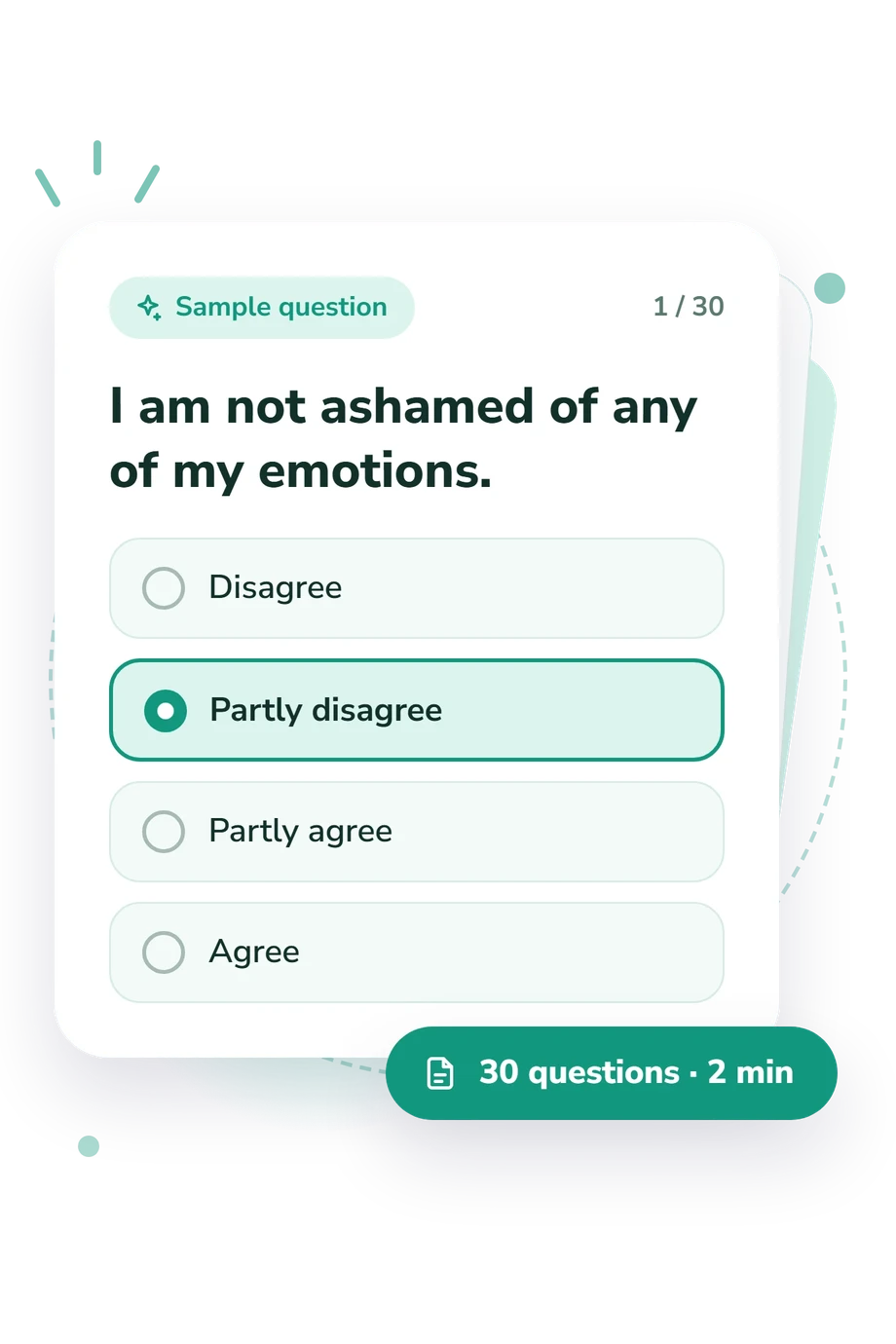
Example Questions From the Test
- Disagree
- Partly disagree
- Partly agree
- Agree
- Disagree
- Somewhat disagree
- Somewhat agree
- Agree
- Disagree
- Somewhat disagree
- Somewhat agree
- Agree
Brief Self-Actualization Index Test - Description and methodology of the test
For readers considering how consistently they live by their own values, the Brief Self-Actualization Index Test offers a focused way to examine everyday attitudes linked with personal development. This self-actualization assessment is useful when you want language for patterns involving independence, emotional openness, relationships, and commitment. The result summarizes a current tendency rather than defining a fixed identity or complete psychological profile.
What This Assessment Explores
The questionnaire examines whether a person can accept inner experience, act without outside approval, remain open to complexity, and sustain trusting relationships. It also touches on responsibility, emotional expression, fear of failure, commitment, and the tension between authenticity and popularity. As a self-actualization questionnaire, it treats these situations as indicators of patterns rather than isolated virtues or faults.
The result is presented through the Self-Actualization Index, which ranges from 15-60. Its four facets are:
- Autonomy shows how readily a person acts from personal values instead of depending on approval.
- Self-acceptance reflects comfort with emotions, weaknesses, and ordinary imperfections.
- Trust concerns expectations that people can be good, understandable, and worthy of connection.
- Responsibility captures commitment, honest expression, and willingness to respond to others without surrendering personal agency.
The displayed bands are Low 15-25, Moderate 26-45, and High 46-60. Higher totals indicate more present-focused living, independence, and rationality within this profile.
Methodology and Evidence Base
Each statement uses four ordered response options, from disagreement to agreement. The items address emotions, approval, trust, failure, authenticity, commitment, and interpersonal responsibility. The questionnaire reports one displayed total, but it does not specify how individual responses are converted into that total or provide an item-level scoring key; interpretation should follow the shown bands rather than inferred weights.
The content is conceptually consistent with the published Short Index of Self-Actualization. Tucker and Weber’s 1988 study examined its factor structure, while Faraci and Cannistraci’s 2015 study examined an Italian sample. The online questionnaire has no stated standardization, norms, or independent validation equivalent to the published instrument; those studies provide evidence about the published instrument’s factor structure, not this online version.
Self-report results can shift with mood, recent relationships, self-awareness, and the wish to present oneself favorably. For self-reflection, this self-actualization test can make response patterns easier to notice, but important decisions should not rest on a permanent label.
- Jones, A., & Crandall, R. (1986). Validation of a Short Index of Self-Actualization. Personality and Social Psychology Bulletin, 12(1), 63-73. 10.1177/0146167286121007
- Tucker, R. K., & Weber, D. R. (1988). Factorial Validity of Jones and Crandall's Short Index of Self-Actualization. Psychological Reports, 63(1), 39-45. 10.2466/pr0.1988.63.1.39
- Faraci, P., & Cannistraci, S. (2015). The Short Index of Self-Actualization: A Factor Analysis Study in an Italian Sample. International Journal of Psychological Research, 8(2), 23-33. 10.21500/20112084.1507
Updated: