
Toronto Empathy Questionnaire (TEQ) Test
How the Scales are Structured
Who Usually Takes This Test?
See How You Compare
Below is a preview of how scores are typically distributed across each scale.
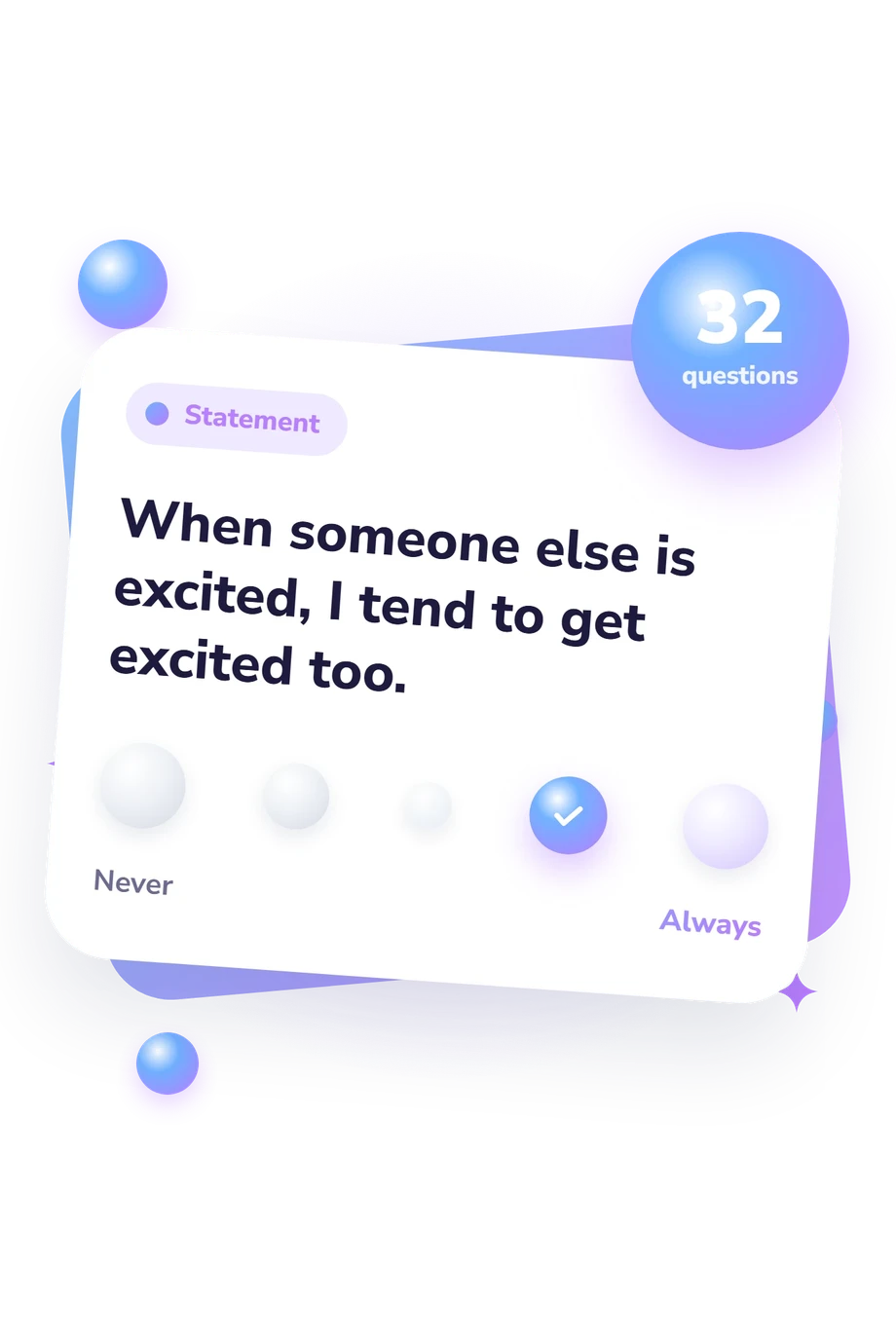
Example Questions From the Test
- Never
- Rarely
- Sometimes
- Often
- Always
- Never
- Rarely
- Sometimes
- Often
- Always
- Never
- Rarely
- Sometimes
- Often
- Always
Toronto Empathy Questionnaire (TEQ) Test - Description and methodology of the test
People who want to examine their interpersonal responsiveness can use the Toronto Empathy Questionnaire (TEQ) Test to receive a broad result describing empathic tendencies across emotional attunement, concern, and supportive action. This empathy assessment suits readers exploring relationship patterns and shows how their responses are grouped into a named level. The result gives them a concise basis for reflection.
What This Assessment Explores
The questionnaire treats empathy as a broad tendency to notice another person's state and respond with concern. Statements address emotional resonance, recognition of unspoken distress, sympathy for hardship, and urges to help or protect, while less responsive reactions add contrast.
The Empathy Scale runs from 0-64 and measures empathic responding and understanding of others' emotions. Higher scores indicate greater empathy. The bands are Low empathy 0-31, Moderate empathy 32-47, and High empathy 48-64. Results provide one overall score; separate subscale scores are not displayed.
The result highlights these themes:
- Emotional resonance shows how another person's excitement or happiness affects your state.
- Emotional recognition captures noticing distress or mood changes without explanation.
- Compassionate and prosocial response reflects sympathy and the urge to comfort, help, or protect people facing hardship, unfairness, or vulnerability.
This profile suits readers reflecting on interpersonal responsiveness.
Methodology and Scientific Basis
Each statement uses a five-point response from Never to Always. Items address emotional contagion, noticing others' states, sympathy, and helping or protective reactions. The questionnaire produces one overall score rather than separate subscale scores, and no separate item-weighting rule is specified.
The online questionnaire is conceptually consistent with the published Toronto Empathy Questionnaire (Spreng et al., 2009), whose development combined several established empathy measures into a coherent construct. It is not an adaptation of that published instrument. Kourmousi et al. (2017) examined reliability and validity in Greek teachers, while Janelt et al. (2024) assessed the German version, including its stability over one year. These studies provide psychometric evidence for their respective language versions and populations; they do not establish that this online version is standardized or has the same norms.
When interpreting empathy test results, treat the band as a descriptive guide rather than a fixed identity label. Self-report can be influenced by current mood, social desirability, memory, and self-awareness, while empathic behavior varies across relationships and situations.
- Spreng, R. Nathan, Margaret C. McKinnon, Raymond A. Mar, and Brian Levine. The Toronto Empathy Questionnaire: Scale Development and Initial Validation of a Factor-Analytic Solution to Multiple Empathy Measures. Journal of Personality Assessment. 2009;91(1):62-71. 10.1080/00223890802484381
- Kourmousi, Ntina, Eirini Amanaki, Chara Tzavara, Kyriakoula Merakou, Anastasia Barbouni, and Vasilios Koutras. The Toronto Empathy Questionnaire: Reliability and Validity in a Nationwide Sample of Greek Teachers. Social Sciences. 2017;6(2):62. 10.3390/socsci6020062
- Janelt, Tobias, Tobias Altmann, R. Nathan Spreng, and Marcus Roth. Analyzing the Factor Structure of the Toronto Empathy Questionnaire: Dimensionality, Reliability, Validity, Measurement Invariance and One-Year Stability of the German Version. Journal of Personality Assessment. 2024;106(2):230-241. 10.1080/00223891.2023.2224873
Updated: