
Element Quiz
How the Scales are Structured
Who Usually Takes This Test?
See How You Compare
Below is a preview of how scores are typically distributed across each scale.
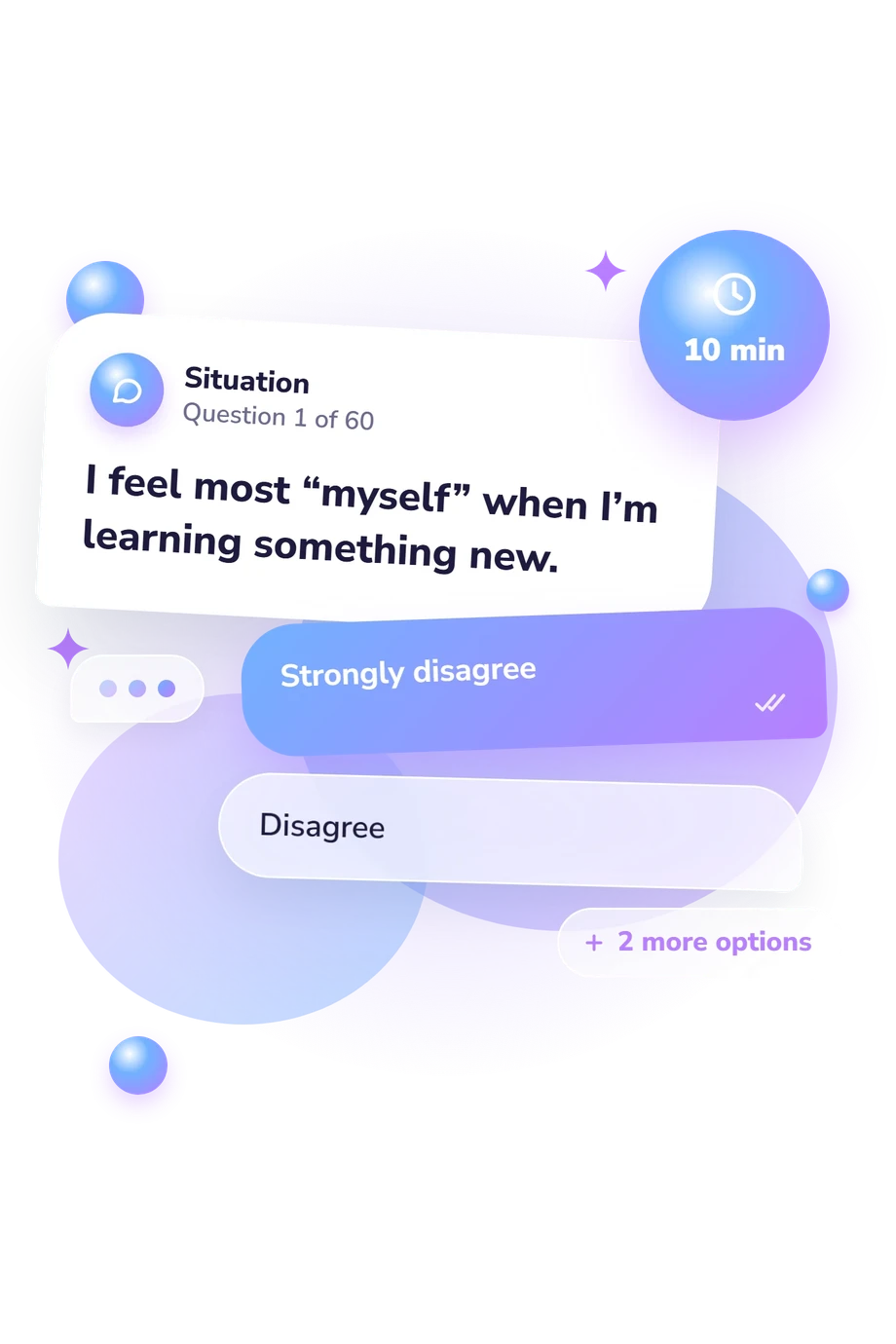
Example Questions From the Test
- Strongly disagree
- Disagree
- Not sure
- Agree
- Strongly disagree
- Disagree
- Not sure
- Agree
- Strongly agree
- Strongly disagree
- Disagree
- Not sure
- Agree
- Strongly agree
Element Quiz - Description and methodology of the test
For people exploring symbolic personality frameworks, the element quiz offers a structured way to reflect on recurring preferences and identify which displayed element affinity is strongest. Using this as a what element am i quiz, people can consider how they approach ideas, routines, social contact, ambition, and pressure. The result is most useful for self-observation when a person wants language for patterns that may otherwise feel diffuse.
What This Assessment Explores
Statements cover curiosity, communication, steadiness, initiative, persistence, and reactions to challenge. As an element test, it compares the three displayed affinities through patterns involving ideas, stability, and action. The result shows which pattern stands out and where the profile is balanced.
The displayed scales are:
- Air Affinity (0-40) measures curious, social, idea-driven alignment; higher scores suggest openness and agility. Low Air (0-13), Moderate Air (14-26), and High Air (27-40) are the bands.
- Earth Affinity (0-40) measures grounded, practical, steady alignment; higher scores suggest stability and practical results. Low (0-13), Moderate (14-26), and High (27-40) are the bands.
- Fire Affinity (0-40) measures energetic, assertive, passionate, action-oriented alignment; higher scores suggest drive and quick activation. Low Fire (0-13), Moderate (14-26), and High Fire (27-40) are the bands.
Together, they frame thinking, stability, and activation; lower scores indicate less emphasis on those qualities.
Methodology and Scientific Basis
Items are self-report statements about learning, persistence, communication, organization, ambition, social energy, and responses to obstacles or stress. Choices are Strongly disagree, Disagree, Not sure, and Agree; some items also include Strongly agree. This records endorsement rather than identity choice.
Separate displayed affinity scores indicate stronger alignment at higher levels. Because the online questionnaire does not specify how answers are weighted or calculated, ranges are descriptive rather than clinical severity cutoffs; self-report also remains sensitive to mood, circumstances, self-awareness, and candor, so interpret the result as a current comparative profile rather than a diagnosis or fixed identity.
Its evidence base is conceptually consistent with the 4Elements Inventory (Höschlová & Bahbouh, 2019), related four-factor work by Fajmonova and Bahbouh (2008), and a 2021 conference paper by Höschlová, Dlouhá, and Bahbouh. These sources connect the four-element metaphor with personality assessment. The online questionnaire is not the published inventory or a documented validated adaptation, and it states no population norms.
Framed as a what element are you quiz, this assessment offers a profile for reflecting on habits and preferences.
- Höschlová, E., & Bahbouh, R. (2019). Replication of psychometric analysis of the 4Elements Inventory (4EI) in the general population. In Work and Organizational Psychology 2019: Proceedings (pp. 53-64). MUNI Press. 10.5817/CZ.MUNI.P210-9488-2019-5
- Höschlová, E., Dlouhá, J., & Bahbouh, R. (2021, July 18-23). 4Elements Inventory: Modern psychometrics applied to an ancient metaphor of the big four personality. Paper presented at the 32nd International Congress of Psychology, Prague, Czech Republic.
- Fajmonova, D., & Bahbouh, R. (2008). The four-factor personality test based on 4 elements [Abstract]. International Journal of Psychology, 43(3-4), 137.
Updated: