
Hypersexuality Test

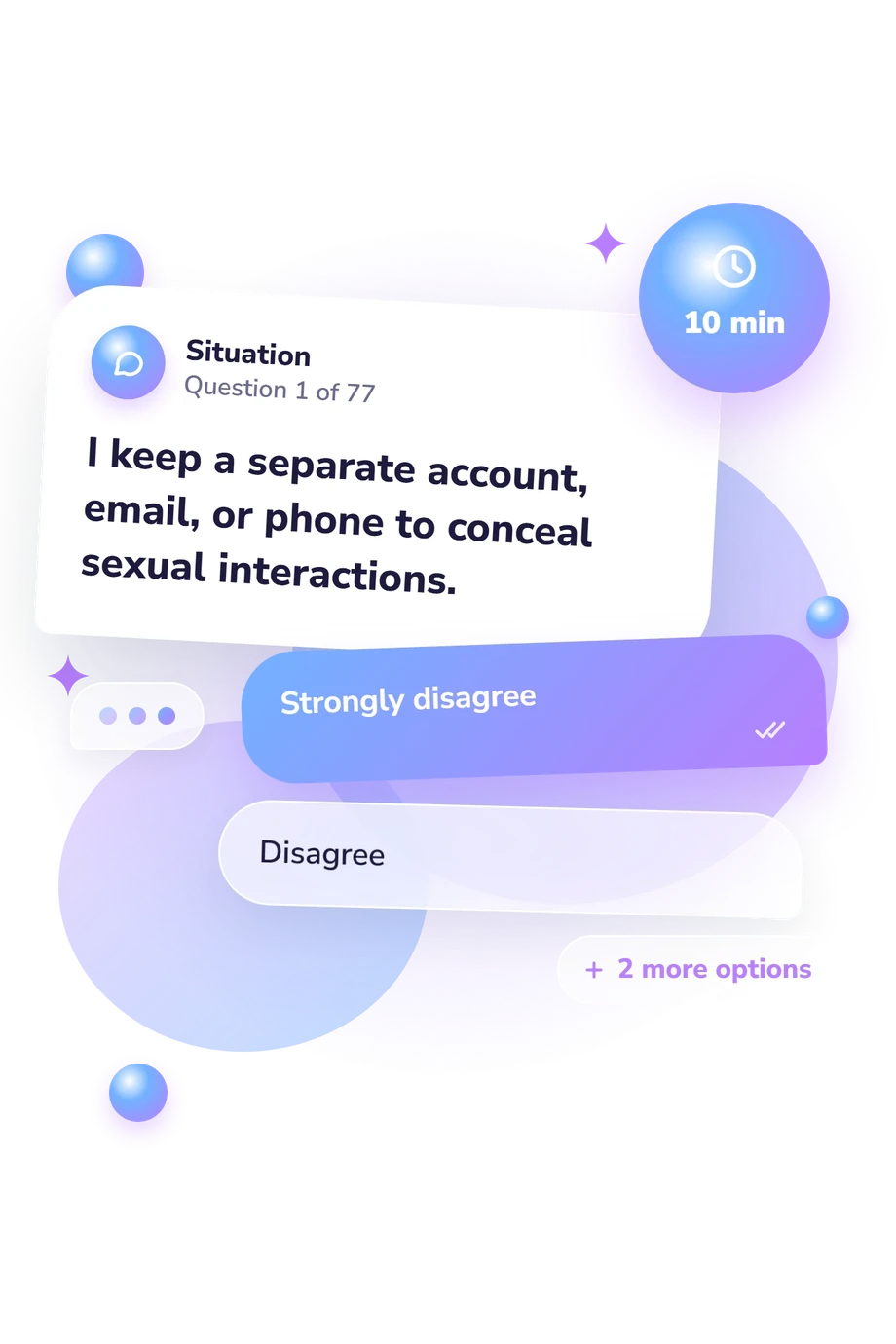
Understand whether sexual urges or behaviors feel hard to control or disrupt your life. Take this Hypersexuality Test to get clear insights across key areas and practical next steps for support.
Start Online Test
Questions7710 minutes
Hi! My name is Freudly, i am an AI therapist, I will give you an interpretation of the test after you complete it.
08:30
March 25, 2026
March 25, 2026
Material has been updated
1,073 views
2,245 completions
15 likes
Verified by Daniel Hall
Psychologist with 25 years of experience
Share
Scale Explorer

How the Scales are Structured

example score
13/30
Compulsive Sexual Behavior (CSB)
Measures how difficult it feels to control sexual thoughts, urges, and behaviors and the sense of being driven by them.
Low
Moderate
High
0NaNLow11NaNModerate21NaNHigh
A score of 13 falls in the Moderate range, suggesting some recurring urges or behaviors that can feel hard to manage at times and may occasionally interfere with daily life.
example score
6/30
Functional Impact (FI)
Measures how much sexual thoughts or behaviors disrupt daily functioning across relationships, work/school, finances, emotional wellbeing, and time management.
Low impact
Moderate impact
High impact
09Low impact1019Moderate impact2030High impact
A score of 6 suggests low functional impact, meaning any effects on daily life are currently limited or infrequent.
example score
10/20
Risk & Secrecy (R&S)
Measures how often sexual behavior involves secrecy or increased exposure to risky, concealed, or boundary-crossing situations.
Low
Moderate
High
06Low713Moderate1420High
A score of 10 falls in the Moderate range, suggesting some reliance on concealment or occasional risk-taking that may be worth monitoring for patterns and impact.
Start Online Test
just completed the test
DATA-BASED USER COHORTS

Who Usually Takes This Test?

Feeling Out of Control
41%OF USERS
People who notice their sexual thoughts or behaviors escalating and want to check whether it’s becoming hard to manage.
Relationship Strain and Secrecy
34%OF USERS
People worried that hiding sexual behavior, pornography use, or flirting is harming trust, intimacy, or communication with a partner.
Stress and Emotional Coping
25%OF USERS
People who turn to sexual behavior to cope with anxiety, loneliness, boredom, or low mood and want to understand their patterns and triggers.
BASED ON AGGREGATED, ANONYMIZED DATA FROM TENS OF THOUSANDS OF FREUDLY USERS.
Benchmarking

See How You Compare

Once you complete the test, your results are compared with real-world data from people in your country.
Below is a preview of how scores are typically distributed across each scale.
Compulsive Sexual Behavior (CSB)
Average
15.1
Normal range
9.920.3
min.
0
max.
30
Majority
This curve shows how scores are typically distributed.
Once you complete the test, your result will appear on the scale so you can see how you compare.
Functional Impact (FI)
Average
16.9
Normal range
11.722
min.
0
max.
30
Majority
This curve shows how scores are typically distributed.
Once you complete the test, your result will appear on the scale so you can see how you compare.
Risk & Secrecy (R&S)
Average
5.7
Normal range
2.78.7
min.
0
max.
20
Majority
This curve shows how scores are typically distributed.
Once you complete the test, your result will appear on the scale so you can see how you compare.
Featured On
CLEAR ANSWERS TO COMMON QUESTIONS

Frequently Asked Questions

What does this Hypersexuality Test measure?
It measures how difficult it feels to control sexual thoughts, urges, and behaviors, how much these patterns disrupt daily functioning across relationships, work, and wellbeing, and how often behavior involves secrecy or increased risk-taking.
Am I hypersexual? Can this quiz tell me?
This am I hypersexual quiz doesn't provide a diagnosis, but it can help you see whether your experience fits patterns associated with compulsive sexual behavior — namely, difficulty controlling urges and real disruption to daily life — rather than simply having a high libido, which isn't a problem on its own.
Is hypersexuality a recognized clinical diagnosis?
Compulsive sexual behavior disorder is recognized in the ICD-11, the diagnostic system used internationally, though it remains a debated category and is not listed as a distinct diagnosis in the DSM-5. This hypersexual quiz reflects the ICD-11 framework for understanding compulsive sexual behavior patterns.
How long does it take?
Most people finish in about 10 minutes. The quiz includes 77 items. Answer based on your typical, recent experience rather than an isolated event, for the most accurate summary.
Is this Hypersexuality Test a diagnostic tool?
No. This is a self-report screening tool — it does not confirm a clinical diagnosis. Results describe patterns across control difficulty, functional impact, and secrecy or risk. Formal evaluation requires a comprehensive assessment by a qualified mental health professional.
How is hypersexuality different from just having a high libido?
A high libido on its own isn't a problem — it becomes hypersexuality, or compulsive sexual behavior, specifically when urges feel hard to control and genuinely disrupt daily life, relationships, work, or emotional wellbeing. This test looks at that functional impact and control difficulty specifically, not simply how often you think about or want sex.
What should I do if my Hypersexuality Test results indicate significant difficulty?
We recommend discussing your results with a therapist experienced in compulsive sexual behavior, who can conduct a comprehensive evaluation and discuss appropriate support options, which may include therapy focused on impulse control and underlying triggers. Your results provide a concrete, nonjudgmental starting point for that conversation.
WHAT THE TEST MEASURES
About This Assessment
Hypersexuality Test

This measure assesses whether sexual thoughts or behaviors feel difficult to control or are interfering with daily life. The Hypersexuality Test includes 77 items and typically takes about 10 minutes to complete, providing clear insights across key areas along with practical next steps for support.

Why Take a Hypersexuality Test

Sexual desire and behavior vary enormously between people, and high desire alone isn't a problem — what distinguishes hypersexuality, sometimes called compulsive sexual behavior, is the sense of being driven by urges that feel hard to control, alongside real disruption to daily life, relationships, or wellbeing. It's worth knowing that compulsive sexual behavior disorder is recognized in the ICD-11, though it remains a debated category and is not listed as a distinct diagnosis in the DSM-5.

A structured am I hypersexual quiz helps clarify whether what you're experiencing fits this specific pattern, rather than relying on shame or vague self-judgment. This hypersexual quiz asks about concrete indicators — how hard it feels to control urges, how much daily functioning is actually affected, and whether behavior increasingly involves secrecy or risk — producing a more useful, specific picture than general worry about "being too into sex."

This assessment is especially useful for people who notice recurring urges or behaviors that feel hard to manage and want a nonjudgmental way to check whether the pattern is significantly affecting their life, and for anyone wondering whether their experience reflects compulsive sexual behavior versus simply having a high libido.

What the Assessment Measures

The quiz explores your experience across several dimensions:

  • Compulsive sexual behavior — how difficult it feels to control sexual thoughts, urges, and behaviors, and the sense of being driven by them
  • Functional impact — how much sexual thoughts or behaviors disrupt daily functioning across relationships, work or school, finances, emotional wellbeing, and time management
  • Secrecy and risk — how often sexual behavior involves secrecy or increased exposure to risky or concealed situations

Results provide a clear summary across these areas, describing patterns rather than delivering a fixed diagnostic label.

Who This Assessment Is For

This Hypersexuality Test is appropriate for anyone who notices recurring sexual urges or behaviors that feel hard to control and wants a nonjudgmental way to check whether the pattern is significantly affecting their life. It's especially useful for people wondering whether their experience reflects compulsive sexual behavior rather than simply having a high libido, and for those noticing that secrecy or risk-taking has increased around sexual behavior.

How to Use This Assessment

This is a self-report screening tool, not a diagnostic instrument. Results describe patterns across control difficulty, functional impact, and secrecy or risk, rather than confirming a clinical diagnosis. Where results indicate significant difficulty or disruption, consultation with a therapist experienced in compulsive sexual behavior can provide a more comprehensive evaluation and appropriate support.

Popular tests
Narcissistic Personality Inventory (NPI)
This self-report measure is used to assess narcissism as a personality trai…
Start Test
Yale-Brown Obsessive Compulsive Scale (Y-BOCS)
This measure is used to rapidly quantify the current severity of obsessive…
Start Test
CRAFFT Screening Test (CRAFFT 2.1)
This brief screening measure is designed to identify potential alcohol and…
Start Test
Patient Health Questionnaire-9 (PHQ-9)
This measure is commonly used to quickly screen for the presence and severi…
Start Test
Maslach Burnout Inventory (MBI)
This self-report measure is used to assess occupational burnout symptoms in…
Start Test
Adolescent Anxiety Questionnaire
This measure is designed to support a brief appraisal of anxiety symptoms a…
Start Test
Emotional Creativity Inventory (ECI)
This self-report measure assesses individual differences in the originality…
Start Test
Horne–Ostberg Morningness–Eveningness Questionnaire (MEQ)
Circadian preferences influence typical patterns of alertness and sleep tim…
Start Test
Ambivalent Sexism Inventory (ASI)
This measure is designed to assess attitudes toward women, including both o…
Start Test
Internalized Misogyny Scale (IMS)
This measure is designed to assess internalized negative beliefs and stereo…
Start Test
Perceived Stress Scale (PSS-10)
This self-report measure assesses the degree to which individuals appraise…
Start Test
Impulsive Behavior Scale (SUPPS-P)
Impulsivity is a multidimensional construct that is often assessed with bri…
Start Test
Clinical Institute Withdrawal Assessment for Alcohol, Revised (CIWA-Ar)
This rating scale is used to rapidly assess the severity of alcohol withdra…
Start Test
Positive and Negative Affect Schedule (PANAS)
This measure provides a brief self-report assessment of current or typical…
Start Test
Light Triad Scale (LTS)
This self-report measure assesses prosocial personality tendencies and orie…
Start Test
Suicidal Ideation Scale
In clinical settings, the Suicidal Ideation Scale is used to structure an i…
Start Test
Body Dysmorphic Disorder Scale (BDD-D)
This brief self-report measure is designed to screen for and quantify distr…
Start Test
Beck Anxiety Inventory (BAI)
This measure is a brief self-report inventory used to screen for anxiety sy…
Start Test
Differential Test of Perfectionism
This instrument is used to screen for perfectionism-related attitudes and t…
Start Test
Locus of Control Scale
This measure assesses generalized expectancies regarding the degree to whic…
Start Test
New Apathy Scale
This brief self-report measure is used to screen for apathy-related symptom…
Start Test
Perth Alexithymia Questionnaire (PAQ)
This measure assesses individual differences in alexithymia, including diff…
Start Test
Social Intelligence Scale
This brief self-report measure is designed to support rapid screening of in…
Start Test
Fear Test
This measure is designed to evaluate individual differences in fear-related…
Start Test
Neuroticism Level Scale
The measure is intended for brief screening of an individual’s propensity t…
Start Test
Aggressiveness Indicators Screening Questionnaire
This screening tool is designed to quickly identify behavioral indicators a…
Start Test
Comments
Leave a Comment