
Expert Rating of Organizational Activity Style Test
How the Scales are Structured
Who Usually Takes This Test?
See How You Compare
Below is a preview of how scores are typically distributed across each scale.
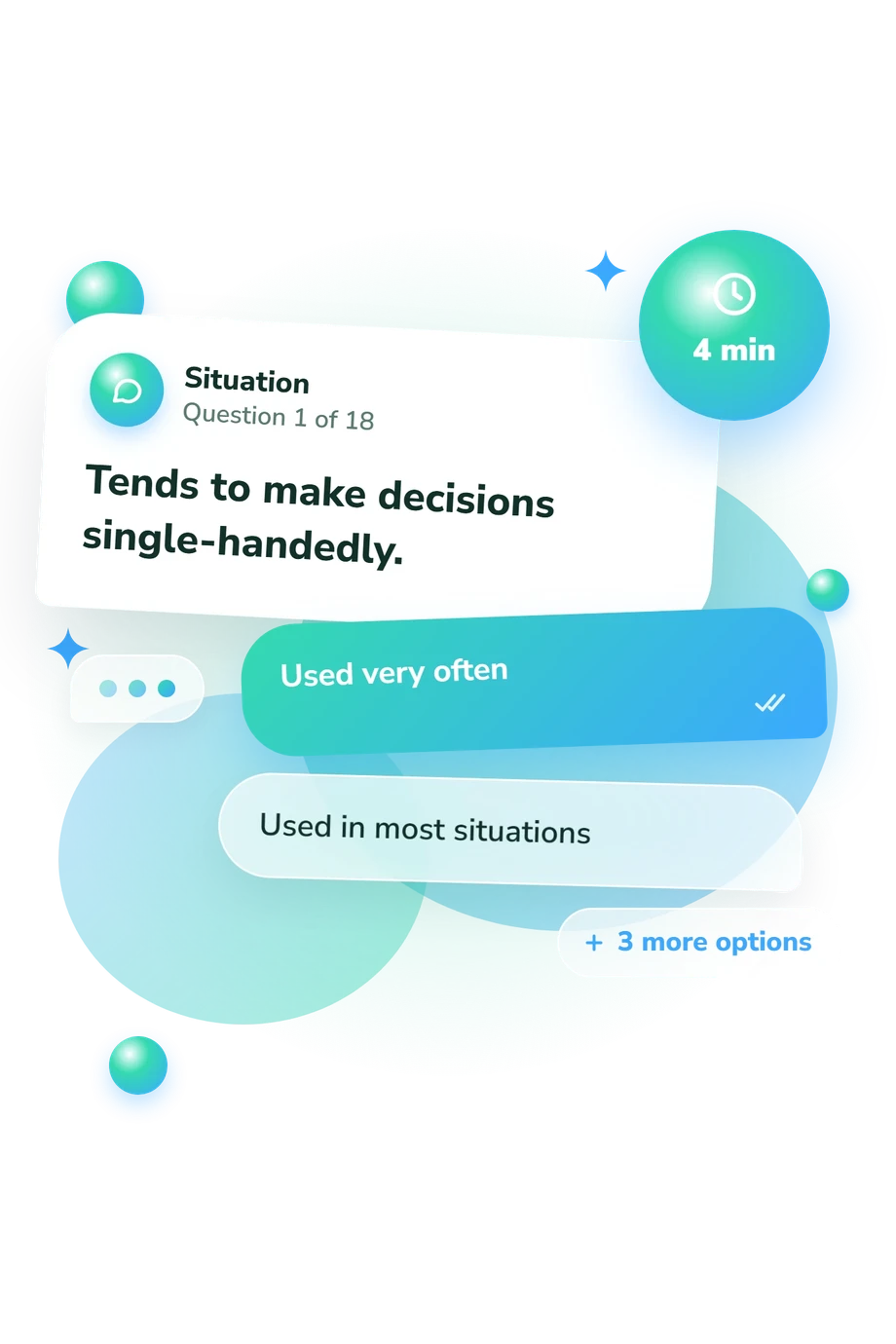
Example Questions From the Test
- Used very often
- Used in most situations
- Difficult to determine how often this is shown
- Used rarely
- Not used in leadership practice
- This approach is used very often
- This approach is used in most cases
- Difficult to determine whether it is shown
- Used rarely
- Not used in organizational practice
- Used very often
- Used in most situations
- Difficult to determine whether it is shown
- Used rarely
- Not used in organizational practice
Expert Rating of Organizational Activity Style Test - Description and methodology of the test
People with direct knowledge of a leader’s work can use this assessment to compare how that leader’s organizational style appears across demanding group situations. The Expert Rating of Organizational Activity Style Test presents a structured profile rather than a single good-or-bad verdict. As an organizational leadership test, it helps evaluators compare recurring patterns when a leader must respond to changing group demands.
What This Assessment Measures
Taken together, the statements examine how a leader handles pressure, disagreement, participation, and follow-through. This leadership style assessment is useful for reviewing a manager’s observable conduct without treating any one style as universally appropriate across teams or situations. The four result dimensions are:
- Shuttle Mediator (0-25) reflects indirect conflict resolution through compromise; bands are Direct approach 0-8, Situational shuttling 9-15, and Strong shuttling 16-25.
- Drifting Raft (0-20) captures low-intervention, go-with-the-flow leadership; bands are Low drifting 0-8, Moderate drifting 9-15, and High drifting 16-20.
- Returning Boomerang (0-20) indicates consultation and collective review; bands are Low consultation 0-8, Moderate consultation 9-15, and High consultation 16-20.
- Striking Arrows (0-25) reflects unilateral decisiveness and persistent enforcement; bands are Low 0-8, Moderate 9-15, and High 16-25.
Methodology and Scientific Basis
Each item describes observable leadership behavior: deciding alone, consulting members, moving between subgroups, or avoiding involvement. The item themes cover authority, collective discussion, mediation between groups, and a leader’s readiness to intervene when work becomes difficult. As a leadership decision-making questionnaire, it uses five response choices: very often, in most situations, difficult to determine, rarely, or not used. This makes the task a structured observer rating rather than a free-form personality description.
Results are reported on four displayed scale scores, but the item-to-score assignments are not specified and should not be inferred from the ranges. The bands indicate the apparent strength of each tendency, not a single overall leadership grade. Interpretation should stay with the scores and labels shown.
The questionnaire is conceptually consistent with the organizational activity style procedure described by Fetiskin et al. (2002), but it is not presented as an adaptation of that published instrument. This online questionnaire is presented without standardised norms or reported reliability and validity estimates. Ratings may also shift with the observer’s access to events and current team conditions.
- Fetiskin, N. P., Kozlov, V. V., & Manuilov, G. M. (2002). Socio-Psychological Diagnostics of the Development of Personality and Small Groups: A Tutorial. Moscow: Institute of Psychotherapy. ISBN 5-89939-086-7.
- Lyutoshkin, A. N. (1981). How to Lead Others: For Senior School Students on the Basics of Organizational Work (2nd ed., revised and expanded). Moscow: Prosveshchenie.
- Kozlowski, S. W. J., & Ilgen, D. R. (2006). Enhancing the Effectiveness of Work Groups and Teams. Psychological Science in the Public Interest, 7(3), 77-124. 10.1111/j.1529-1006.2006.00030.x
Updated: