
Sport Participation Motives Questionnaire Test
How the Scales are Structured
Who Usually Takes This Test?
See How You Compare
Below is a preview of how scores are typically distributed across each scale.
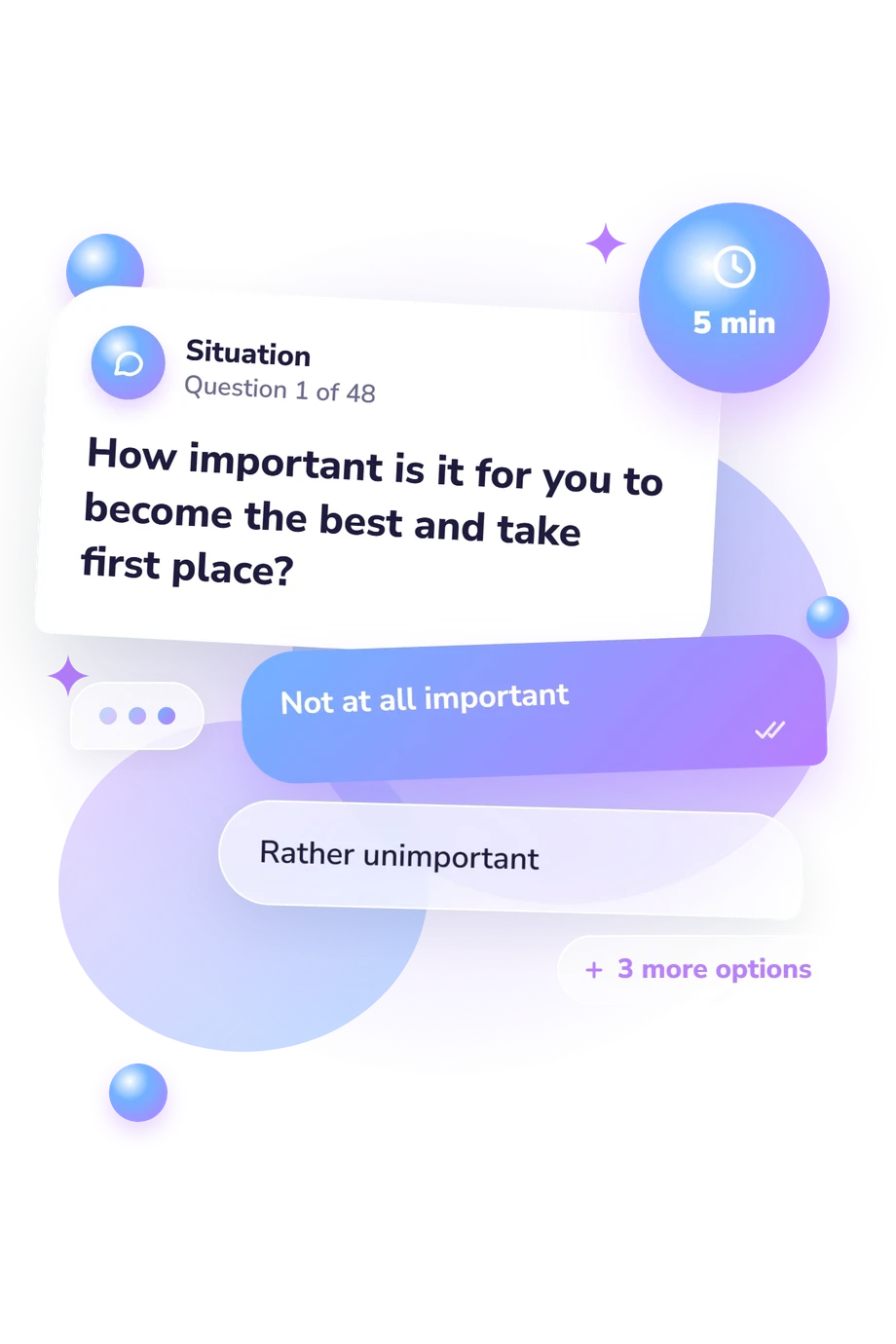
Example Questions From the Test
- Not at all important
- Somewhat unimportant
- Moderately important
- Somewhat important
- Very important
- Not at all important
- Rather unimportant
- Moderately important
- Rather important
- Very important
- Not at all important
- Rather unimportant
- Moderately important
- Rather important
- Very important
Sport Participation Motives Questionnaire Test - Description and methodology of the test
People who want to understand what keeps them training, competing, or returning to sport can use the Sport Participation Motives Questionnaire Test as a structured self-reflection tool. The questionnaire suits respondents considering their own involvement, from recreational activity to organized competition. A sport motivation profile can clarify whether participation is connected mainly with achievement, external incentives, personal growth, relationships, enjoyment, or a sense of duty.
What This Assessment Explores
The questionnaire examines why someone participates, not athletic ability. Its dimensions can coexist, forming a pattern of incentives and personal meaning. The result presents sport participation motives across these scales:
- Obligation Motivation (0-16) measures duty or necessity: Low obligation 0-5; Moderate obligation 6-11; High obligation 12-16.
- Reward Motivation (0-16) measures desire for incentives: Low reward focus 0-5; Moderate reward focus 6-10; High reward focus 11-16.
- Self-Improvement Motivation (0-16) measures growth and ability development: Low 0-5; Moderate 6-11; High 12-16.
- Social Interaction Motivation (0-16) measures communication with others: Low 0-5; Moderate 6-11; High 12-16.
- Enjoyment of the Process (0-16) measures pleasure in activity itself: Low process enjoyment 0-5; Moderate process enjoyment 6-11; High process enjoyment 12-16.
- Performance Motivation (0-16) measures focus on goals and winning: Low result focus 0-5; Moderate result focus 6-11; High result focus 12-16.
Methodology and Evidence Base
Each self-report item asks how important a reason is, using five ordered choices from not at all important to very important. Results are presented through six separate scale scores, and higher values indicate stronger orientation toward the corresponding motive. The wording covers achievement, physical development, social contact, rewards, expectations, excitement, and enjoyment.
Conceptually, the online questionnaire aligns with the Participation Motivation Questionnaire (Gill et al., 1983), while remaining a separate questionnaire rather than that published instrument. Dwyer (1992) examined the internal structure of participation-motivation responses, and Kondric et al. (2013) provide comparative evidence about motives across sport-student samples in three countries. These studies provide context for common motives in sport participation, but they do not establish the exact six-scale structure, norms, reliability, or validity of this questionnaire.
Interpret the bands as descriptive indicators of the respondent’s current pattern, not universal cutoffs. Scores may shift with training goals, social setting, recent success, and honest self-report. The questionnaire does not specify how the five response choices are converted into points on each scale, so the result is best used to organize reflection on what sustains participation.
- Gill, D. L., Gross, J. B., & Huddleston, S. (1983). Participation motivation in youth sports. International Journal of Sport Psychology, 14, 1-14.
- Dwyer, J. J. M. (1992). Internal structure of Participation Motivation Questionnaire completed by undergraduates. Psychological Reports, 70(1), 283-290. 10.2466/pr0.1992.70.1.283
- Kondric, M., Sindik, J., Furjan-Mandic, G., & Schiefler, B. (2013). Participation Motivation and Student’s Physical Activity among Sport Students in Three Countries. Journal of Sports Science and Medicine, 12, 10-18.
Updated: