
Consequentialism Scale Test
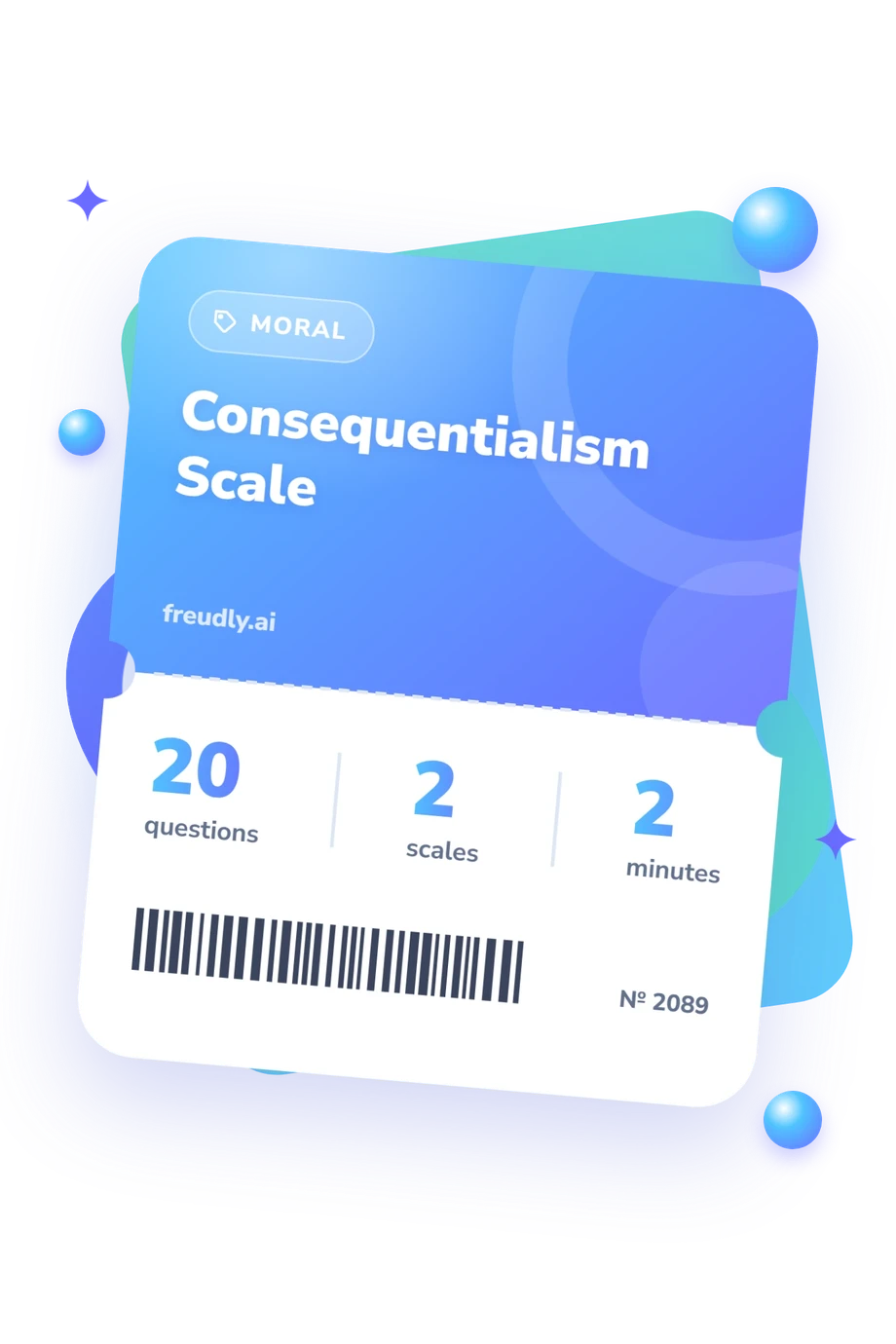
How the Scales are Structured
Who Usually Takes This Test?
See How You Compare
Below is a preview of how scores are typically distributed across each scale.
Example Questions From the Test
- Strongly disagree
- Disagree
- Neither agree nor disagree
- Agree
- Strongly agree
- Strongly disagree
- Disagree
- Neither agree nor disagree
- Agree
- Strongly agree
- Strongly disagree
- Disagree
- Neither agree nor disagree
- Agree
- Strongly agree
Consequentialism Scale Test - Description and methodology of the test
People considering how they make difficult moral judgments can use this questionnaire as a moral reasoning test for self-reflection. The Consequentialism Scale Test examines the tension between obligations and outcomes for readers thinking about harm, universal duties, happiness, and the common good. It describes a pattern of judgment, not a verdict on character.
What This Assessment Explores
Items contrast two routes to moral evaluation. Rule-oriented statements address duties, harm, sacred values, and universal boundaries that may remain binding despite possible benefits. Outcome-oriented statements ask whether happiness and wider benefit should guide action when rules may be overridden.
For a reader taking this consequentialism questionnaire, the result provides two displayed scores: one for prioritising principles and obligations, and one for prioritising consequences and majority benefit. Each score has its own bands, making the profile a prompt for examining why moral scenarios feel compelling.
The displayed dimensions are:
- Deontological Beliefs (5-25) measure priority given to principles and obligations; Low 5-12, Moderate 13-19, and High 20-25 indicate increasing rule-focused endorsement.
- Utilitarian Beliefs (5-25) measure priority given to consequences and benefit to the majority; Rule-focused 5-11, Balanced 12-18, and Utility-focused 19-25 describe the displayed outcome orientation.
Methodology and Evidence Base
Each statement uses five agreement options. Rule-focused items address duties, harm, sacred values, and universal limits; outcome-focused items address happiness, benefit, and when rules should yield to consequences. The items form two belief dimensions in this moral decision-making questionnaire, one for rule-based and one for consequence-based moral evaluation.
Respondents choose among five agreement options and receive two scale scores with bands. The questionnaire does not state its scoring formula, so interpret labels as categories rather than treating one number as decisive.
The closest source, Consequentialist Scale (Robinson, 2012), separates rule-based and consequence-focused beliefs. This questionnaire resembles that two-domain structure but is separate, not Robinson’s instrument or adaptation. Kosteletos et al. (2023) report Greek evidence, so their study concerns a different language and sample, not validation of this English questionnaire. Greene et al. (2001) address emotional engagement in moral judgment, not validation of this version.
This self-report questionnaire is not normed or standardized, so its bands describe categories rather than universal or clinical cutoffs. Responses may vary with circumstances, wording, self-awareness, and social desirability, making the result a snapshot for reflection.
- Robinson, Jeffrey Sean. The Consequentialist Scale: Elucidating the Role of Deontological and Utilitarian Beliefs in Moral Judgments. Master's thesis, Department of Psychology, University of Toronto, 2012.
- Kosteletos, George, Ioanna Zioga, Evangelos D. Protopapadakis, Andrie G. Panayiotou, Konstantinos Kontoangelos, and Charalabos Papageorgiou. The Consequentialist Scale: Translation and Empirical Investigation in a Greek Sample. Heliyon 9, no. 7 (2023): e18386. 10.1016/j.heliyon.2023.e18386
- Greene, Joshua D., R. Brian Sommerville, Leigh E. Nystrom, John M. Darley, and Jonathan D. Cohen. An fMRI investigation of emotional engagement in moral judgment. Science 293, no. 5537 (2001): 2105-2108. 10.1126/science.1062872
Updated: