
Negative Attitudes Toward Robots Scale (NARS) Test
How the Scales are Structured
Who Usually Takes This Test?
See How You Compare
Below is a preview of how scores are typically distributed across each scale.
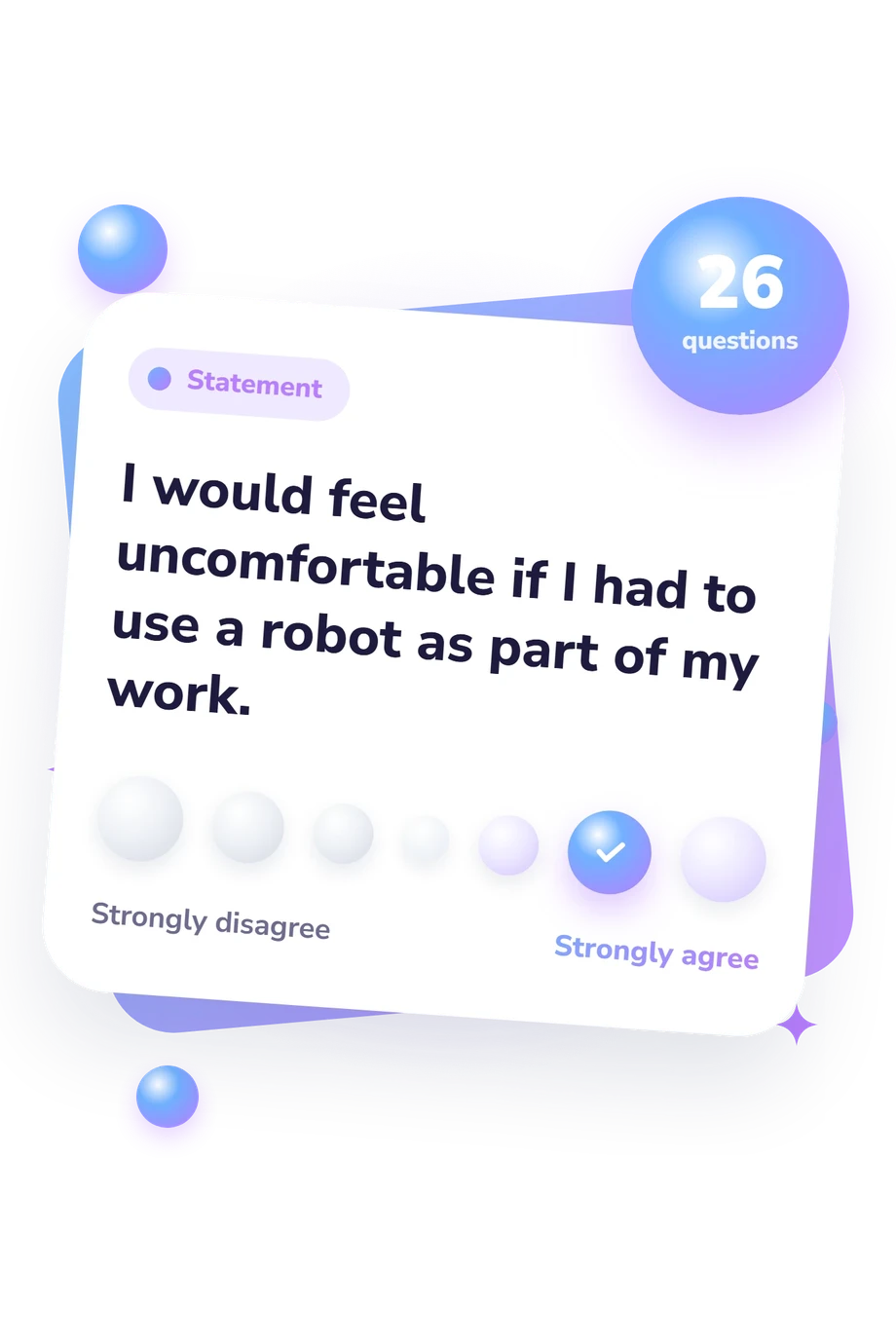
Example Questions From the Test
- Strongly disagree
- Disagree
- Somewhat disagree
- Neither agree nor disagree
- Somewhat agree
- Agree
- Strongly agree
- Strongly disagree
- Disagree
- Somewhat disagree
- Neither agree nor disagree
- Somewhat agree
- Agree
- Strongly agree
- Strongly disagree
- Disagree
- Somewhat disagree
- Neither agree nor disagree
- Somewhat agree
- Agree
- Strongly agree
Negative Attitudes Toward Robots Scale (NARS) Test - Description and methodology of the test
For readers who want to understand their reactions to robotic systems, the Negative Attitudes Toward Robots Scale (NARS) Test offers a structured self-report profile rather than a general opinion question. It suits people reflecting on technology use, human-robot contact, or uneasiness around increasingly capable machines. As a robot attitude questionnaire, it separates broad negativity from behavioral, cognitive, and emotional patterns, making the result easier to interpret.
What This Assessment Measures
This assessment examines reactions to robots in work, conversation, and social situations. Items touch on comfort, distrust, dependence, perceived influence, emotional expression, and consequences for people. That combination makes the negative attitudes toward robots questionnaire useful for self-reflection about approaching robotic systems.
The profile has four dimensions:
- Negative Attitudes Toward Robots (13-91) measures overall concerns, distrust, and discomfort: Low negativity 13-38; Moderate negativity 39-65; High negativity 66-91.
- Interaction (5-35) measures the behavioral attitude toward interacting with robots; higher scores may indicate avoidance of contact or low interest: Low negativity 5-14; Moderate negativity 15-24; High negativity 25-35.
- Social Influence (5-35) measures perceived influence, loss of control, suspiciousness, and doubts about robots’ abilities: Low concern 5-15; Moderate concern 16-25; High concern 26-35.
- Emotional Component (3-21) measures fear, anxiety, or irritation around robots: Low negativity 3-9; Moderate negativity 10-15; High negativity 16-21.
Methodology and Evidence Base
Each statement uses a seven-point agreement scale from Strongly disagree to Strongly agree, including a neutral midpoint. This format records degree of agreement rather than a yes-or-no reaction.
Responses are combined into the displayed dimensions, with higher values indicating more negativity or concern within each definition. The ranges are result bands, not clinical thresholds or population norms. This online questionnaire can show how reactions cluster within one profile, but a score alone does not establish a disorder or fixed trait.
The published Negative Attitudes toward Robots Scale (NARS), developed by Nomura and colleagues in 2006, provides the closest conceptual reference. Related work by Nomura, Kanda, and Suzuki in 2006, and by Nomura and colleagues in 2008, examined links between negative attitudes, interaction, and predicted behavior. Conceptual consistency with that measure does not establish the original instrument’s validation or norms here; these bands are interpretive ranges for this presentation.
Responses may reflect prior experience, current mood, familiarity with robots, self-awareness, and expectations about technology. Interpret the pattern with those influences in mind and with attention to the person’s actual context.
- Nomura, Tatsuya, Tomohiro Suzuki, Takayuki Kanda, and Kensuke Kato. (2006). Measurement of negative attitudes toward robots. Interaction Studies: Social Behaviour and Communication in Biological and Artificial Systems, 7(3), 437-454. 10.1075/is.7.3.14nom
- Nomura, Tatsuya, Takayuki Kanda, and Tomohiro Suzuki. (2005). Experimental investigation into influence of negative attitudes toward robots on human-robot interaction. AI & Society, 20(2), 138-150. 10.1007/s00146-005-0012-7
- Nomura, Tatsuya, Takayuki Kanda, Tomohiro Suzuki, and Kensuke Kato. (2008). Prediction of human behavior in human-robot interaction using psychological scales for anxiety and negative attitudes toward robots. IEEE Transactions on Robotics, 24(2), 442-451. 10.1109/TRO.2007.914004
Updated: