
Does She Like Me Quiz
How the Scales are Structured
Who Usually Takes This Test?
See How You Compare
Below is a preview of how scores are typically distributed across each scale.
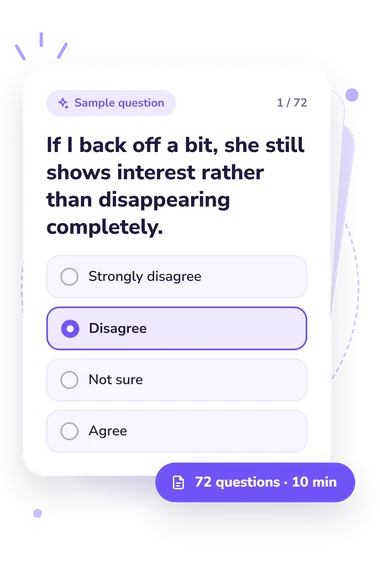
Example Questions From the Test
- Strongly disagree
- Disagree
- Not sure
- Agree
- Strongly disagree
- Disagree
- Not sure
- Agree
- Strongly disagree
- Disagree
- Not sure
- Agree
Does She Like Me Quiz - Description and methodology of the test
People unsure whether a connection is becoming romantic can use the Does She Like Me Quiz to weigh whether a cautious, direct, or delayed next step fits the signals. It suits readers weighing a respectful invitation, distinguishing friendliness from attraction, or feeling unsettled by mixed behavior. A does-she-like-me test can help weigh receptiveness, probable interest, and behavioral consistency rather than treating one memorable moment as decisive.
What This Assessment Explores
Rather than judging one smile or message, the questionnaire looks across repeated interactions and settings. Its scenarios cover communication, planning, follow-through, disclosure, group attention, one-to-one comfort, flirting, compliments, proximity, and nonverbal engagement. That makes it useful for interpreting signs she likes you without treating one behavior as proof.
The result groups those observations into three dimensions:
- Approach Readiness (0-20) indicates whether openness and reciprocity support a respectful next step: Hold Back (0-7), Proceed Gently (8-14), or Good Timing (15-20).
- Interest Likelihood (0-40) estimates possible romantic interest from repeated engagement: Low (0-13), Mixed/Unclear (14-27), or High (28-40).
- Signal Consistency (0-20) measures whether behavior aligns across contexts and time: Mixed signals (0-9) or Consistent signals (10-20).
Together, they separate possible attraction from readiness and the consistency of her signals.
Methodology and Evidence Base
The response format uses four options: Strongly disagree, Disagree, Not sure, or Agree. The format covers communication, plans, flirting, and nonverbal behavior, while answers depend on memory, context, and honest self-report.
Responses produce displayed results, but the questionnaire does not document a universal point rule for every answer. It is an online self-report questionnaire whose scoring has not been standardized, so its displayed bands are interpretive guidance rather than fixed probabilities.
Place et al. (2009) offers the closest conceptual anchor: people can judge romantic interest with some accuracy, but errors remain. Hall et al. (2015) addresses the difficulty of detecting flirting; Grammer et al. (2000) supports attention to nonverbal courtship cues and context; and Koenig et al. (2007) examines misread romantic interest in opposite-sex friendships. The questionnaire is conceptually consistent with these works, but it is neither adapted from them nor validated by them.
The questionnaire functions as a romantic interest test, but attraction is situational and reciprocal. Use the profile with direct communication and clear boundaries; no single observation establishes what another person feels.
- Place, Skyler S., Peter M. Todd, Lars Penke, and Jens B. Asendorpf. (2009). The Ability to Judge the Romantic Interest of Others. Psychological Science, 20(1), 22-26. 10.1111/j.1467-9280.2008.02248.x
- Hall, Jeffrey A., Chong Xing, and Seth Brooks. (2015). Accurately Detecting Flirting: Error Management Theory, the Traditional Sexual Script, and Flirting Base Rate. Communication Research, 42(7), 939-958. 10.1177/0093650214534972
- Grammer, K., Kruck, K., Juette, A., and Fink, B. (2000). Non-verbal behavior as courtship signals: The role of control and choice in selecting partners. Evolution and Human Behavior, 21(6), 371-390. 10.1016/S1090-5138(00)00053-2
- Koenig, Bryan L., Lee A. Kirkpatrick, and Timothy Ketelaar. (2007). Misperception of Sexual and Romantic Interests in Opposite-Sex Friendships: Four Hypotheses. Personal Relationships, 14(3), 411-429. 10.1111/j.1475-6811.2007.00163.x