
Freudly+971 508685814hello@freudly.ai
Freudly
social anxiety

Liebowitz Social Anxiety Scale (LSAS) Test
Take the online Liebowitz Social Anxiety Scale (LSAS) Test - AI psychologist FreudlyYou can take Liebowitz Social Anxiety Scale (LSAS) Testhere. Online version of a simple and accurate psychological test with interpretation.en
Understand how social anxiety affects your comfort in common situations in about 9 minutes. Get a clear snapshot of anxiety and avoidance to support diagnosis, tracking progress, and care planning.
Start Online Test
Questions: 489 minutes
08:30
October 2, 2025
October 2, 2025
Material has been updated
October 2, 2025
Material has been published
32,791 view
3,851 completion
2,956 likes
Verified by Daniel Hall
Psychologist with 25 years of experience
Share
Scale Explorer

How the Scales are Structured

example score
72/144
Social Anxiety Total Score (SATS)
This total score reflects the severity of social anxiety by combining anxiety intensity and avoidance across common social and performance situations.
Low
Moderate
High
049: Low | 5079: Moderate | 80144: High
A score of 72 falls in the Moderate range, suggesting a noticeable level of social anxiety and avoidance across social situations.
example score
32/72
Fear (F)
Measures how strongly a person experiences fear/anxiety across a range of social interaction and performance situations.
Low fear
Moderate fear
High fear
023: Low fear | 2447: Moderate fear | 4872: High fear
A score of 32 falls in the Moderate fear range, suggesting noticeable anxiety in some social situations but not consistently at a high level.
example score
31/72
Avoidance (A)
Measures how often a person tends to avoid social situations due to anxiety or fear.
Low avoidance
Moderate avoidance
High avoidance
023: Low avoidance | 2447: Moderate avoidance | 4872: High avoidance
A score of 31 falls in the Moderate avoidance range, suggesting a noticeable tendency to avoid some social situations, though not consistently across most situations.
example score
14/27
Interpersonal Contact: Fear (ICF)
Measures the intensity of fear and anxiety experienced during informal interpersonal interactions.
Low
Moderate
High
09: Low | 1018: Moderate | 1927: High
A score of 14 falls in the Moderate range, suggesting noticeable fear or anxiety in informal interpersonal contact that may affect comfort in some social situations.
example score
11/27
Interpersonal Contact: Avoidance (ICA)
Measures how often a person avoids interpersonal contact situations due to anxiety or fear.
Low avoidance
Moderate avoidance
High avoidance
08: Low avoidance | 918: Moderate avoidance | 1927: High avoidance
A score of 11 falls in the Moderate avoidance range, suggesting the person sometimes avoids interpersonal contact situations when they feel anxious.
example score
8/18
Formal Interactions: Fear (FIF)
Assesses the intensity of fear and anxiety in formal communication and situations where you need to make an impression on unfamiliar people.
Low
Moderate
High
05: Low | 611: Moderate | 1218: High
A score of 8 falls in the Moderate range, suggesting noticeable but not extreme fear in formal interactions and impression-making situations.
example score
9/18
Formal Social Interaction: Avoidance (FSIA)
Measures how often a person avoids formal interactions and situations with unfamiliar people due to anxiety.
Low avoidance
Moderate avoidance
High avoidance
05: Low avoidance | 612: Moderate avoidance | 1318: High avoidance
A score of 9 falls in the Moderate avoidance range, suggesting a noticeable tendency to avoid some formal or unfamiliar social situations, though not consistently across all such contexts.
example score
6/12
Public Places: Fear (PPF)
Measures fear and anxiety about performing personal actions in public places.
Low
Moderate
High
03: Low | 47: Moderate | 812: High
A score of 6 falls in the Moderate range, suggesting a noticeable but not extreme level of fear in public-place situations.
example score
6/12
Public Places: Avoidance (PPA)
Measures how much a person avoids activities in public places due to anxiety or fear.
Low avoidance
Moderate avoidance
High avoidance
03: Low avoidance | 48: Moderate avoidance | 912: High avoidance
A score of 6 indicates moderate avoidance of public-place situations, suggesting these activities are sometimes avoided when anxiety or fear is anticipated.
Start Online Test
just completed the test
DATA-BASED USER COHORTS

Who Usually Takes This Test?

People avoiding social situations
41%OF USERS
They often skip parties, meetings, or speaking up because the anxiety feels overwhelming and they want to understand how severe it is.
Students and young professionals
34%OF USERS
They feel nervous during presentations, interviews, or networking and want a quick check of how much this holds them back.
Therapy and research clients
25%OF USERS
They take the test to help a clinician or study track social anxiety levels over time and measure progress.
BASED ON AGGREGATED, ANONYMIZED DATA FROM TENS OF THOUSANDS OF FREUDLY USERS.
Benchmarking

See How You Compare

Once you complete the test, your results are compared with real-world data from people in your country.
Below is a preview of how scores are typically distributed across each scale.
Social Anxiety Scale (SAS)
Average
66.5
Normal range
43.989.1
min.
0
max.
144
This curve shows how scores are typically distributed.
Once you complete the test, your result will appear on the scale so you can see how you compare.
Fear (F)
Fear (F)
Average
24.5
Normal range
14.734.2
min.
0
max.
72
This curve shows how scores are typically distributed.
Once you complete the test, your result will appear on the scale so you can see how you compare.
Avoidance (A)
Avoidance (A)
Average
20.9
Normal range
9.432.5
min.
0
max.
72
This curve shows how scores are typically distributed.
Once you complete the test, your result will appear on the scale so you can see how you compare.
Interpersonal Contact: Fear (ICF)
Average
7.1
Normal range
2.112
min.
0
max.
27
This curve shows how scores are typically distributed.
Once you complete the test, your result will appear on the scale so you can see how you compare.
Interpersonal Contact: Avoidance (ICA)
Average
14.7
Normal range
9.619.8
min.
0
max.
27
This curve shows how scores are typically distributed.
Once you complete the test, your result will appear on the scale so you can see how you compare.
Formal communication: fear (Fcf)
Average
6.5
Normal range
4.38.7
min.
0
max.
18
This curve shows how scores are typically distributed.
Once you complete the test, your result will appear on the scale so you can see how you compare.
Formal communication: avoidance (Fca)
Average
12.1
Normal range
8.715.4
min.
0
max.
18
This curve shows how scores are typically distributed.
Once you complete the test, your result will appear on the scale so you can see how you compare.
Public Places: Fear (PPF)
Average
4.9
Normal range
2.77.1
min.
0
max.
12
This curve shows how scores are typically distributed.
Once you complete the test, your result will appear on the scale so you can see how you compare.
Public Places: Avoidance (PPA)
Average
3
Normal range
1.54.5
min.
0
max.
12
This curve shows how scores are typically distributed.
Once you complete the test, your result will appear on the scale so you can see how you compare.
Featured On
SAMPLE QUESTIONS

Example Questions From the Test

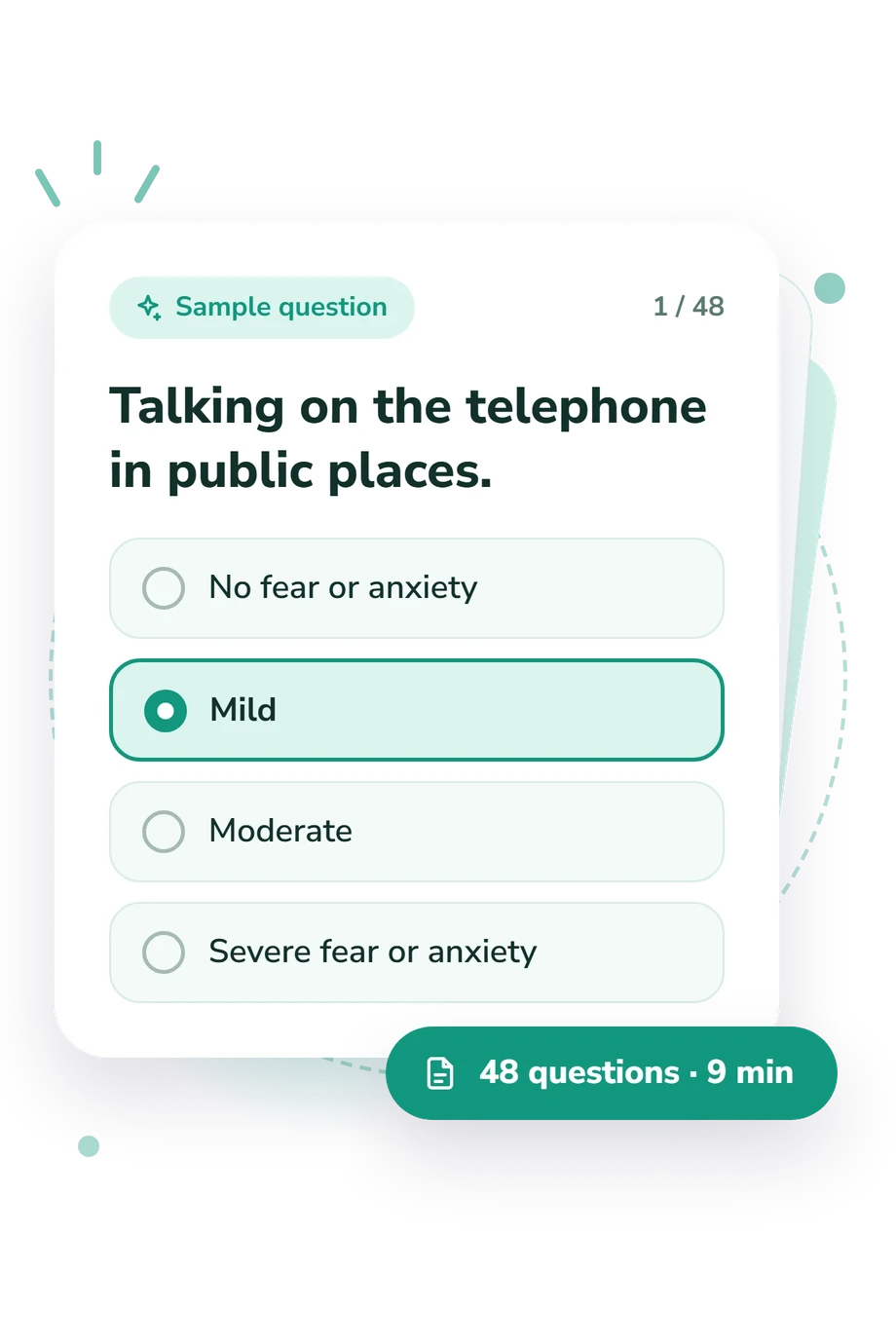
This questionnaire assesses the impact of social phobia on your life across a range of situations. Read each situation carefully and answer two questions about that situation: (1) the intensity of fear or anxiety experienced in that situation; and (2) how often you avoid such situations. If an item describes a situation you do not typically encounter, imagine that you are in that situation and rate the degree to which you would fear this hypothetical situation and how often you would try to avoid it. Base your ratings on how you have felt in similar situations during the past week.
    • No fear or anxiety
    • Mild
    • Moderate
    • Severe fear or anxiety
    • Never
    • Rarely
    • Often
    • Always
    • None
    • Mild
    • Moderate
    • Severe fear or anxiety
WHAT THE TEST MEASURES
About This Assessment
Liebowitz Social Anxiety Scale, LSAS Test

Liebowitz Social Anxiety Scale (LSAS) Test - Symptoms and Signs

social anxiety

This measure is designed to assess the severity of social anxiety symptoms across a range of common interpersonal and performance situations. The Liebowitz Social Anxiety Scale (LSAS), developed by Michael R. Liebowitz, captures both subjective fear/anxiety and behavioral avoidance.

The instrument includes 48 items and typically takes about 9 minutes to complete. Responses are commonly used to support clinical case formulation and to monitor change over time, with interpretation informed by the broader clinical context rather than used as a stand-alone diagnostic determination.

The Liebowitz Social Anxiety Scale (LSAS) is generally administered as a self-report or clinician-rated questionnaire and may be appropriate in outpatient, research, and other behavioral health settings when evaluating social anxiety concerns.

Author: Michael R. Liebowitz
Literature: Heimberg, R. G., Horner, K. J., Juster, H. R., Safren, S. A., Brown, E. J., Schneier, F. R., & Liebowitz, M. R. Psychometric properties of the Liebowitz Social Anxiety Scale. Psychological Medicine. 1999.; Liebowitz, M. R. Social phobia. Modern Trends in Pharmacopsychiatry. Karger. 1987.
Popular tests
Comments
Leave a Comment