
Brainrot Quiz

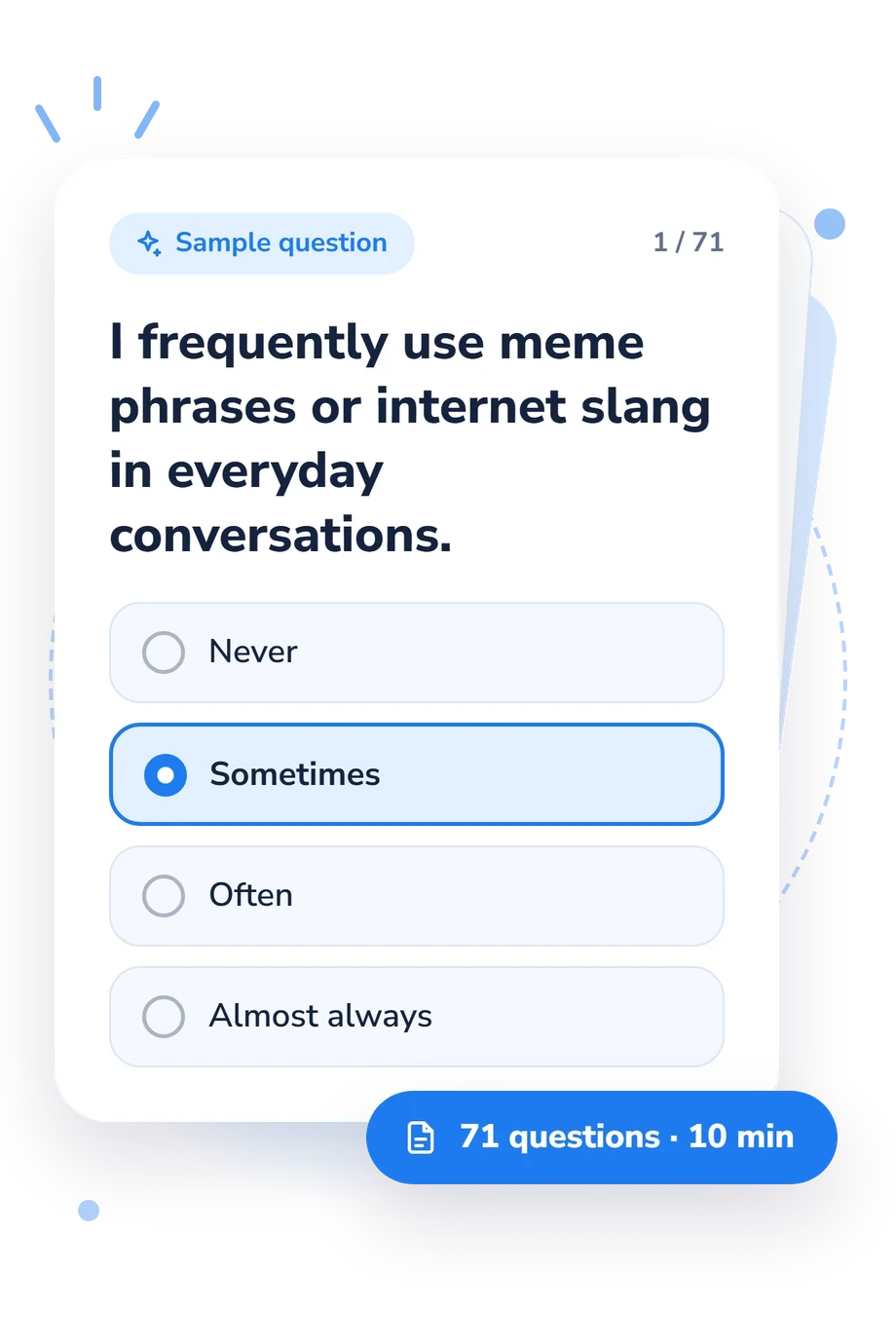
How "brainrot" is your feed, really? Take this Brainrot Quiz — 71 questions, about 10 minutes — to estimate your internet culture saturation based on scrolling habits, meme vocabulary, and viral trend fluency. Get a total score from "Mostly Offline" to "Fully Cooked."
Start Online Test
Questions7110 minutes
Hi! My name is Freudly, i am an AI therapist, I will give you an interpretation of the test after you complete it.
08:30
March 25, 2026
March 25, 2026
Material has been updated
233 views
19 completions
19 likes
Verified by Daniel Hall
Psychologist with 25 years of experience
Share
Scale Explorer

How the Scales are Structured

example score
22/40
Brainrot Saturation (BS)
Measures how saturated your daily life is with internet culture based on scrolling frequency, meme fluency, trend exposure, and caption-like thinking.
Mostly Offline
Online (Moderate)
Fully Cooked
013Mostly Offline1426Online (Moderate)2740Fully Cooked
A score of 22 suggests a moderate level of brainrot saturation, where internet references and trends show up regularly but don’t dominate your day.
example score
6/20
Meme & Reference Fluency (M&RF)
Measures how readily you recognize, understand, and use memes, viral trends, niche fandom references, and in-jokes.
Casual Familiarity
Fluent Scroller
Deep Cut Decoder
07Casual Familiarity814Fluent Scroller1520Deep Cut Decoder
A score of 6 suggests you catch some common memes and references, but many niche or fast-moving in-jokes may pass by without clicking.
example score
9/20
Short-Form Looping (SFL)
Measures how strongly short-form, algorithmic feeds keep you in repetitive auto-play viewing loops and rapid context switching.
Light Looping
Moderate Looping
Heavy Looping
06Light Looping713Moderate Looping1420Heavy Looping
A score of 9 indicates moderate looping, suggesting short-form feeds sometimes pull you into “just one more” cycles but you still break out fairly often.
Start Online Test
just completed the test
DATA-BASED USER COHORTS

Who Usually Takes This Test?

Chronically Online Memers
46%OF USERS
They live in comment sections, speak fluent meme slang, and want to know if their humor and references are officially too deep.
Trend-Tracking Social Scrollers
34%OF USERS
They keep up with viral moments and group chat jokes and take the quiz to see how much their feed is shaping what they think and say.
Offline-Curious Dabblers
20%OF USERS
They scroll in bursts and feel a little out of the loop, using the quiz to gauge how saturated they are compared to friends.
BASED ON AGGREGATED, ANONYMIZED DATA FROM TENS OF THOUSANDS OF FREUDLY USERS.
Benchmarking

See How You Compare

Once you complete the test, your results are compared with real-world data from people in your country.
Below is a preview of how scores are typically distributed across each scale.
Brainrot Saturation (BS)
Average
26.8
Normal range
20.333.2
min.
0
max.
40
Majority
This curve shows how scores are typically distributed.
Once you complete the test, your result will appear on the scale so you can see how you compare.
Meme & Reference Fluency (M&RF)
Average
6.2
Normal range
3.58.9
min.
0
max.
20
Majority
This curve shows how scores are typically distributed.
Once you complete the test, your result will appear on the scale so you can see how you compare.
Short-Form Looping (SL)
Average
6
Normal range
3.28.7
min.
0
max.
20
Majority
This curve shows how scores are typically distributed.
Once you complete the test, your result will appear on the scale so you can see how you compare.
Featured On
CLEAR ANSWERS TO COMMON QUESTIONS

Frequently Asked Questions

What does this Brainrot Quiz measure?
It estimates internet culture saturation across three areas: overall exposure to memes, trends, and scrolling habits; fluency in recognizing and using current memes and references; and how much short-form, algorithmic feeds pull you into repetitive viewing loops. A total score is provided from 'Mostly Offline' to 'Fully Cooked.'
How long does it take and how many questions are included?
Estimated completion time is about 10 minutes. The quiz includes 71 questions. If your behavior varies by day, answer based on your overall pattern over a recent typical week rather than an unusually online or unusually offline day.
Is this brain rot quiz a real mental health assessment?
No. It is intended for entertainment and self-reflection and does not assess mental health conditions. It's a fun, lighthearted way to put a number on your internet culture exposure, not a clinical or diagnostic tool.
What does my total score on this Brainrot Quiz mean?
Your total score falls somewhere between 'Mostly Offline' and 'Fully Cooked,' along with a breakdown highlighting likely drivers such as algorithmic exposure, group chat activity, late-night scrolling, or frequent short-form viewing. Higher scores simply reflect greater saturation with internet culture and current trends, not anything to worry about.
Can I compare my brainrot test results with friends?
Yes, this is one of the most popular ways to use it. Many people take it specifically to compare scores with friends or share in a group chat, since the breakdown of scrolling habits and meme fluency tends to spark immediate, relatable conversation.
Can my score change if I retake this quiz later?
Yes. Since the score reflects your current scrolling habits, meme fluency, and exposure to trends, retaking the quiz after a period of less (or more) social media use can produce a noticeably different result.
Why do some brainrot quiz questions ask about group chats and late-night scrolling?
These are common drivers of internet culture saturation identified in the quiz's breakdown — group chat activity keeps references and in-jokes circulating quickly, while late-night scrolling often correlates with more algorithmic, short-form viewing loops. Both contribute meaningfully to your overall score alongside general meme fluency.
WHAT THE TEST MEASURES
About This Assessment
Brainrot Quiz

This quiz estimates internet culture saturation based on reported exposure to memes, viral trends, niche references, and short-form content patterns. The Brainrot Quiz includes 71 questions and typically takes about 10 minutes to complete. It is intended for entertainment and self-reflection and does not assess mental health conditions.

Why Take a Brainrot Quiz

"Brainrot" has become a popular, half-joking way to describe how saturated everyday thinking gets with memes, viral trends, and short-form content — catching yourself thinking in captions, quoting a sound bite unprompted, or losing an hour to "just one more" video. This brain rot quiz turns that self-aware joke into an actual, structured score, rather than just a vague feeling of "I'm too online."

This quiz measures internet culture saturation across several angles — how often you're scrolling, how fluent you are in current memes and references, and how much short-form feeds pull you into repetitive viewing loops. Seeing these broken down separately is part of what makes the result feel genuinely accurate rather than just a generic "you're chronically online" label.

This assessment is especially popular for comparing results with friends or a group chat, since scores tend to spark immediate, relatable conversation about everyone's actual scrolling habits.

What the Assessment Measures

The quiz estimates brainrot saturation across several dimensions:

  • Internet culture saturation — how saturated daily life is with internet culture based on scrolling frequency, meme fluency, trend exposure, and caption-like thinking
  • Meme and reference fluency — how readily you recognize, understand, and use memes, viral trends, niche fandom references, and in-jokes
  • Algorithmic looping — how strongly short-form, algorithmic feeds keep you in repetitive auto-play viewing loops and rapid context switching

A total score is provided on a range from "Mostly Offline" to "Fully Cooked," along with a brief breakdown summarizing likely drivers such as algorithmic exposure, group chat activity, late-night scrolling, and frequent short-form viewing.

Who This Assessment Is For

This Brainrot Quiz is appropriate for anyone curious how saturated their daily thinking has become with internet culture and short-form content. It's especially popular with friend groups and group chats who enjoy comparing scores and discussing which trends, memes, and scrolling habits actually apply to them.

How to Use This Assessment

This is intended for entertainment and self-reflection and does not assess mental health conditions. If your typical behavior varies day to day, answer based on your overall pattern over a recent typical week rather than an unusually online or unusually offline day, for the most representative score.

Popular tests
Narcissistic Personality Inventory (NPI)
This self-report measure is used to assess narcissism as a personality trai…
Start Test
Yale-Brown Obsessive Compulsive Scale (Y-BOCS)
This measure is used to rapidly quantify the current severity of obsessive…
Start Test
CRAFFT Screening Test (CRAFFT 2.1)
This brief screening measure is designed to identify potential alcohol and…
Start Test
Patient Health Questionnaire-9 (PHQ-9)
This measure is commonly used to quickly screen for the presence and severi…
Start Test
Maslach Burnout Inventory (MBI)
This self-report measure is used to assess occupational burnout symptoms in…
Start Test
Adolescent Anxiety Questionnaire
This measure is designed to support a brief appraisal of anxiety symptoms a…
Start Test
Emotional Creativity Inventory (ECI)
This self-report measure assesses individual differences in the originality…
Start Test
Horne–Ostberg Morningness–Eveningness Questionnaire (MEQ)
Circadian preferences influence typical patterns of alertness and sleep tim…
Start Test
Ambivalent Sexism Inventory (ASI)
This measure is designed to assess attitudes toward women, including both o…
Start Test
Internalized Misogyny Scale (IMS)
This measure is designed to assess internalized negative beliefs and stereo…
Start Test
Perceived Stress Scale (PSS-10)
This self-report measure assesses the degree to which individuals appraise…
Start Test
Impulsive Behavior Scale (SUPPS-P)
Impulsivity is a multidimensional construct that is often assessed with bri…
Start Test
Clinical Institute Withdrawal Assessment for Alcohol, Revised (CIWA-Ar)
This rating scale is used to rapidly assess the severity of alcohol withdra…
Start Test
Positive and Negative Affect Schedule (PANAS)
This measure provides a brief self-report assessment of current or typical…
Start Test
Light Triad Scale (LTS)
This self-report measure assesses prosocial personality tendencies and orie…
Start Test
Suicidal Ideation Scale
In clinical settings, the Suicidal Ideation Scale is used to structure an i…
Start Test
Body Dysmorphic Disorder Scale (BDD-D)
This brief self-report measure is designed to screen for and quantify distr…
Start Test
Beck Anxiety Inventory (BAI)
This measure is a brief self-report inventory used to screen for anxiety sy…
Start Test
Differential Test of Perfectionism
This instrument is used to screen for perfectionism-related attitudes and t…
Start Test
Locus of Control Scale
This measure assesses generalized expectancies regarding the degree to whic…
Start Test
New Apathy Scale
This brief self-report measure is used to screen for apathy-related symptom…
Start Test
Perth Alexithymia Questionnaire (PAQ)
This measure assesses individual differences in alexithymia, including diff…
Start Test
Social Intelligence Scale
This brief self-report measure is designed to support rapid screening of in…
Start Test
Fear Test
This measure is designed to evaluate individual differences in fear-related…
Start Test
Neuroticism Level Scale
The measure is intended for brief screening of an individual’s propensity t…
Start Test
Aggressiveness Indicators Screening Questionnaire
This screening tool is designed to quickly identify behavioral indicators a…
Start Test
Comments
Leave a Comment