
DID Test
How the Scales are Structured
Who Usually Takes This Test?
See How You Compare
Below is a preview of how scores are typically distributed across each scale.
Example Questions From the Test
- Strongly disagree
- Disagree
- Not sure
- Agree
- Strongly disagree
- Disagree
- Not sure
- Agree
- Never
- Rarely
- Sometimes
- Often
DID Test - Description and methodology of the test
People who notice unexplained memory gaps, detachment, or unsettling shifts in their sense of self may use this DID Test to focus on the experiences that concern them. Its result separates memory loss, dissociative frequency, and identity disruption into three dimensions for closer consideration. As a dissociation test, it keeps attention on patterns rather than a single label.
What This Assessment Explores
This multiple personality disorder test focuses on experiences difficult to connect in everyday life: missing time, actions you do not remember, feeling detached from your body, uncertainty about identity, and internal parts that seem to influence reactions, preferences, or skills. Higher scores indicate stronger endorsement of the relevant experiences.
Three displayed scales organize the result:
- Amnesia & Time Loss (0-30) measures memory gaps and unexplained time loss; Low 0-9, Moderate 10-19, High 20-30.
- Dissociation Frequency (0-40) measures how often detachment, derealization/depersonalization, or time loss occurs in daily life; Low 0-13, Moderate 14-26, High 27-40.
- Identity Disruption (0-30) measures identity confusion and internal-part experiences; Low 0-10, Moderate 11-20, High 21-30.
These bands show how strongly each dimension is represented in the responses, while the situations behind each answer give the result its meaning.
Methodology and Scientific Basis
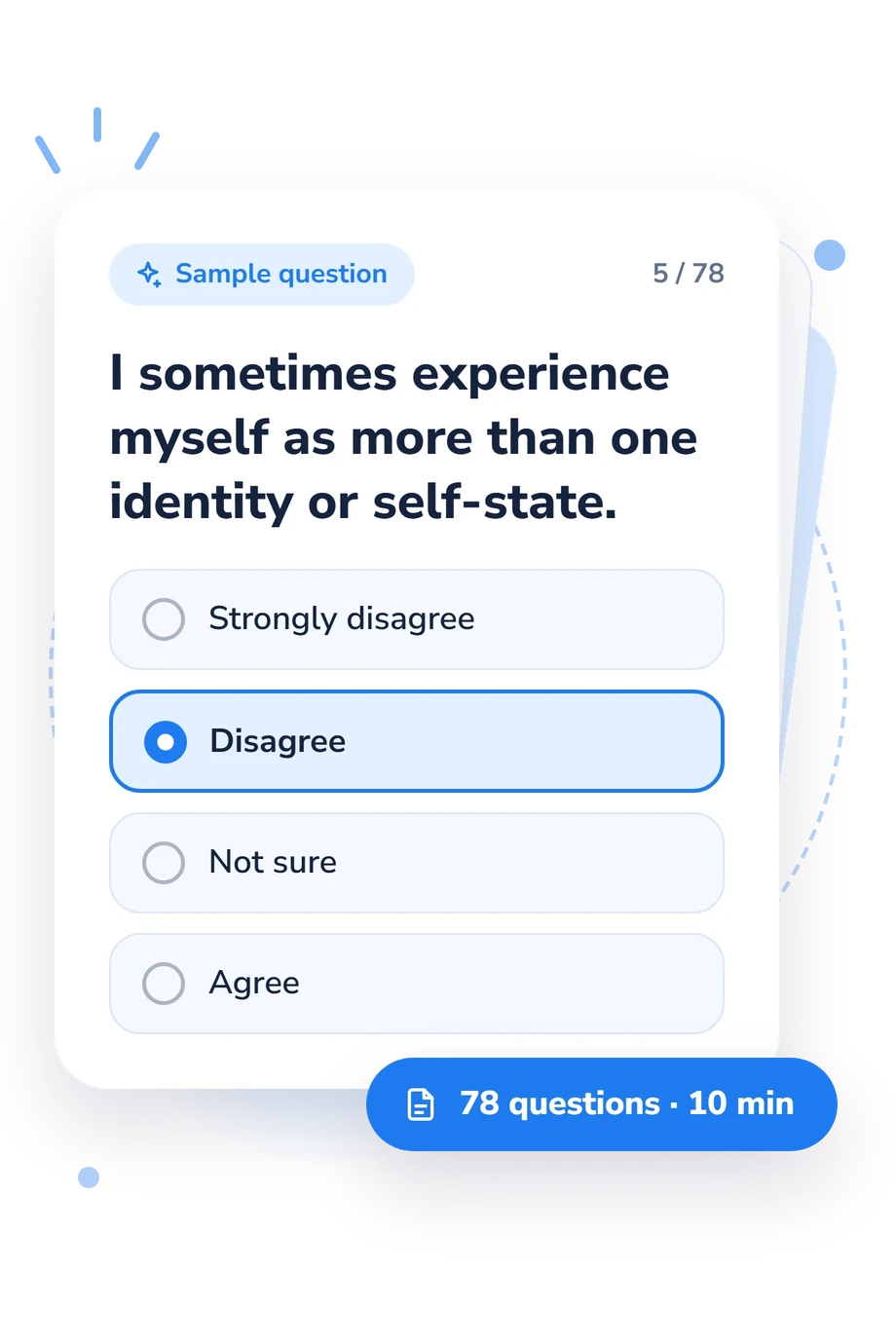
Shown items use four-level patterns: Strongly disagree to Agree for inner-experience statements and Never to Often for frequency statements. Answers group into three scales, but ranges do not specify each response's point contribution. One conceptual reference is Multidimensional Inventory of Dissociation (MID). Its multidimensional approach is relevant because this questionnaire separates memory disruption, dissociative frequency, and identity-related experiences. Steinberg, Rounsaville, and Cicchetti (1990) describe a structured interview approach for dissociative disorders, while Bernstein and Putnam (1986) provide a dissociation-scale reference. This questionnaire is conceptually consistent with these works, not a direct reproduction or validated adaptation.
The listed bands are the questionnaire's result categories for each scale. Although the term is older and colloquial, this questionnaire focuses on dissociative identity symptoms. They show the strongest reported dimension. As a dissociative disorder test, this questionnaire focuses on memory gaps, dissociation frequency, and identity disruption. The profile remains dimension-specific. This dissociative identity disorder test summarizes responses across those dimensions. Current stress, memory limits, self-awareness, and response bias can affect self-report, so the profile cannot by itself establish DID.
- Dell, P. F. (2006). The Multidimensional Inventory of Dissociation (MID): A Comprehensive Measure of Pathological Dissociation. Journal of Trauma & Dissociation, 7(2), 77-106. 10.1300/J229v07n02_06
- Steinberg, M., Rounsaville, B. J., & Cicchetti, D. V. (1990). The Structured Clinical Interview for DSM-III-R Dissociative Disorders: Preliminary Report on a New Diagnostic Instrument. American Journal of Psychiatry, 147(1), 76-82. 10.1176/ajp.147.1.76
- Bernstein, E. M., & Putnam, F. W. (1986). Development, Reliability, and Validity of a Dissociation Scale. The Journal of Nervous and Mental Disease, 174(12), 727-735. 10.1097/00005053-198612000-00004
Updated: