
Histrionic Personality Disorder Test

Understand attention seeking, approval needs, and emotional shifts in about 10 minutes. 81 items give a gentle summary to reflect on work, relationships, and whether to talk with a clinician.
Start Online Test
Questions8110 minutes
Hi! My name is Freudly, i am an AI therapist, I will give you an interpretation of the test after you complete it.
08:30
March 25, 2026
March 25, 2026
Material has been updated
194 views
12 completions
23 likes
Verified by Daniel Hall
Psychologist with 25 years of experience
Share
Scale Explorer

How the Scales are Structured

example score
13/30
Approval Dependence (AD)
Measures how much self-worth and decision-making rely on reassurance, compliments, and others’ acceptance.
Low
Moderate
High
09Low1019Moderate2030High
A score of 13 falls in the Moderate range, suggesting a noticeable but not pervasive tendency to seek reassurance or feel sensitive to approval and criticism.
example score
18/NaN
Attention-Seeking (AS)
Measures how strongly you seek to be noticed, validated, or centered in social interactions.
Low
Moderate
High
0NaNLow11NaNModerate21NaNHigh
A score of 18 falls in the Moderate range, suggesting you may sometimes look for attention or reassurance, especially in situations where you feel overlooked.
example score
16/30
Emotional Lability (EL)
Assesses how quickly and intensely your emotions shift and how strongly feelings influence your immediate reactions.
Steady
Variable
Highly labile
010Steady1120Variable2130Highly labile
A score of 16 falls in the Variable range, suggesting noticeable shifts in mood and expressiveness that may sometimes steer your reactions in the moment.
Start Online Test
just completed the test
DATA-BASED USER COHORTS

Who Usually Takes This Test?

Relationship feedback seekers
41%OF USERS
People who keep hearing they’re “too intense,” “flirty,” or “dramatic” in dating or friendships and want to understand their patterns.
Emotion and attention worriers
34%OF USERS
People who notice rapidly shifting feelings, strong need for reassurance, or fear of being ignored and want a clearer picture of what’s going on.
Therapy-curious self reflectors
25%OF USERS
People considering counseling who want language for their experiences and a starting point for discussing concerns with a clinician.
BASED ON AGGREGATED, ANONYMIZED DATA FROM TENS OF THOUSANDS OF FREUDLY USERS.
RESULTS YOU CAN ACTUALLY USE

Scale Results
— Explained Clearly
Your scores across each test scale are translated into plain, usable insights. You won’t just get numbers — you’ll learn how your results impact your daily life, emotional state, and overall well-being.
AI-Powered
Interpretation
You’ll receive a structured, clinically-grounded explanation. Our AI analyzes patterns and relationships between scales to provide a coherent interpretation, without exaggerated language.
Statistical
Comparison
See how your results compare to others. Anonymized platform data is used to create a percentile scale, which identifies whether your results are typical.
Practical
Recommendations
You’ll receive clear, actionable guidance tailored to your profile. These easy-to-implement suggestions focus on coping, self-regulation, and realistic next steps.
AI-Powered
Insights
Get insights on behavioral and thought patterns you might not notice on your own. By uncovering subtle connections between your responses, you’ll better understand what may be driving your current results.
Discuss with
an AI Therapist
Clarify, reflect, and explore your results right away. Talk through your experience, ask questions, and explore meanings in a calm, non-diagnostic dialogue.
Start Online Test
Used in 52+ countries
Benchmarking

See How You Compare

Once you complete the test, your results are compared with real-world data from people in your country.
Below is a preview of how scores are typically distributed across each scale.
Approval Dependence (AD)
Average
21.7
Normal range
17.725.6
min.
0
max.
30
Majority
This curve shows how scores are typically distributed.
Once you complete the test, your result will appear on the scale so you can see how you compare.
Attention-Seeking (A)
Average
15.5
Normal range
10.520.6
min.
0
max.
30
Majority
This curve shows how scores are typically distributed.
Once you complete the test, your result will appear on the scale so you can see how you compare.
Emotional Lability (EL)
Average
17.7
Normal range
13.621.9
min.
0
max.
30
Majority
This curve shows how scores are typically distributed.
Once you complete the test, your result will appear on the scale so you can see how you compare.
Featured On
CLEAR ANSWERS TO COMMON QUESTIONS

Frequently Asked Questions

What does this self-check measure?
It reviews patterns that may resemble traits often linked to histrionic personality features, such as strong attention-seeking, quickly changing emotions, high need for approval, and dramatic self-presentation.
Can the results be used as a diagnosis?
No. Results are not diagnostic and cannot replace an evaluation by a licensed mental health professional.
How long does it take and how many items are included?
Estimated completion time is about 10 minutes. The questionnaire includes 81 items.
How should items be answered for the most accurate results?
Answer based on typical behavior over time rather than a single recent situation. Use the first response that fits without overthinking.
What should be done if the content causes distress or raises safety concerns?
Stop the questionnaire and seek support from a licensed clinician or local emergency services if there is immediate risk. Consider contacting a trusted support person if distress increases.
WHAT THE TEST MEASURES
About This Assessment

Histrionic Personality Disorder Test - Symptoms and Signs
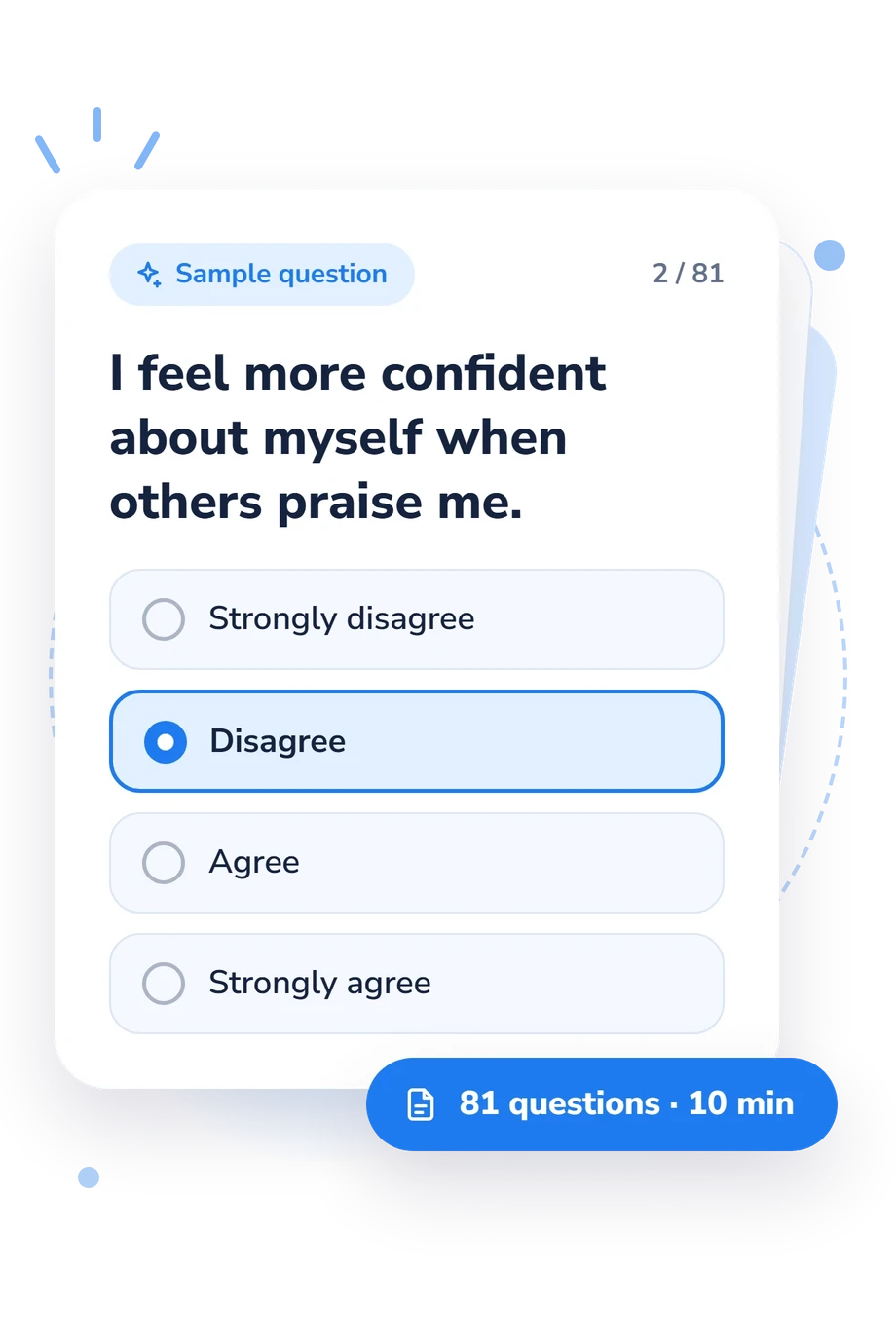
Explore whether your patterns resemble traits often associated with histrionic personality disorder (HPD)—such as strong attention-seeking, rapidly shifting emotions, intense need for approval, or dramatic self-presentation. This self-check offers reflective questions and a gentle results summary to help you think about your relationships, work, and emotional habits. It’s not a diagnosis or a substitute for professional evaluation, but it can help you decide whether to learn more or talk with a licensed clinician.

Popular tests
Narcissistic Personality Inventory (NPI)
This self-report measure is used to assess narcissism as a personality trai…
Start Test
Yale-Brown Obsessive Compulsive Scale (Y-BOCS)
This measure is used to rapidly quantify the current severity of obsessive…
Start Test
CRAFFT Screening Test (CRAFFT 2.1)
This brief screening measure is designed to identify potential alcohol and…
Start Test
Patient Health Questionnaire-9 (PHQ-9)
This measure is commonly used to quickly screen for the presence and severi…
Start Test
Maslach Burnout Inventory (MBI)
This self-report measure is used to assess occupational burnout symptoms in…
Start Test
Adolescent Anxiety Questionnaire
This measure is designed to support a brief appraisal of anxiety symptoms a…
Start Test
Emotional Creativity Inventory (ECI)
This self-report measure assesses individual differences in the originality…
Start Test
Horne–Ostberg Morningness–Eveningness Questionnaire (MEQ)
Circadian preferences influence typical patterns of alertness and sleep tim…
Start Test
Ambivalent Sexism Inventory (ASI)
This measure is designed to assess attitudes toward women, including both o…
Start Test
Internalized Misogyny Scale (IMS)
This measure is designed to assess internalized negative beliefs and stereo…
Start Test
Perceived Stress Scale (PSS-10)
This self-report measure assesses the degree to which individuals appraise…
Start Test
Impulsive Behavior Scale (SUPPS-P)
Impulsivity is a multidimensional construct that is often assessed with bri…
Start Test
Clinical Institute Withdrawal Assessment for Alcohol, Revised (CIWA-Ar)
This rating scale is used to rapidly assess the severity of alcohol withdra…
Start Test
Positive and Negative Affect Schedule (PANAS)
This measure provides a brief self-report assessment of current or typical…
Start Test
Light Triad Scale (LTS)
This self-report measure assesses prosocial personality tendencies and orie…
Start Test
Suicidal Ideation Scale
In clinical settings, the Suicidal Ideation Scale is used to structure an i…
Start Test
Body Dysmorphic Disorder Scale (BDD-D)
This brief self-report measure is designed to screen for and quantify distr…
Start Test
Beck Anxiety Inventory (BAI)
This measure is a brief self-report inventory used to screen for anxiety sy…
Start Test
Differential Test of Perfectionism
This instrument is used to screen for perfectionism-related attitudes and t…
Start Test
Locus of Control Scale
This measure assesses generalized expectancies regarding the degree to whic…
Start Test
New Apathy Scale
This brief self-report measure is used to screen for apathy-related symptom…
Start Test
Perth Alexithymia Questionnaire (PAQ)
This measure assesses individual differences in alexithymia, including diff…
Start Test
Social Intelligence Scale
This brief self-report measure is designed to support rapid screening of in…
Start Test
Fear Test
This measure is designed to evaluate individual differences in fear-related…
Start Test
Neuroticism Level Scale
The measure is intended for brief screening of an individual’s propensity t…
Start Test
Aggressiveness Indicators Screening Questionnaire
This screening tool is designed to quickly identify behavioral indicators a…
Start Test
Comments
Leave a Comment