
PTSD Therapeutic Change Questionnaire Test
How the Scales are Structured
Who Usually Takes This Test?
See How You Compare
Below is a preview of how scores are typically distributed across each scale.
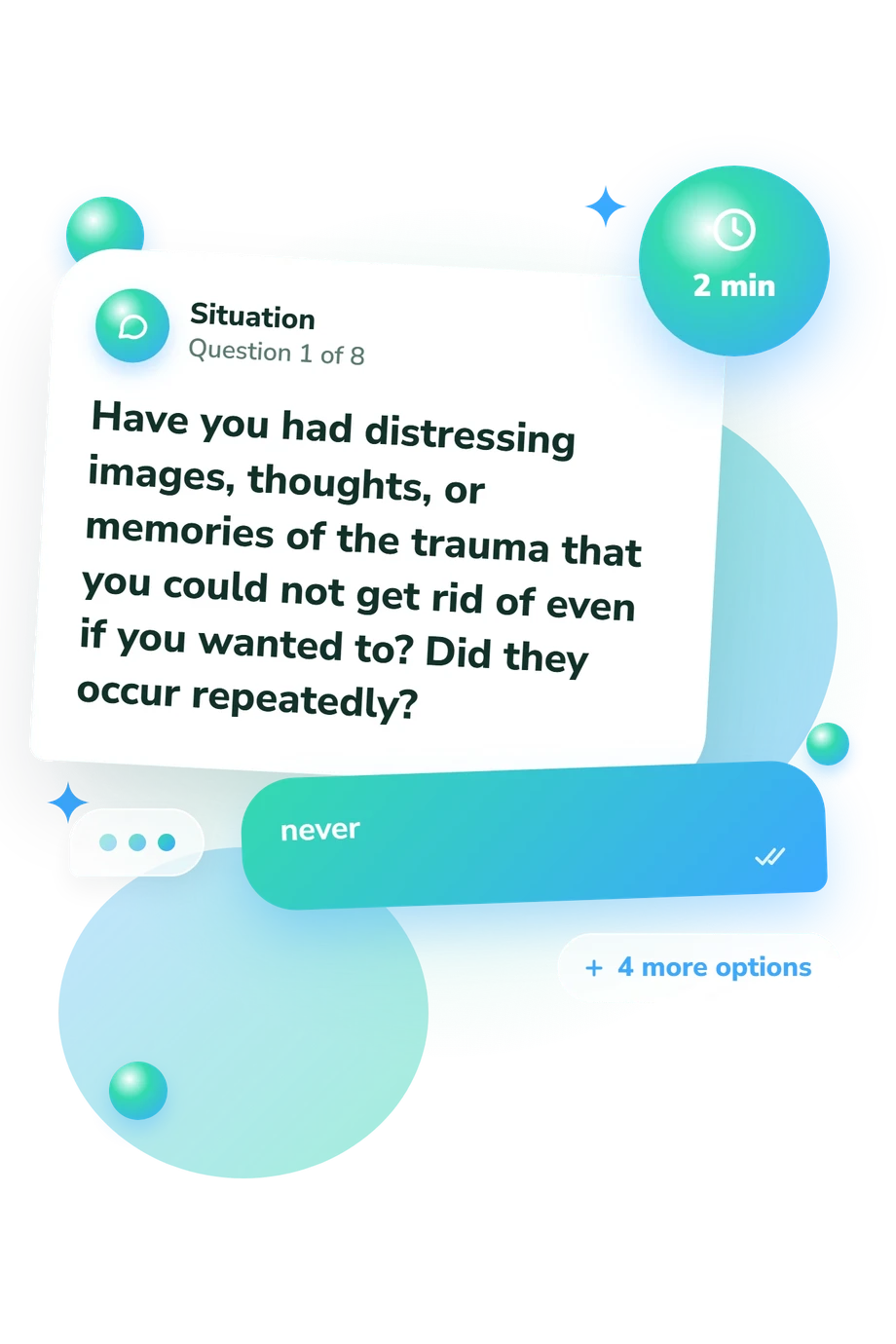
Example Questions From the Test
- never
- mild: infrequent and not upsetting
- moderate: at least once a week and/or causing slight distress
- severe: at least 4 times a week or causing moderate distress
- very severe: daily, or causing distress to the extent that the patient cannot work or function socially
- never
- slight: infrequent or questionable
- moderate: causing mild distress
- severe: causing marked distress
- extreme: causing marked distress or requiring medical attention for the physical reactions (e.g., chest pain so intense that the person was convinced they were having a heart attack)
- No loss of interest
- One or two activities give less pleasure
- Several activities give less pleasure
- Most activities give less pleasure
- Almost all activities give less pleasure
PTSD Therapeutic Change Questionnaire Test - Description and methodology of the test
People receiving therapy for trauma-related symptoms may use this self-report to organize what they are noticing and to consider whether distress is easing, persisting, or shifting. The PTSD Therapeutic Change Questionnaire Test offers a structured snapshot of symptom burden for anyone monitoring treatment-related changes. By tracking PTSD symptom change during treatment, the current result provides a reference point for later administrations and clarifies whether symptom burden is easing, persisting, or shifting.
What This Assessment Explores
Rather than isolating one trauma response, the questionnaire samples recurring experiences that may remain active during treatment. It offers a structured way to reflect on PTSD treatment outcomes, especially for people monitoring post-traumatic stress symptoms across therapy. The result summarizes current symptom severity; therapeutic change is inferred by comparing scores taken at different points in treatment.
The displayed PTSD Therapeutic Change Scale ranges from 0-32. Results are labelled Low symptom severity (0-10), Moderate symptom severity (11-21), or High symptom severity (22-32). The questions cover these thematic groups:
- Intrusive memories and reactivity capture unwanted recollections and bodily responses to trauma reminders.
- Avoidance reflects staying away from people, places, media, or situations linked to the trauma.
- Interest and connection reflect reduced pleasure, social withdrawal, detachment, and emotional numbness.
- Alertness and startle reflect feeling on guard, distractibility, and strong reactions to unexpected cues.
Methodology and Evidence Base
Each item uses a graded 0-4 response scale, moving from no problem or never through increasing frequency, distress, interference, or functional impact. The anchors make the options more informative than a yes-or-no choice: a higher response represents a more burdensome experience. Together, the graded responses show how frequently or intensely each experience is present and how much it interferes with functioning; higher displayed results indicate greater current PTSD symptom severity within this questionnaire.
The structure is conceptually consistent with TOP-8, a brief PTSD outcome measure, and its symptom coverage can also be read alongside the Davidson Trauma Scale, a related PTSD self-rating instrument. This relationship identifies the clinical construct behind the questions; the online questionnaire is a self-report measure, and conceptual consistency does not establish it as an adaptation of either instrument.
For someone tracking therapeutic change in PTSD, repeating the questionnaire under comparable circumstances may make broad direction easier to notice. Its result is best interpreted alongside symptom history, functioning, and treatment context because self-report is affected by memory, current stress, willingness to disclose, and personal interpretation of the anchors.
- Davidson, J. R., & Colket, J. T. (1997). The eight-item treatment-outcome post-traumatic stress disorder scale: A brief measure to assess treatment outcome in post-traumatic stress disorder. International Clinical Psychopharmacology, 12(1), 41-45. 10.1097/00004850-199701000-00006
- Davidson, J. R., Book, S. W., Colket, J. T., Tupler, L. A., Roth, S., David, D., Hertzberg, M., Mellman, T., Beckham, J. C., Smith, R. D., Davison, R. M., Katz, R., & Feldman, M. E. (1997). Assessment of a new self-rating scale for post-traumatic stress disorder. Psychological Medicine, 27(1), 153-160. 10.1017/S0033291796004229
Updated: