
Aesthetic Quiz
How the Scales are Structured
Who Usually Takes This Test?
See How You Compare
Below is a preview of how scores are typically distributed across each scale.
Example Questions From the Test
- Strongly disagree
- Disagree
- Not sure
- Agree
- Strongly disagree
- Disagree
- Not sure
- Agree
- Strongly disagree
- Disagree
- Not sure
- Agree
Aesthetic Quiz - Description and methodology of the test
For readers trying to understand recurring choices in clothing, interiors, colors, or visual inspiration, this aesthetic quiz offers a focused way to reflect on personal taste. A personal aesthetic profile can make those preferences easier to name without forcing them into one fixed identity. The assessment suits anyone shaping a wardrobe, room, creative project, or online visual identity and wanting a clearer sense of what feels coherent.
What This Assessment Explores
Rather than assigning one identity, the aesthetic test places preferences along two contrasts. One concerns visual density: some respondents prefer restraint, coordination, and open space, while others enjoy layering, contrast, statement pieces, and decorative abundance. The other concerns stylistic preference, ranging from retro and heritage influences to modern, tech-forward styling.
These dimensions clarify tastes across clothes, rooms, accessories, colors, materials, and imagery. The profile helps people organize inspiration and understand why certain combinations feel natural.
The displayed scales describe the two directions:
- Minimalist-Maximalist (0-20) measures preference for clean, simple aesthetics versus bold, layered, highly decorated looks; bands are Minimalist-leaning 0-7, Balanced 8-13, and Maximalist-leaning 14-20.
- Vintage-Futuristic (0-20) measures attraction to retro and heritage influences versus modern, tech-forward styling; bands are Vintage-leaning 0-7, Balanced blend 8-13, and Futuristic-leaning 14-20.
Methodology and Evidence Base
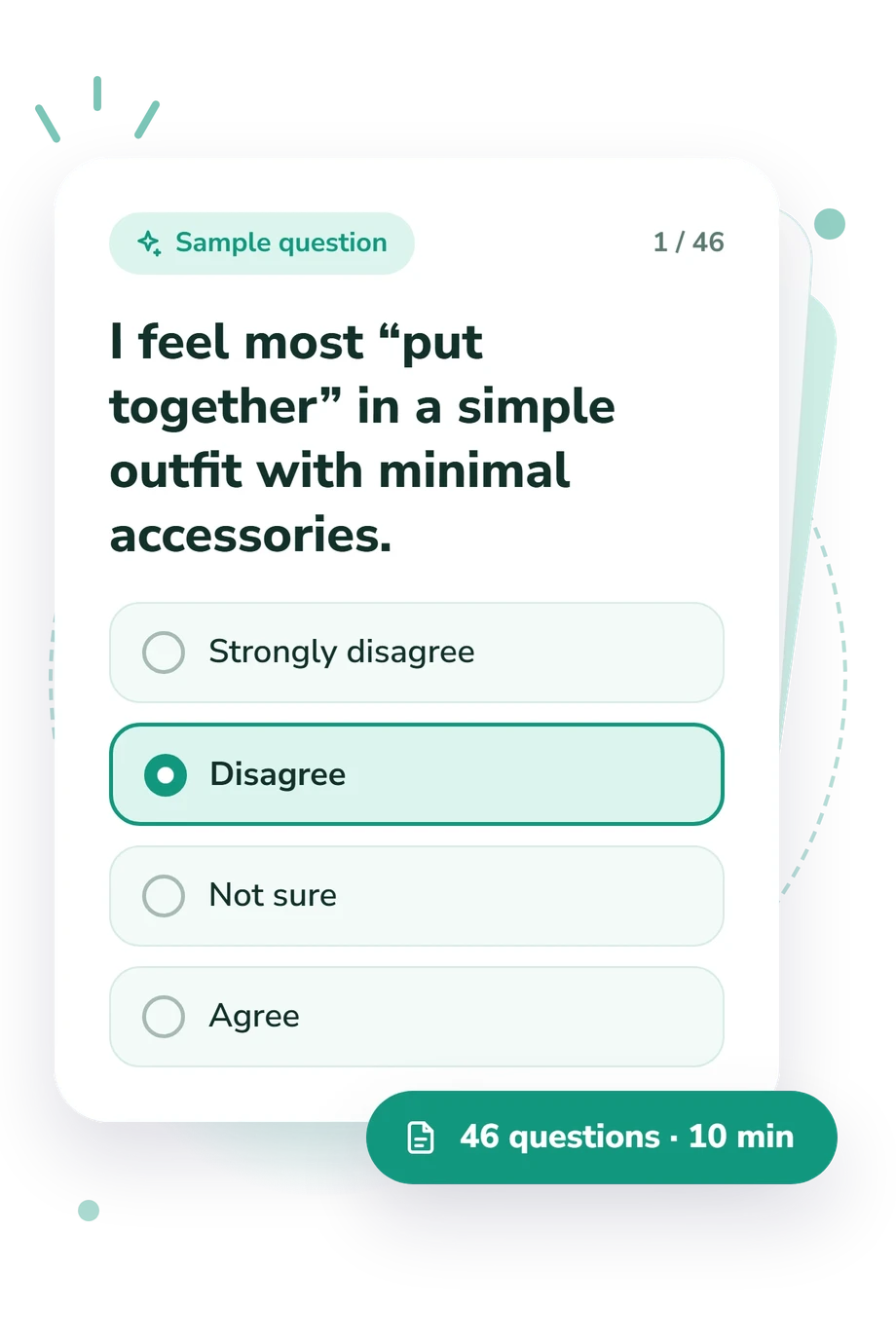
Sampled items cover clothing, décor, colors, materials, and visual atmosphere. The respondent chooses one of four options-Strongly disagree, Disagree, Not sure, or Agree-so the format records a reaction's direction rather than inviting explanation. Answers are most useful when they reflect ordinary preferences.
The response pattern is reported as a profile across the two dimensions. The questionnaire displays score bands but does not state how each response contributes to a total or provide population norms. This visual style assessment summarizes tendencies, not a calibrated ranking or permanent identity.
The 2010 study by Chamorro-Premuzic and colleagues examines aesthetic preferences, perceived complexity, and emotional valence. Wilson and Bellezza discuss minimalist consumption, while Holbrook and Schindler connect attitudes toward the past with aesthetic taste. Lasaleta and Loveland examine nostalgia and retro styling. The questionnaire is conceptually consistent with these works but is not presented as an adaptation of any one of them.
Mood, context, self-awareness, and the wish to appear consistent can shape self-report answers in this aesthetic style quiz. Tastes may change with experience, so the result is best read as a snapshot.
- Chamorro-Premuzic, Tomas, Charlotte Burke, Anne Hsu, and Viren Swami. "Personality Predictors of Artistic Preferences as a Function of the Emotional Valence and Perceived Complexity of Paintings." Psychology of Aesthetics, Creativity, and the Arts, vol. 4, no. 4, 2010, pp. 196-204. 10.1037/a0019211
- Wilson, Anne V., and Silvia Bellezza. "Consumer Minimalism." Journal of Consumer Research, vol. 48, no. 5, 2022, pp. 796-816. 10.1093/jcr/ucab038
- Holbrook, Morris B., and Robert M. Schindler. "Age, Sex, and Attitude toward the Past as Predictors of Consumers' Aesthetic Tastes for Cultural Products." Journal of Marketing Research, vol. 31, no. 3, 1994, pp. 412-422. 10.1177/002224379403100309
- Lasaleta, Jannine D., and Katherine E. Loveland. "What's New Is Old Again: Nostalgia and Retro-Styling in Response to Authenticity Threats." Journal of the Association for Consumer Research, vol. 4, no. 2, 2019, pp. 172-184. 10.1086/702473
Updated: