
Best Friend Test

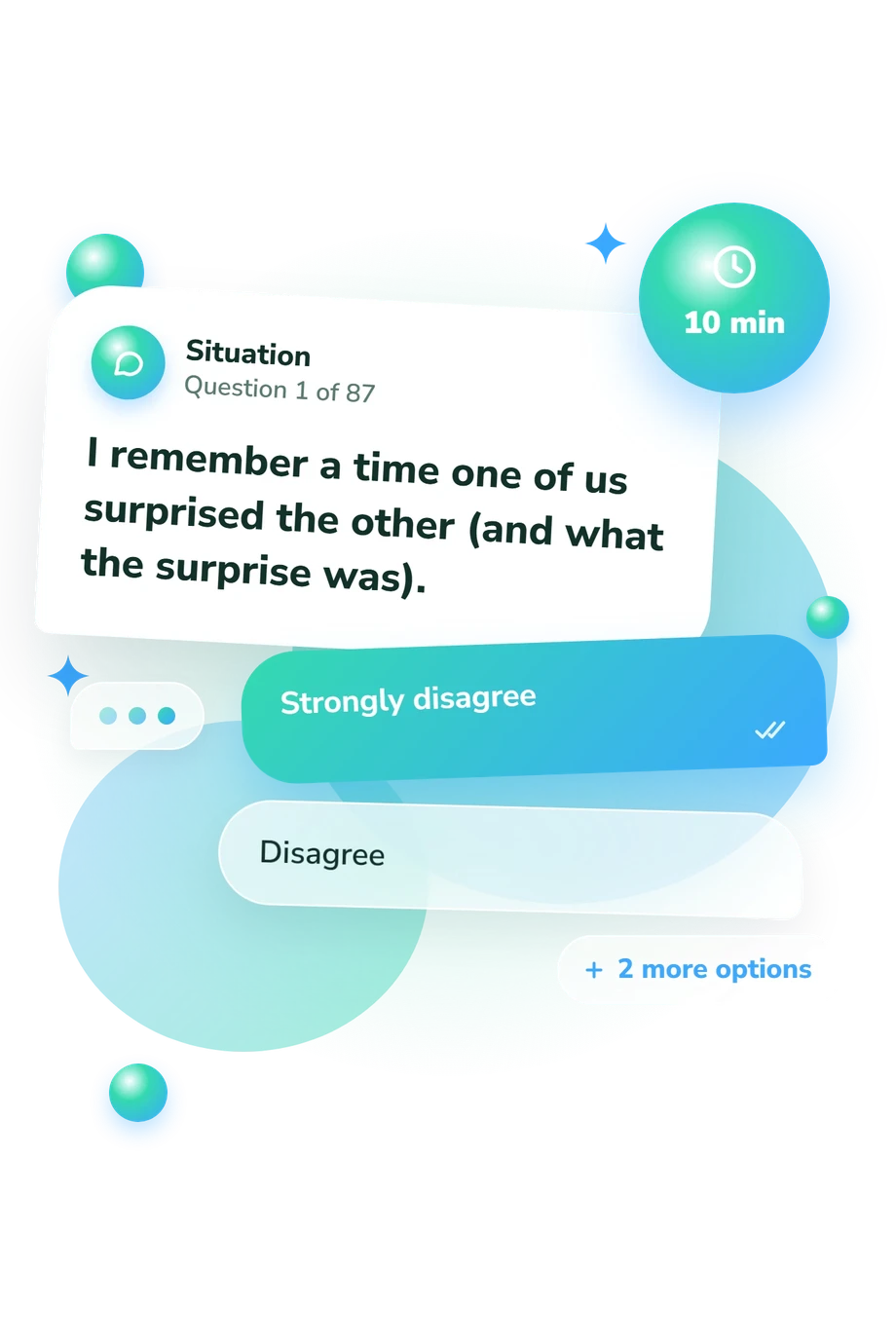
How well do you and your best friend really know each other? Take this Best Friend Test — 87 questions, about 10 minutes — for a fun, shareable quiz you can take solo or send to your BFF. Answer questions about favorites, memories, habits, pet peeves, and inside jokes, then compare results.
Start Online Test
Questions8710 minutes
Hi! My name is Freudly, i am an AI therapist, I will give you an interpretation of the test after you complete it.
08:30
March 25, 2026
March 25, 2026
Material has been updated
532 views
662 completions
15 likes
Verified by Daniel Hall
Psychologist with 25 years of experience
Share
Scale Explorer

How the Scales are Structured

example score
21/30
Habits & Quirks Insight (H&QI)
Measures how closely you and your friend align on everyday habits, routines, pet peeves, and quirks.
Lots of surprises
Mostly in sync
Quirk-level match
010Lots of surprises1120Mostly in sync2130Quirk-level match
A score of 21 suggests you’re highly in tune with your friend’s day-to-day habits and quirks, with only a few small surprises likely.
example score
12/30
Memory & Moments (M&M)
Measures how closely you and your friend align on shared memories, key moments, and personal history details.
Memory mismatch
Some shared recall
Strong shared history
010Memory mismatch1120Some shared recall2130Strong shared history
A score of 12 suggests you share some of the same memories, but there are noticeable gaps or differences in how you remember past moments.
example score
16/100
Overall Match (OM)
Overall Match measures the percentage of quiz answers that match between you and your best friend across all items.
Low match
Moderate match
High match
033Low match3466Moderate match67100High match
A score of 16 indicates a low overall match, meaning many answers differed or weren’t known between you and your best friend.
Start Online Test
just completed the test
DATA-BASED USER COHORTS

Who Usually Takes This Test?

Teen and College Besties
41%OF USERS
Friends who want a fun way to see how well they know each other and laugh over surprising mismatches.
Long-Distance Close Friends
33%OF USERS
Best friends who don’t see each other often and use the quiz to spark conversation and feel more connected.
Friend Groups and Roommates
26%OF USERS
Groups who take turns answering, compare scores, and uncover inside jokes, pet peeves, and shared memories.
BASED ON AGGREGATED, ANONYMIZED DATA FROM TENS OF THOUSANDS OF FREUDLY USERS.
Benchmarking

See How You Compare

Once you complete the test, your results are compared with real-world data from people in your country.
Below is a preview of how scores are typically distributed across each scale.
Habits & Quirks Insight (H&QI)
Average
10.4
Normal range
4.815.9
min.
0
max.
30
Majority
This curve shows how scores are typically distributed.
Once you complete the test, your result will appear on the scale so you can see how you compare.
Memory & Moments (M&M)
Average
11.6
Normal range
6.916.3
min.
0
max.
30
Majority
This curve shows how scores are typically distributed.
Once you complete the test, your result will appear on the scale so you can see how you compare.
Overall Match (OM)
Average
69.8
Normal range
54.585
min.
0
max.
100
Majority
This curve shows how scores are typically distributed.
Once you complete the test, your result will appear on the scale so you can see how you compare.
Featured On
CLEAR ANSWERS TO COMMON QUESTIONS

Frequently Asked Questions

What does this Best Friend Test measure?
It measures how many quiz answers match between you and your best friend across favorites, memories, habits, pet peeves, and inside jokes. Scores reflect response agreement — they don't indicate relationship quality or how close your friendship actually is.
How is this friendship quiz taken — together or separately?
Each person completes the same set of items separately, and matching responses are tallied afterward. You can take it live together, or send it to your friend to complete on their own time and compare results after.
How long does it take and how many questions are included?
Most respondents finish in about 10 minutes, though time may vary based on reading speed and how much time is spent considering each item. The quiz contains 87 items, all using simple prompts about favorites, memories, habits, pet peeves, and inside references.
Is this bff test a serious assessment of our friendship?
No. This is a recreational questionnaire and does not assess mental health, personality disorders, or clinical traits. It's designed purely for fun, connection, and conversation — not as a serious evaluation of your friendship's depth or quality.
What if our friend quiz results show a low match score?
A lower match score doesn't mean your friendship is lacking — it usually just means you'll have fun laughing over where your assumptions turned out wrong. Since results reflect answer agreement rather than relationship quality, plenty of very close friends still miss a few surprising details about each other.
Can I send this bestie quiz to a long-distance friend?
Yes, this is one of the most popular ways to use it. Many people send it to a best friend who lives far away as a fun, low-effort way to reconnect and compare notes, even without being in the same place.
How should we use our Best Friend Test results?
Use the results as a starting point for conversation and laughs rather than a serious evaluation. Comparing where you matched and where you didn't often sparks fun stories and reminders about shared memories you might not have brought up otherwise.
WHAT THE TEST MEASURES
About This Assessment
Best Friend Test
friendship
relationships

This is a recreational questionnaire designed to see how well you and a friend really know each other. The Best Friend Test contains 87 items using simple prompts about favorites, memories, habits, pet peeves, and inside references. It does not assess mental health, personality disorders, or clinical traits — it's built purely for fun and connection.

Why Take a Best Friend Test

Most close friendships build up a huge amount of shared history — inside jokes, tiny habits, favorite meals, memories that only make sense to the two of you. A best friend quiz gives you a fun way to actually test that shared history against reality, rather than just assuming you know each other inside out.

This friendship quiz works especially well because it's designed to be taken together or sent back and forth — one person answers about themselves, the other guesses, and then you compare. The gap between what you assumed and what's actually true is often where the funniest and most surprising moments come from.

This bff test is popular for catching up with a friend you haven't talked to in a while, for long-distance best friends looking for a fun way to connect remotely, and for friend groups who want a lighthearted activity to do together.

How the Test Works

Each person completes the same set of items covering everyday favorites, shared memories, habits, pet peeves, and inside jokes. Matching responses are tallied, and scores reflect response agreement — not relationship quality. The test yields three types of results:

  • Everyday habits and quirks — how closely you align on day-to-day routines, pet peeves, and personal quirks
  • Shared memories — how closely you align on key moments and personal history details
  • Overall match — the percentage of quiz answers that match between you and your best friend across all items

All items use simple, low-pressure prompts, so no deep personal disclosure is required to enjoy the quiz.

Who This Assessment Is For

This Best Friend Test is appropriate for any pair of close friends curious how well they actually know each other. It's especially popular for catching up after time apart, for long-distance besties who want a fun, low-effort way to connect, and for friend groups looking for a shareable activity that sparks conversation and laughs.

How to Use This Assessment

This is a recreational questionnaire and does not assess mental health, personality disorders, or clinical traits. Results reflect response agreement, not the quality or depth of the friendship itself — a lower match score is just as likely to be funny and surprising as it is meaningful, and shouldn't be read as a verdict on how close you actually are.

Popular tests
Narcissistic Personality Inventory (NPI)
This self-report measure is used to assess narcissism as a personality trai…
Start Test
Yale-Brown Obsessive Compulsive Scale (Y-BOCS)
This measure is used to rapidly quantify the current severity of obsessive…
Start Test
CRAFFT Screening Test (CRAFFT 2.1)
This brief screening measure is designed to identify potential alcohol and…
Start Test
Patient Health Questionnaire-9 (PHQ-9)
This measure is commonly used to quickly screen for the presence and severi…
Start Test
Maslach Burnout Inventory (MBI)
This self-report measure is used to assess occupational burnout symptoms in…
Start Test
Adolescent Anxiety Questionnaire
This measure is designed to support a brief appraisal of anxiety symptoms a…
Start Test
Emotional Creativity Inventory (ECI)
This self-report measure assesses individual differences in the originality…
Start Test
Horne–Ostberg Morningness–Eveningness Questionnaire (MEQ)
Circadian preferences influence typical patterns of alertness and sleep tim…
Start Test
Ambivalent Sexism Inventory (ASI)
This measure is designed to assess attitudes toward women, including both o…
Start Test
Internalized Misogyny Scale (IMS)
This measure is designed to assess internalized negative beliefs and stereo…
Start Test
Perceived Stress Scale (PSS-10)
This self-report measure assesses the degree to which individuals appraise…
Start Test
Impulsive Behavior Scale (SUPPS-P)
Impulsivity is a multidimensional construct that is often assessed with bri…
Start Test
Clinical Institute Withdrawal Assessment for Alcohol, Revised (CIWA-Ar)
This rating scale is used to rapidly assess the severity of alcohol withdra…
Start Test
Positive and Negative Affect Schedule (PANAS)
This measure provides a brief self-report assessment of current or typical…
Start Test
Light Triad Scale (LTS)
This self-report measure assesses prosocial personality tendencies and orie…
Start Test
Suicidal Ideation Scale
In clinical settings, the Suicidal Ideation Scale is used to structure an i…
Start Test
Body Dysmorphic Disorder Scale (BDD-D)
This brief self-report measure is designed to screen for and quantify distr…
Start Test
Beck Anxiety Inventory (BAI)
This measure is a brief self-report inventory used to screen for anxiety sy…
Start Test
Differential Test of Perfectionism
This instrument is used to screen for perfectionism-related attitudes and t…
Start Test
Locus of Control Scale
This measure assesses generalized expectancies regarding the degree to whic…
Start Test
New Apathy Scale
This brief self-report measure is used to screen for apathy-related symptom…
Start Test
Perth Alexithymia Questionnaire (PAQ)
This measure assesses individual differences in alexithymia, including diff…
Start Test
Social Intelligence Scale
This brief self-report measure is designed to support rapid screening of in…
Start Test
Fear Test
This measure is designed to evaluate individual differences in fear-related…
Start Test
Neuroticism Level Scale
The measure is intended for brief screening of an individual’s propensity t…
Start Test
Aggressiveness Indicators Screening Questionnaire
This screening tool is designed to quickly identify behavioral indicators a…
Start Test
Comments
Leave a Comment