
Neurodivergent Test
How the Scales are Structured
Who Usually Takes This Test?
See How You Compare
Below is a preview of how scores are typically distributed across each scale.
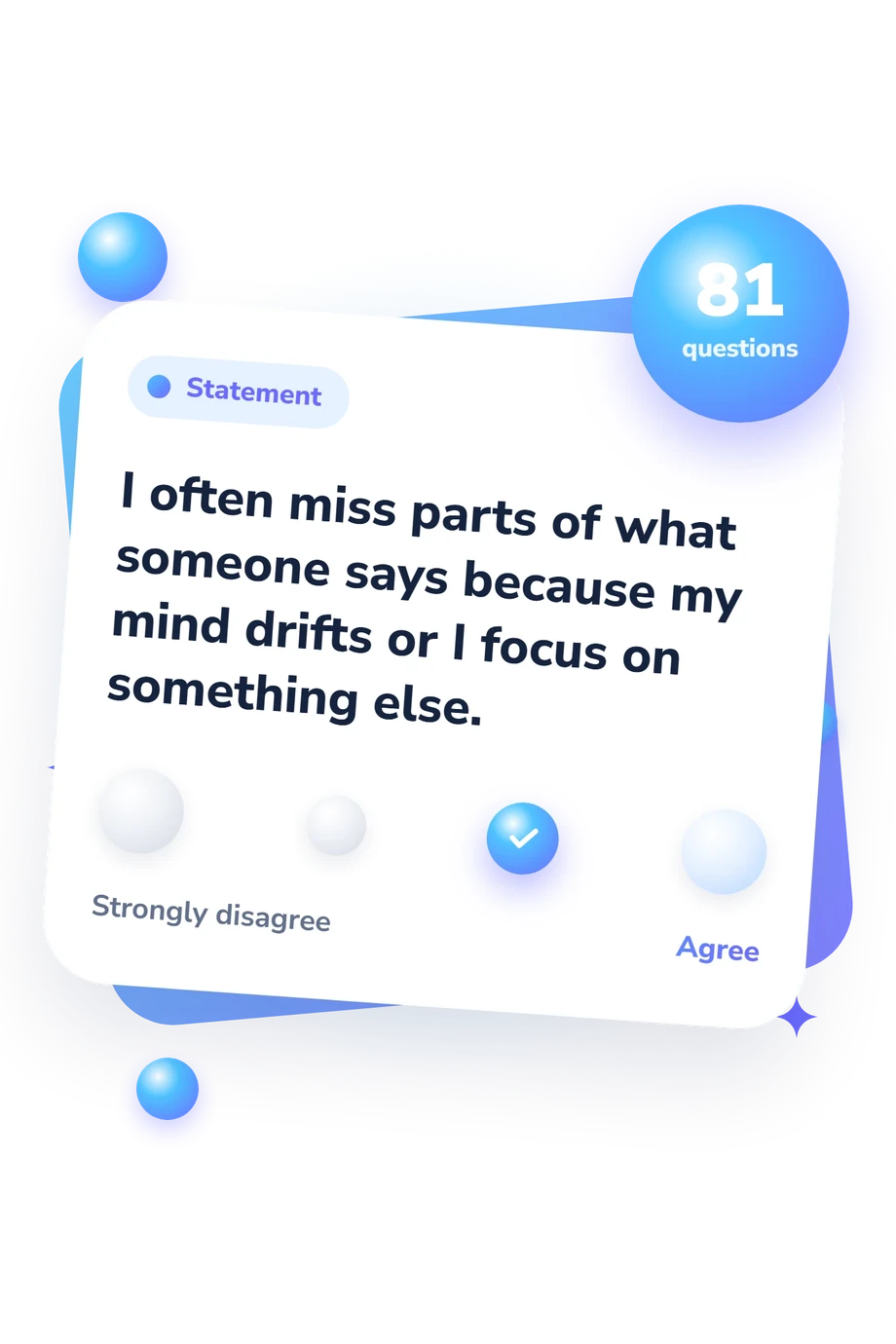
Example Questions From the Test
- Strongly disagree
- Disagree
- Not sure
- Agree
- Strongly disagree
- Disagree
- Not sure
- Agree
- Strongly disagree
- Disagree
- Not sure
- Agree
Neurodivergent Test - Description and methodology of the test
People who notice recurring differences in daily life may use this neurodivergent test to organize a broad personal question. People wondering whether they may be neurodivergent can use it as an am I neurodivergent quiz, gaining a structured way to explore that question while the result highlights areas for further exploration without forcing every experience into one explanation or label.
What This Assessment Explores
The questionnaire focuses on everyday situations rather than a single identity label. Statements cover attention lapses, task initiation and transitions, sensory discomfort, reliance on routines, social-cue reading, masking, and absorbing interests. For many readers, this neurodivergent quiz is most useful when its prompts are compared with real-life patterns.
The result is organized into three displayed dimensions:
- Attention & Executive Function (0-30) reads attention regulation, planning, initiation, organization, time management, and working memory; Lower endorsement 0-10, Moderate endorsement 11-20, Higher endorsement 21-30.
- Sensory & Routine Sensitivity (0-30) reads sensory reactivity and reliance on routines or predictability; Lower 0-10, Moderate 11-20, Higher 21-30.
- Social Communication & Interests (0-30) reads cue interpretation, reciprocity, masking, and focused interests; Lower endorsement 0-10, Moderate endorsement 11-20, Higher endorsement 21-30.
For people exploring possible neurodivergent patterns, it shows whether endorsement is concentrated in one area or distributed across several.
Methodology and Scientific Basis
The displayed statements use four response options: Strongly disagree, Disagree, Not sure, and Agree. Responses are grouped by content and combined into displayed scores; the bands describe the result but do not show how many points each answer contributes. This free test for neurodivergent patterns offers a profile-level reading rather than a formula the respondent can reconstruct.
Conceptually, its themes overlap with constructs measured by CATI, ASRS, SPQ, and CAT-Q, which address autistic traits, attention and executive difficulties, sensory perception, and social camouflaging. These separate instruments cannot transfer their validation findings or population norms to this questionnaire. The overlap locates its themes in established constructs without validating this online scoring model.
Scores should be read as descriptive endorsement bands; the questionnaire provides no population-norm comparison. Current stress, memory, self-awareness, and response style can influence self-report, while developmental history and context may change interpretation. Use the profile to identify themes worth exploring and practical supports worth testing; fuller assessment requires broader information.
- English, M. C. W., Gignac, G. E., Visser, T. A. W., Whitehouse, A. J. O., Enns, J. T., & Maybery, M. T. (2021). The Comprehensive Autistic Trait Inventory (CATI): development and validation of a new measure of autistic traits in the general population. Molecular Autism, 12, 37. 10.1186/s13229-021-00445-7
- Kessler, R. C., Adler, L., Ames, M., Demler, O., Faraone, S., Hiripi, E., Howes, M. J., Jin, R., Secnik, K., Spencer, T., Ustun, T. B., & Walters, E. E. (2005). The World Health Organization Adult ADHD Self-Report Scale (ASRS): a short screening scale for use in the general population. Psychological Medicine, 35(2), 245-256. 10.1017/S0033291704002892
- Tavassoli, T., Hoekstra, R. A., & Baron-Cohen, S. (2014). The Sensory Perception Quotient (SPQ): development and validation of a new sensory questionnaire for adults with and without autism. Molecular Autism, 5, 29. 10.1186/2040-2392-5-29
- Hull, L., Mandy, W., Lai, M.-C., Baron-Cohen, S., Allison, C., Smith, P., & Petrides, K. V. (2019). Development and Validation of the Camouflaging Autistic Traits Questionnaire (CAT-Q). Journal of Autism and Developmental Disorders, 49(3), 819-833. 10.1007/s10803-018-3792-6
Updated: