
Perceived Stress Scale (PSS) Test
How the Scales are Structured
Who Usually Takes This Test?
See How You Compare
Below is a preview of how scores are typically distributed across each scale.
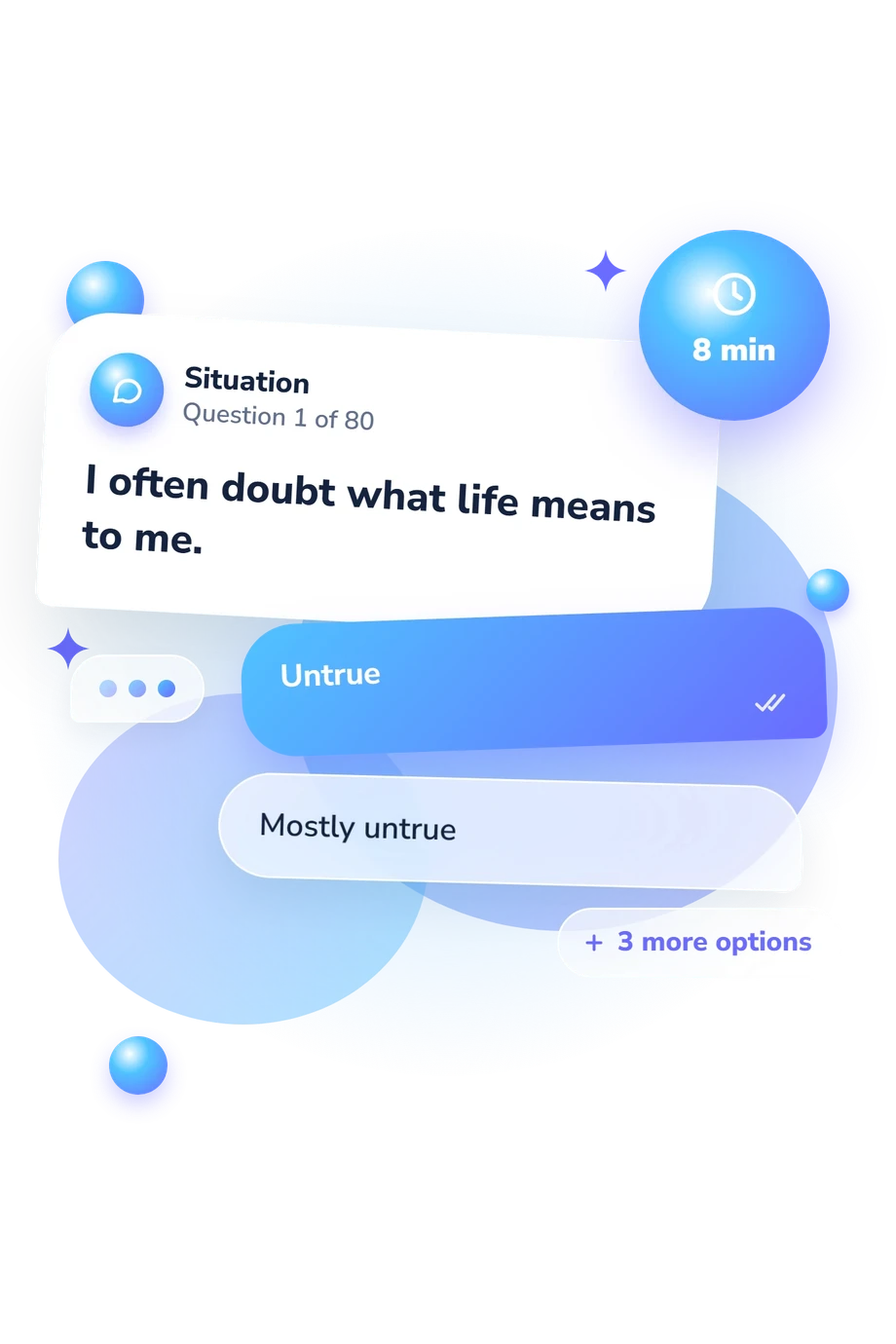
Example Questions From the Test
- Untrue
- Mostly untrue
- Neither true nor untrue
- Mostly true
- True
- False
- Somewhat false
- Neither true nor false
- Somewhat true
- True
- Untrue
- Mostly untrue
- Neither true nor untrue
- Mostly true
- True
Perceived Stress Scale (PSS) Test - Description and methodology of the test
People who feel pulled between demanding circumstances, personal goals, social expectations, and limited control may use this assessment to organize those experiences. The Perceived Stress Scale (PSS) Test examines four distinct dimensions and is conceptually consistent with Zhang’s Psychological Strain Scales. These distinctions help organize the experiences described by the items. As an online questionnaire, it separates several patterns instead of reducing every difficulty to one general label.
What This Assessment Explores
The items explore uncertainty about values, frustration over blocked goals, social comparison, and reactions to crisis, isolation, or lost control. They suit readers examining how circumstances and perceived expectations shape current strain. Taken together, these themes make this a psychological strain assessment of distinct sources rather than a general mood check.
The result separates four dimensions, each interpreted through its own range and band:
- Coping Strain (10-50) reflects difficulty adapting to crises and seeking support; Low 10-23, Moderate 24-36, High 37-50.
- Deprivation Strain (10-50) reflects perceived disadvantage and unfair comparison; Low 10-23, Moderate 24-36, High 37-50.
- Aspirational Strain (10-50) reflects a gap between desired outcomes and reality; Low 10-23, Moderate 24-36, High 37-50.
- Value Strain (10-50) reflects conflict between personal beliefs and social demands; Low 10-23, Moderate 24-36, High 37-50.
Methodology and Scientific Basis
Five ordered response choices vary between false/true, agree/disagree, and statements of truth. The psychological strain test displays four separate scale scores; its format does not establish how responses are combined or whether a total is calculated. Results are read through displayed bands.
Conceptually, the content is consistent with Psychological Strain Scales, published by Zhang and colleagues in 2014, a four-domain model examined in an English-language study by Zhang and Lyu in 2014. Related work by Zhang, Wieczorek, Conwell, and Tu from 2011 connects strain with social integration and moral regulation. This online form is conceptually consistent with that framework, not an adaptation of it; these publications do not establish its validation, norms, or scoring procedures.
The bands are descriptive guides rather than universal clinical cutoffs or a standalone clinical conclusion. Within these definitions, higher values may indicate reduced capacity to adapt and seek support, feelings of injustice or inequality, frustration over unattainable goals, or discomfort from conflict between personal and social values, respectively. Interpretation depends on circumstances; self-report is affected by mood, memory, social comparison, and willingness to disclose.
- Zhang, J., Lu, J., Zhao, S., Lamis, D. A., Li, N., Kong, Y., Jia, C., Zhou, L., & Ma, Z. (2014). Developing the Psychological Strain Scales (PSS): Reliability, validity, and preliminary hypothesis tests. Social Indicators Research, 115(1), 337-361. 10.1007/s11205-012-0222-6
- Zhang, J., & Lyu, J. (2014). Reliability, validity and preliminary hypothesis tests for the English version of the Psychological Strain Scales (PSS). Journal of Affective Disorders, 164, 69-75. 10.1016/j.jad.2014.04.011
- Zhang, J., Wieczorek, W. F., Conwell, Y., & Tu, X. M. (2011). Psychological strains and youth suicide in rural China. Social Science & Medicine, 72(12), 2003-2010. 10.1016/j.socscimed.2011.03.048
Updated: