
Big Five Inventory-2 Extra-Short Form (BFI-2-XS) Test
How the Scales are Structured
Who Usually Takes This Test?
See How You Compare
Below is a preview of how scores are typically distributed across each scale.
Example Questions From the Test
- Strongly disagree
- Disagree a little
- Neutral, no opinion
- Agree a little
- Strongly agree
- Strongly disagree
- Disagree a little
- Neutral, no opinion
- Agree a little
- Strongly agree
- Strongly disagree
- Disagree a little
- Neutral, no opinion
- Agree a little
- Strongly agree
Big Five Inventory-2 Extra-Short Form (BFI-2-XS) Test - Description and methodology of the test
People who want a concise view of their characteristic ways of thinking, feeling, and behaving can use this assessment for structured self-reflection. The Big Five Inventory-2 Extra-Short Form (BFI-2-XS) Test presents a dimensional personality profile rather than a single type. As a Big Five personality test, it helps readers notice broad tendencies across everyday situations without reducing personality to one label.
What This Assessment Explores
Five domains cover social energy, cooperation, organization, Negative Emotionality, and curiosity. The BFI-2-XS questionnaire suits readers seeking a concise view of everyday tendencies. Each result describes a pattern, not a value judgment.
The displayed scales are:
- Extraversion (E), 0-100, measures sociability and social energy; Low 0-30, Moderate 31-70, High 71-100.
- Agreeableness (A), 0-100, reflects cooperation, tact, trust, and compassion; Lower kindness 0-30, Moderate kindness 31-70, Higher kindness 71-100.
- Conscientiousness (C), 0-100, reflects organization, responsibility, and goal focus; Low 0-30, Moderate 31-70, High 71-100.
- Negative Emotionality (N), 0-100, reflects emotional sensitivity, mood fluctuation, and the tendency to experience negative emotions; higher scores indicate greater instability, while lower scores indicate greater emotional stability and stress resilience; Low 0-30, Moderate 31-70, High 71-100.
- Openness to Experience (O), 0-100, measures curiosity, creativity, and novelty; Low 0-30, Moderate 31-70, High 71-100.
Methodology and Scientific Basis
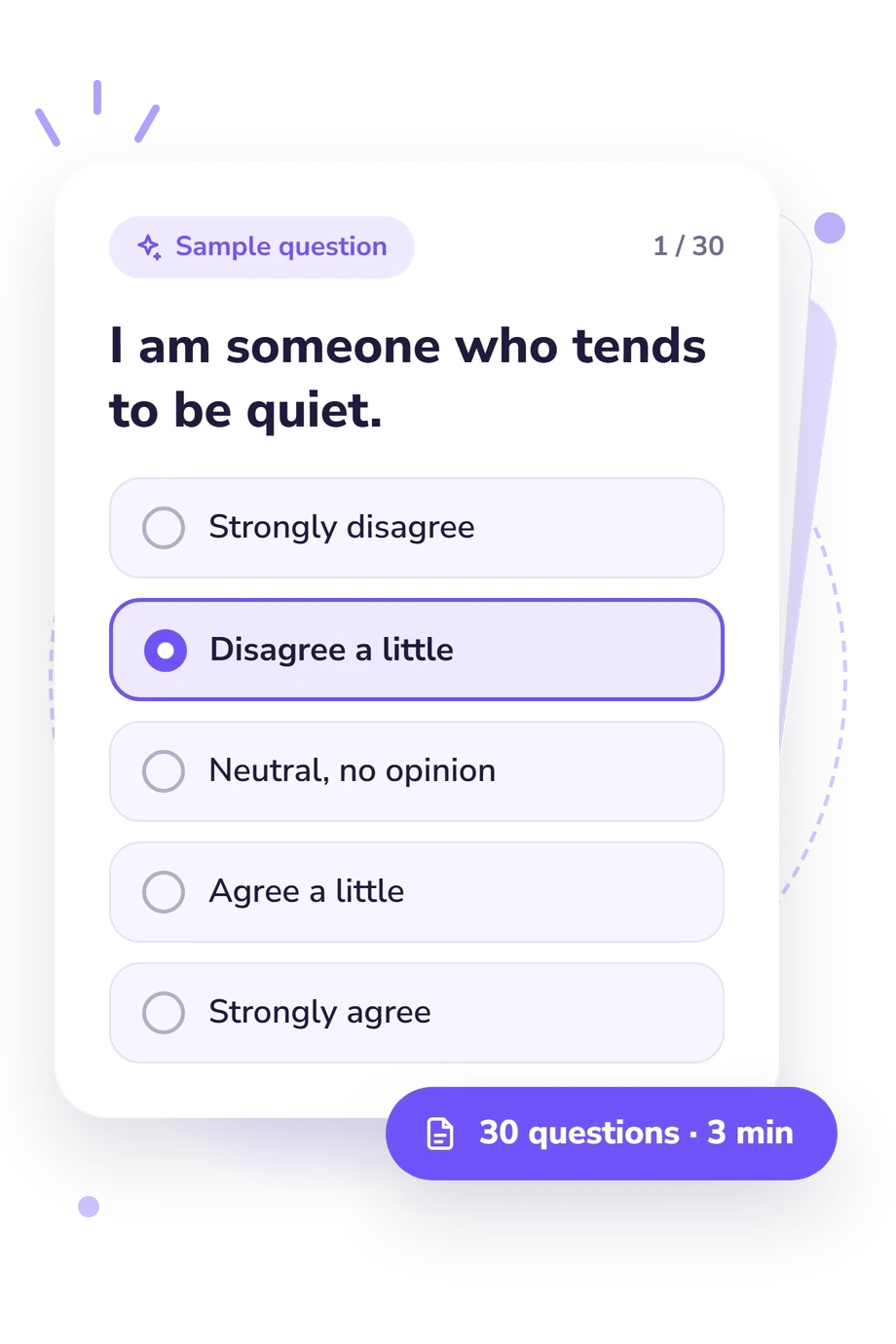
Each item is a short self-description answered on a five-point scale, from Strongly disagree to Strongly agree. The statements address quietness, kindness, organization, worry, artistic interest, leadership, reliability, mood, energy, and creativity. The questionnaire presents separate domain results, and each displayed result describes a tendency.
The published BFI-2-XS instrument is a 15-item short form of the BFI-2. The broader model describes personality through the Big Five personality traits and 15 more specific facets, while this extra-short version prioritizes coverage of the domains over detailed facet interpretation. This questionnaire is conceptually consistent with that published instrument, not a reproduction of the full BFI-2.
The published BFI-2-XS and BFI-2 studies provide evidence about those source instruments, including reliability, validity, and the trade-off between brevity and coverage; that evidence does not automatically apply to every online scoring presentation. Read the five domain tendencies together as a compact pattern: the displayed bands organize each result, while the profile is most useful for individual self-reflection. As a self-report, responses may shift with current mood, self-presentation, and self-knowledge.
- Soto, Christopher J., and Oliver P. John. “Short and extra-short forms of the Big Five Inventory-2: The BFI-2-S and BFI-2-XS.” Journal of Research in Personality, vol. 68, 2017, pp. 69-81. 10.1016/j.jrp.2017.02.004
- Soto, Christopher J., and Oliver P. John. “The next Big Five Inventory (BFI-2): Developing and assessing a hierarchical model with 15 facets to enhance bandwidth, fidelity, and predictive power.” Journal of Personality and Social Psychology, vol. 113, no. 1, 2017, pp. 117-143. 10.1037/pspp0000096
- Soto, Christopher J., and Oliver P. John. “Optimizing the length, width, and balance of a personality scale: How do internal characteristics affect external validity?” Psychological Assessment, vol. 31, no. 4, 2019, pp. 444-459. 10.1037/pas0000586
Updated: