
Twin Flame Test
How the Scales are Structured
Who Usually Takes This Test?
See How You Compare
Below is a preview of how scores are typically distributed across each scale.
Example Questions From the Test
- Strongly disagree
- Disagree
- Not sure
- Agree
- Strongly disagree
- Disagree
- Not sure
- Agree
- Strongly disagree
- Disagree
- Not sure
- Agree
Twin Flame Test - Description and methodology of the test
For someone wondering whether an unusually intense bond reflects a recurring relational pattern, a twin flame test offers a focused way to organize observations. It is intended for people examining a current or past connection, especially when closeness, distance, and reunion seem difficult to interpret. A twin flame quiz makes that reflection more concrete by turning memorable experiences into comparable response patterns, while leaving room for the relationship’s wider context.
What This Assessment Explores
The questionnaire separates felt intensity, recurring instability, and the practical quality of the bond. Its online format keeps this twin-flame test free to take, while the result still needs to be read as a profile of reported experiences rather than proof of spiritual status. The displayed dimensions are:
- The Separation-Reunion Cycle (0-30) measures repeated distance, silence, breakup, and return; bands are Low 0-10, Moderate 11-20, and High 21-30.
- Connection Resonance (0-40) measures intense attraction, mirroring, recognition, and shared direction; bands are Low Resonance 0-13, Moderate Resonance 14-26, and High Resonance 27-40.
- Relational Health and Boundaries (0-30) measures communication, respected limits, self-care, and stable growth; bands are Low 0-10, Medium 11-20, and High 21-30.
The result can therefore distinguish a powerful felt connection from the ability to sustain it.
Methodology and Evidence Base
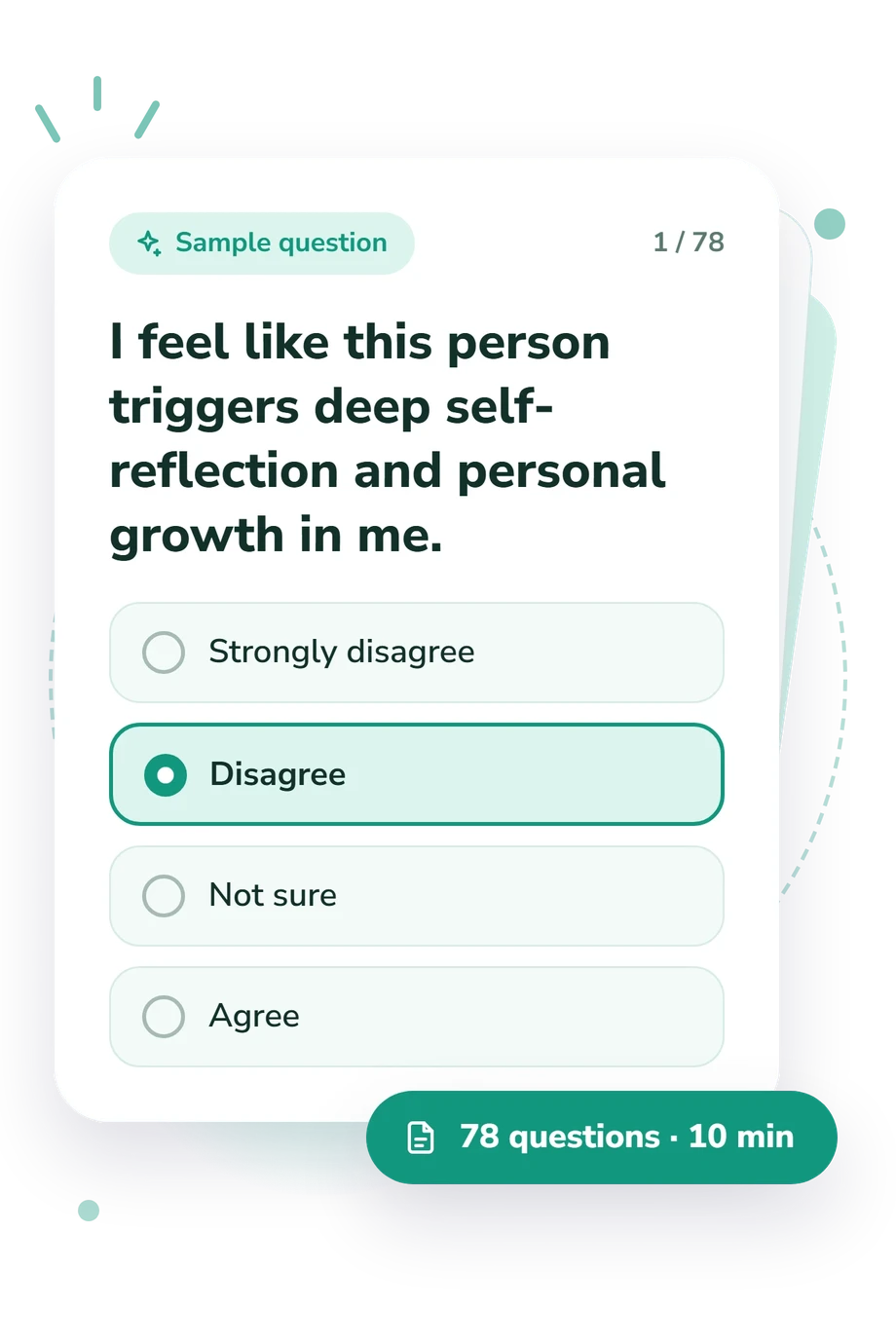
The statements use four response options-Strongly disagree, Disagree, Not sure, and Agree-to rate experiences involving attraction, reflection, distance, reunion, conflict, boundaries, and everyday functioning. This makes the result a self-report profile rather than a relationship label.
Rather than producing a yes-or-no verdict, this twin flame connection quiz groups related responses into three displayed dimensions. Each dimension receives its own range and band. The ranges do not reveal an additional weighting rule, so point values should not be inferred beyond the questionnaire’s stated outputs.
Conceptually, the structure is closest to research on on-again/off-again relationships. Dailey et al. (2009) examined recurring transitions, while Dailey et al. (2013) described these relationships dimensionally. The resonance theme also overlaps with the passionate-love approach of Hatfield and Sprecher (1986). Those works provide a conceptual comparison, not evidence that this online form is a validated adaptation of their instruments.
This exact form has no stated published norms, reliability estimates, or clinical cutoffs. Results may shift with current conflict, longing, reconciliation, self-awareness, and response bias, so they are best read as structured reflection rather than diagnosis.
- Dailey, René M., Abigail Pfiester, Borae Jin, Gary Beck, and Gretchen Clark. (2009). On-again/off-again dating relationships: How are they different from other dating relationships? Personal Relationships, 16(1), 23-47. 10.1111/j.1475-6811.2009.01208.x
- Dailey, René M., Borae Jin, Nicholas Brody, and Andrea A. McCracken. (2013). A Dimensional Approach to Characterizing On-Again/Off-Again Romantic Relationships. Interpersona: An International Journal on Personal Relationships, 7(2), 196-214. 10.5964/ijpr.v7i2.131
- Hatfield, Elaine, and Susan Sprecher. (1986). Measuring passionate love in intimate relationships. Journal of Adolescence, 9(4), 383-410. 10.1016/S0140-1971(86)80043-4
Updated: