
What Color Am I Quiz
How the Scales are Structured
Who Usually Takes This Test?
See How You Compare
Below is a preview of how scores are typically distributed across each scale.
Example Questions From the Test
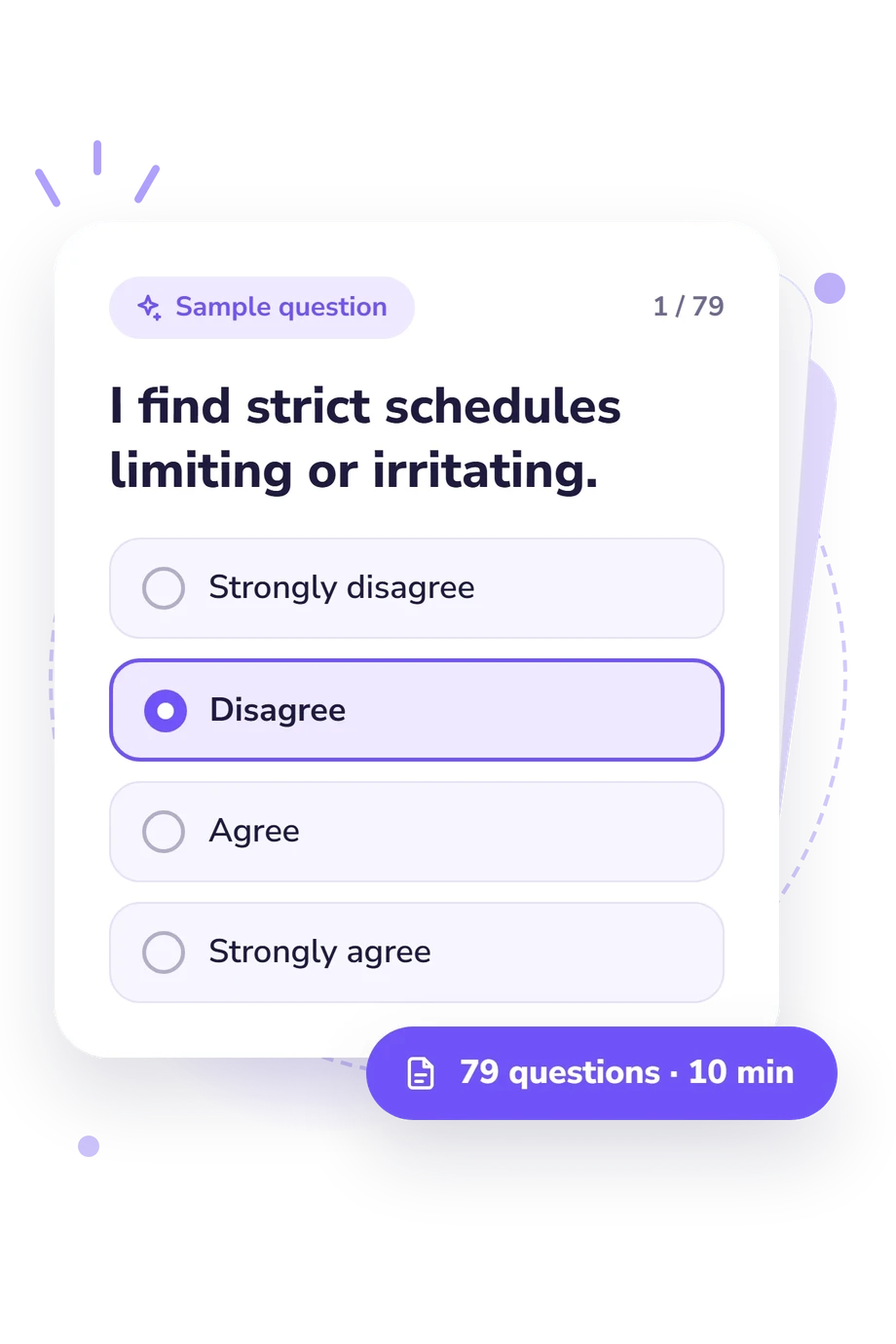
- Strongly disagree
- Disagree
- Agree
- Strongly agree
- Strongly disagree
- Disagree
- Not sure
- Agree
- Strongly disagree
- Disagree
- Agree
- Strongly agree
What Color Am I Quiz - Description and methodology of the test
Readers seeking a compact personality reflection may find this profile useful when they are curious about emotional expression, sociability, and planning style. The What Color Am I Quiz turns those themes into a readable three-dimension profile. It helps readers reflect on their social and emotional style, and consider how these tendencies may appear in everyday life.
What This Assessment Explores
The questionnaire groups everyday experiences into three dimensions: emotional reactivity, social engagement, and the balance between planning and improvisation. These personality dimensions suit readers seeking a snapshot, while the result is a three-scale profile to read through those dimensions.
The dimensions are:
- Emotional Intensity (0-30) shows whether feelings are Steady 0-10, Balanced 11-20, or Intense 21-30, with higher results indicating stronger, faster reactions and lower results indicating steadier emotional responses.
- Social Energy (0-30) shows whether interaction style is Reserved 0-10, Balanced 11-20, or Outgoing 21-30, from reflective reserve to expressive presence.
- Structure vs Spontaneity (0-30) shows whether habits are Spontaneous 0-10, Balanced 11-20, or Structured 21-30, from improvisation to planning and predictability.
This questionnaire produces a three-dimension profile that is best read as a pattern across these scales, not as a single label for your current self-description.
Methodology and Evidence Base
Each item is a self-report statement about feelings, social situations, or order preferences. Choices run from Strongly disagree to Strongly agree; some feeling-focused items offer Not sure. This self-report questionnaire captures degree of agreement, but each answer’s point value is unspecified.
The questionnaire is conceptually consistent with Jue and Ha (2022), which examined personality and color preferences, but it is not an adaptation of that study. Lüscher’s test is a separate historical color-selection instrument, while Elliot and Maier (2014) describe context-dependent effects of color on psychological functioning. Jonauskaite et al. (2021) caution against treating favorite color as a personality measure. Together, these sources provide context for research on color and personality; they do not establish this questionnaire’s framework or validate its scores.
Scoring presents three scores within the displayed bands; each answer’s contribution is unspecified, and the questionnaire’s scoring rules are therefore only partly transparent. Its profile is shaped by mood, context, self-awareness, and impression management, so results are more useful for reflection than fixed judgment. Accordingly, the outcome is best treated as a reflective profile rather than a diagnosis.
- Jue, J., & Ha, J. H. (2022). Exploring the relationships between personality and color preferences. Frontiers in Psychology, 13, 1065372. 10.3389/fpsyg.2022.1065372
- Jonauskaite, D., Thalmayer, A. G., Muller, L., & Mohr, C. (2021). What Does Your Favourite Colour Say About Your Personality? Not Much. Personality Science, 2, Article e6297. 10.5964/ps.6297
- Luscher, M. (1970). The Luscher colour test (I. A. Scott, Trans. and Ed.). London: Cape.
- Elliot, A. J., & Maier, M. A. (2014). Color psychology: Effects of perceiving color on psychological functioning in humans. Annual Review of Psychology, 65, 95-120. 10.1146/annurev-psych-010213-115035
Updated: