
Responsibility Express Assessment Test
How the Scales are Structured
Who Usually Takes This Test?
See How You Compare
Below is a preview of how scores are typically distributed across each scale.
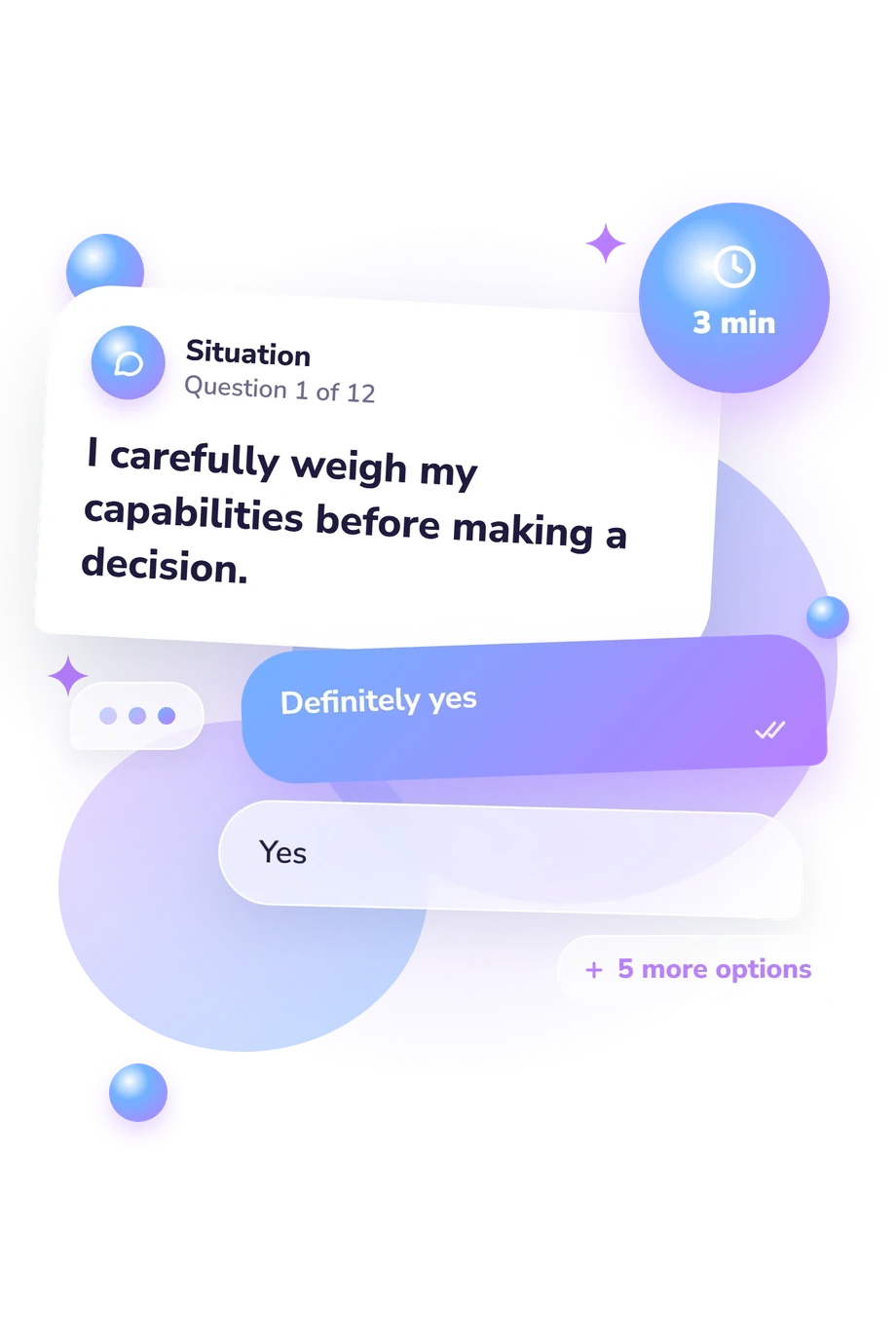
Example Questions From the Test
- Definitely yes
- Yes
- Possibly yes
- Neutral response
- Possibly no
- No
- Definitely no
- Definitely yes
- Yes
- Possibly yes
- Neutral response
- Possibly no
- No
- Definitely no
- Definitely yes
- Yes
- Possibly yes
- Neutral response
- Possibly no
- No
- Definitely no
Responsibility Express Assessment Test - Description and methodology of the test
People who want to examine how they respond when everyday expectations become demanding can use the Responsibility Express Assessment Test as a focused self-report exercise. It suits readers considering a practical question: when duties are personal, shared, or public, what patterns shape their willingness to carry them through? The result from a responsibility assessment can help them reflect on whether their usual choices remain dependable when circumstances change.
What This Assessment Explores
At its core, this responsibility questionnaire examines the tendency to assume obligations and follow through on them. The items ask about judging your capabilities before decisions, owning behavior, responding to mistakes, and accepting serious, group, or public duties. The result therefore describes a practical pattern relevant across everyday roles.
The questions touch four recurring areas:
- Self-appraisal shows whether you consider your capabilities before taking on demanding roles.
- Commitment and follow-through indicate whether you keep promises and finish started tasks.
- Personal accountability reflects ownership of behavior and reactions to mistakes.
- Shared and public duty describes your stance toward group obligations and visible responsibilities.
The result uses one Responsibility scale from 12-84, with Low responsibility (12-36), Situational responsibility (37-59), and Pronounced responsibility (60-84). Higher bands indicate a stronger reported tendency to assume and complete obligations, not a moral verdict.
Methodology and Scientific Basis
Responses use seven ordered choices, from Definitely yes to Definitely no, with a neutral middle option. This format captures degrees of agreement rather than forcing a yes-or-no answer. The statements cover independent judgment, promises, guilt after mistakes, reluctance toward serious tasks, and whether others have carried responsibility for the respondent.
The result is reported on a single scale, but the questionnaire does not state item weights, reverse-keying, or population norms. Do not infer equal contribution or percentile meaning; read the displayed band as a descriptive classification.
Pryadein’s Express Diagnostics of Responsibility is the closest conceptual reference, described in his 2013 book Psychology of Responsibility. Pryadein (2001) treats responsibility as an integrated personality quality, while Buzgan (2023) examines its relationship with self-actualization. These sources support the construct’s relevance, but do not establish this online questionnaire as a standardized adaptation.
In practice, a responsibility self-assessment is sensitive to circumstances, self-presentation, and self-awareness. Use the result as a snapshot, considering whether it fits your behavior across situations rather than treating the score as a complete account of your personality.
- Pryadein, Valery P. (2013). Psychodiagnostics of Personality: Selected Psychological Methods and Tests. Surgut: Editorial and Publishing Department of Surgut State Pedagogical University. ISBN 978-5-93190-313-2.
- Buzgan, Ekaterina I. (2023). The Relationship of Responsibility and Self-Actualization among Today’s Youth. Experimental Psychology, 16(4), 75-87. 10.17759/exppsy.2023160405.
- Pryadein, Valery P. (2001). Responsibility as a Systemic Quality of Personality. Yekaterinburg: Ural State Pedagogical University. ISBN 5-7186-0282-4.
Updated: