
Interpersonal Reactivity Index (IRI) Test
How the Scales are Structured
Who Usually Takes This Test?
See How You Compare
Below is a preview of how scores are typically distributed across each scale.
Example Questions From the Test
- Strongly disagree
- Somewhat disagree
- Not sure
- Somewhat agree
- Strongly agree
- Strongly disagree
- Somewhat disagree
- Cannot say
- Somewhat agree
- Strongly agree
- Strongly disagree
- Somewhat disagree
- Cannot say
- Somewhat agree
- Strongly agree
Interpersonal Reactivity Index (IRI) Test - Description and methodology of the test
People who want a structured way to examine their interpersonal responses may find the Interpersonal Reactivity Index (IRI) Test useful. This IRI empathy test presents a profile rather than one overall label, helping readers compare how their results differ across the questionnaire’s dimensions and identify patterns worth reflecting on in everyday relationships. It offers a clear starting point for noticing similarities and contrasts within one personal profile.
What This Assessment Explores
Empathy is treated here as a group of related tendencies rather than one overall ability. The items touch on disagreements, helping, fiction, criticism, and emotionally tense situations. As a multidimensional empathy assessment, the profile shows which patterns are more characteristic of your responses. The four displayed scales are:
- Perspective Taking (0-28) reflects considering another person’s experience: Low 0-10; Moderate 11-20; High 21-28.
- Empathic Engagement (Fantasy) (0-28) reflects imaginative identification with fictional characters: Low 0-10; Moderate 11-22; High 23-28.
- Empathic Concern (0-28) reflects warmth, compassion, sympathy, and a helping orientation: Low 0-10; Moderate 11-21; High 22-28.
- Personal Distress (0-28) reflects unease around others’ suffering: Low distress 0-4; Moderate distress 5-16; High distress 17-28.
Read as a pattern, the profile can show how perspective-taking and concern coexist with imaginative engagement or emotional unease.
Methodology and Scientific Basis
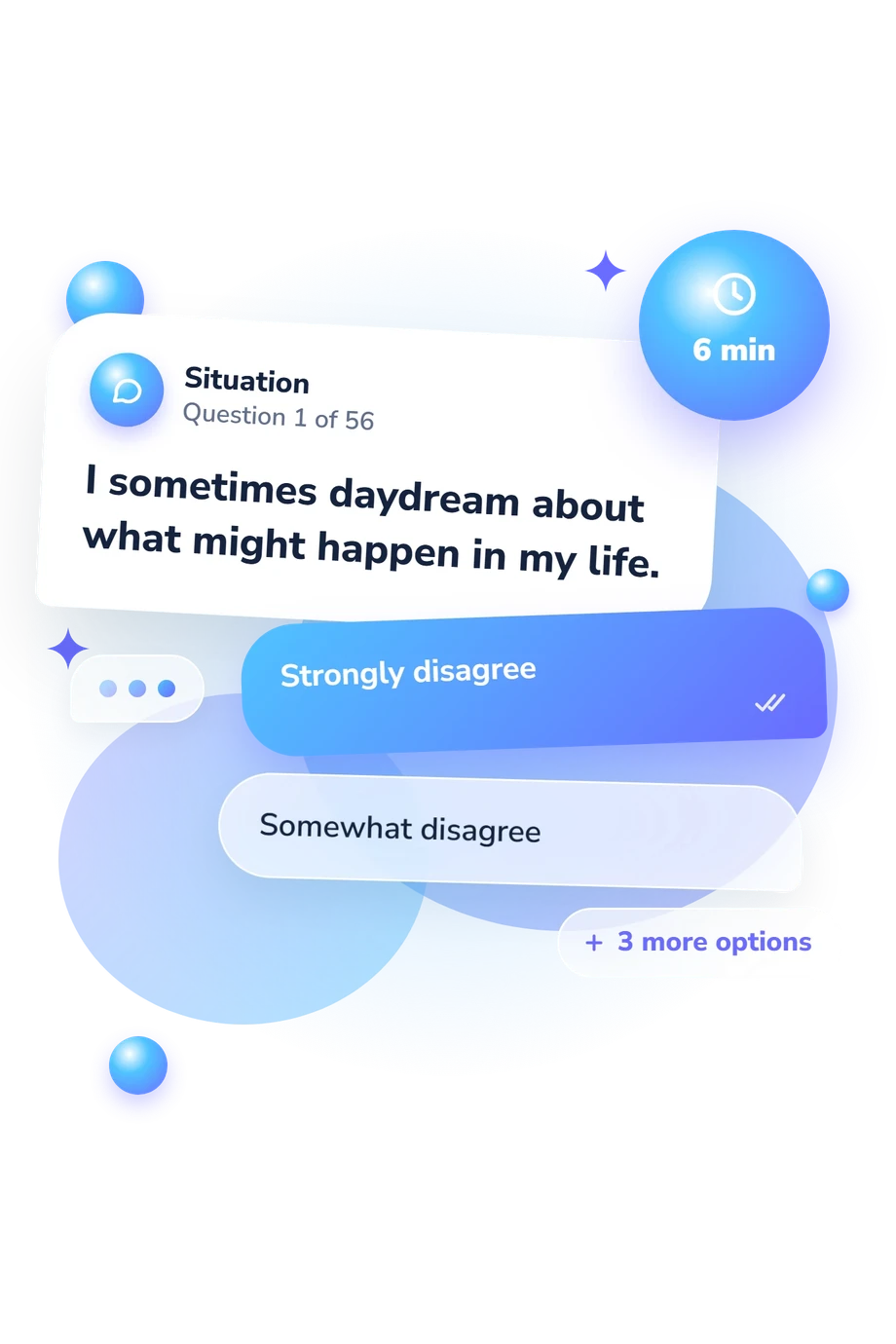
Each item uses a five-point agreement response, from Strongly disagree to Strongly agree, with a middle uncertainty option. The questionnaire reports a separate online score for each dimension; the displayed bands describe low, moderate, or high levels within this questionnaire. They should not be read as universal clinical cutoffs.
Conceptually, this online questionnaire is consistent with the Interpersonal Reactivity Index (Davis, 1983), a multidimensional approach to empathy, but the profile should not be assumed to reproduce every feature of the published instrument. Research on the Dutch version (De Corte et al., 2007) supports examining separate empathic tendencies, while Chrysikou and Thompson (2016) caution that a simple cognitive-versus-affective split may oversimplify the instrument’s structure. This IRI questionnaire is best read as a profile of related tendencies, not a single empathy score.
Because it is self-report, results can shift with current mood, self-awareness, and the wish to appear socially desirable. Consider the pattern alongside real-life behavior and context when drawing conclusions.
- Davis, M. H. (1983). Measuring individual differences in empathy: Evidence for a multidimensional approach. Journal of Personality and Social Psychology, 44(1), 113–126. 10.1037/0022-3514.44.1.113
- De Corte, K., Buysse, A., Verhofstadt, L. L., Roeyers, H., Ponnet, K., & Davis, M. H. (2007). Measuring empathic tendencies: Reliability and validity of the Dutch version of the Interpersonal Reactivity Index. Psychologica Belgica, 47(4), 235–260. 10.5334/pb-47-4-235
- Chrysikou, E. G., & Thompson, W. J. (2016). Assessing cognitive and affective empathy through the Interpersonal Reactivity Index: An argument against a two-factor model. Assessment, 23(6), 769–777. 10.1177/1073191115599055
Updated: