
ADHD Test for Teens

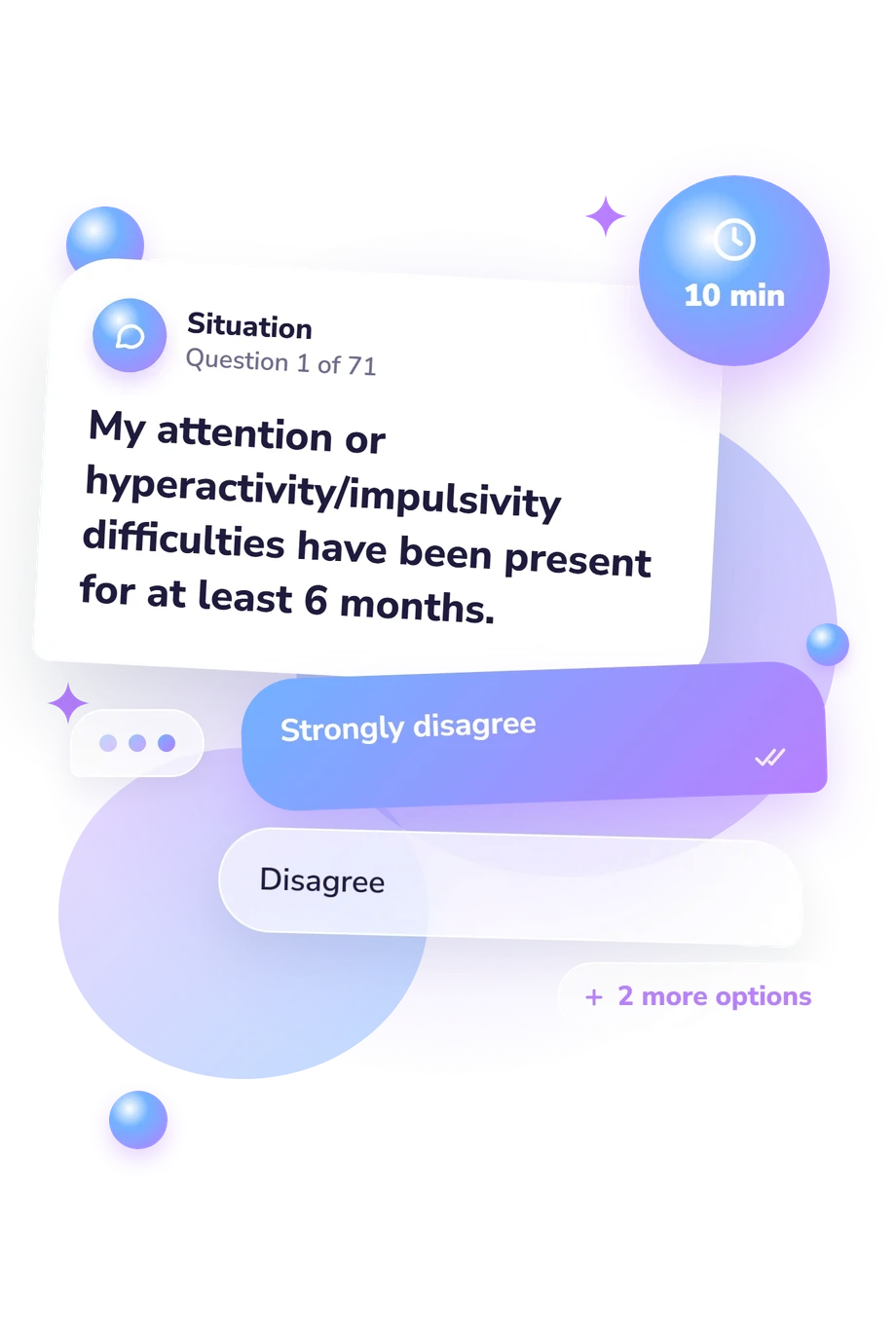
In 10 minutes, get a clearer view of attention, impulsivity, and hyperactivity and how they affect school and daily life. Take this ADHD Test for Teens — a 71-item, teen-focused screen — for a simple summary to share with a parent, teacher, or clinician.
Start Online Test
Questions7110 minutes
Hi! My name is Freudly, i am an AI therapist, I will give you an interpretation of the test after you complete it.
08:30
March 23, 2026
March 23, 2026
Material has been updated
198 views
111 completions
9 likes
Verified by Daniel Hall
Psychologist with 25 years of experience
Share
Scale Explorer

How the Scales are Structured

example score
8/NaN
Cross-Setting & Duration Flags (CS&DF)
This scale reflects how strongly the responses indicate symptoms that persist over time and show up across multiple settings with noticeable impact.
Low flags
Moderate flags
High flags
0NaNLow flags4NaNModerate flags7NaNHigh flags
A score of 8 falls in the High flags range, suggesting the reported symptoms are more likely to be longstanding and present in more than one setting with related impairment indicators.
example score
16/24
Hyperactivity-Impulsivity (HI)
Assesses teen-reported restlessness, fidgeting, excessive activity, interrupting, and acting without thinking.
Low
Moderate
High
07Low815Moderate1624High
A score of 16 falls in the High range, suggesting more frequent or more impairing hyperactive-impulsive symptoms as reported in this quiz.
example score
19/24
Inattention (I)
Measures teen-reported difficulties with attention, focus, follow-through, and distractibility in daily life and schoolwork.
Low
Moderate
High
08Low916Moderate1724High
A score of 19 falls in the High range, suggesting more frequent and/or more impairing inattentive symptoms that may be affecting schoolwork and everyday tasks.
Start Online Test
just completed the test
DATA-BASED USER COHORTS

Who Usually Takes This Test?

Teens Feeling Scattered
44%OF USERS
Teens who struggle to focus, stay organized, or finish schoolwork take it to see if their day-to-day challenges match common ADHD symptom areas.
Parents Seeking Clarity
34%OF USERS
Parents use it when they notice ongoing inattention, impulsivity, or hyperactivity at home and want a clear summary to discuss with school staff or a clinician.
Counselors and Teachers
22%OF USERS
School counselors or teachers share it with students who are having consistent attention or behavior issues across classes to support a next-step conversation.
BASED ON AGGREGATED, ANONYMIZED DATA FROM TENS OF THOUSANDS OF FREUDLY USERS.
Benchmarking

See How You Compare

Once you complete the test, your results are compared with real-world data from people in your country.
Below is a preview of how scores are typically distributed across each scale.
Cross-Setting & Duration Flags (C&DF)
Average
3.2
Normal range
1.64.8
min.
0
max.
10
Majority
This curve shows how scores are typically distributed.
Once you complete the test, your result will appear on the scale so you can see how you compare.
Hyperactivity-Impulsivity (H)
Average
11.9
Normal range
7.616.3
min.
0
max.
24
Majority
This curve shows how scores are typically distributed.
Once you complete the test, your result will appear on the scale so you can see how you compare.
Inattention (I)
Average
12.7
Normal range
8.516.8
min.
0
max.
24
Majority
This curve shows how scores are typically distributed.
Once you complete the test, your result will appear on the scale so you can see how you compare.
Featured On
CLEAR ANSWERS TO COMMON QUESTIONS

Frequently Asked Questions

What does this ADHD Test for Teens measure?
It screens for attention, impulsivity, and hyperactivity symptoms and how they affect school and daily life. Items ask whether difficulties have been present for at least 6 months, were noticeable before age 12, and show up in more than one setting — patterns that align with common clinical criteria for ADHD.
Is this the same as an ADHD test for kids or younger children?
This is a self-report questionnaire designed for teens to answer about their own experience. Younger children typically can't reliably self-report on symptoms in the same way, so ADHD screening for younger kids usually relies on parent- or teacher-completed questionnaires instead. If you're asking about a much younger child, a parent-report tool would be more appropriate than this teen self-report format.
Does my child have ADHD? Can this quiz tell me?
This teen ADHD quiz doesn't provide a diagnosis, but it can clarify whether your teen's attention, impulsivity, and hyperactivity patterns match common ADHD symptom areas across multiple settings. Many parents use the results as a structured starting point for a conversation with a teacher, school counselor, or pediatrician.
How long does it take and how many questions are included?
Estimated completion time is about 10 minutes. The quiz includes 71 questions. Items ask whether symptoms have been present for an extended period and whether they occur in more than one setting, such as home and school, to help summarize patterns rather than isolated situations.
Is this ADD test for teens a diagnostic tool?
No. Results are informational and cannot confirm or rule out ADHD. A qualified professional can evaluate symptoms, impairment, and possible alternative explanations such as anxiety, learning differences, or sleep problems, which can sometimes look similar to ADHD symptoms.
Who typically uses this ADHD quiz for teens?
Teens who struggle to focus, stay organized, or finish schoolwork use it to see if their challenges match common ADHD symptom areas. Parents use it when they notice ongoing inattention, impulsivity, or hyperactivity at home, and school counselors or teachers share it with students having consistent attention or behavior issues across classes.
What should we do with the ADHD Test for Teens results?
Use the summary to guide a discussion with a parent, teacher, school counselor, or clinician. A qualified professional can evaluate symptoms, impairment, and possible alternative explanations, and determine whether a fuller ADHD evaluation is warranted based on the patterns the quiz identifies.
WHAT THE TEST MEASURES
About This Assessment

This measure is designed to support a teen-focused screening of attention, impulsivity, and hyperactivity across school and daily life. The ADHD Test for Teens asks about symptoms inspired by common DSM-5 symptom areas, including how long difficulties have been present and whether they show up in more than one setting, such as home and school. It includes 71 items and typically takes about 10 minutes to complete.

Why Take an ADHD Test for Teens

Struggling to focus in class, forgetting assignments, or feeling restless during long stretches of schoolwork can look a lot like ordinary teenage disorganization from the outside — which is exactly why ADHD in teens is so often missed or dismissed as "just being lazy" or "not trying hard enough." The reality is usually more specific: real, persistent difficulties with attention, impulse control, or activity level that show up consistently across different settings, not just occasionally.

This ADD test for teens gives structure to that distinction. Rather than relying on a vague sense that school "feels harder than it should," it asks specifically whether difficulties have lasted at least six months, whether they were noticeable before age 12, and whether they show up in more than one setting — home, school, sports, or with friends. This specificity matters, since these are the exact patterns clinicians look for when evaluating ADHD, rather than isolated bad days or a single difficult class.

This ADHD quiz for teens is especially useful as a starting point before a conversation with a parent, teacher, or clinician — turning a vague worry into a structured summary that makes that conversation easier and more productive.

What the Assessment Measures

The questionnaire screens for ADHD-related symptom patterns across several dimensions:

  • Symptom persistence and settings — whether attention or hyperactivity/impulsivity difficulties have been present for at least six months, noticeable before age 12, and observed by more than one adult across more than one setting
  • Hyperactivity and impulsivity — restlessness, fidgeting, excessive activity, interrupting others, and acting without thinking
  • Inattention — difficulty sustaining focus, following through on schoolwork, staying organized, and completing tasks
  • Impact on daily life — how these symptoms affect schoolwork, home routines, and relationships with peers and family

Results are informational and summarize patterns rather than isolated situations, helping identify whether symptoms are longstanding and present in more than one setting with related impairment.

Who This Assessment Is For

This ADHD Test for Teens is appropriate for teens who struggle to focus, stay organized, or finish schoolwork and want to see if their day-to-day challenges match common ADHD symptom areas. It is also used by parents who notice ongoing inattention, impulsivity, or hyperactivity at home and want a clear summary to discuss with school staff or a clinician, and by school counselors or teachers who share it with students having consistent attention or behavior issues across classes.

Clinical Validity and Use in Practice

This ADHD test for kids and teens is informational and cannot confirm or rule out ADHD on its own. Results are intended to guide a discussion with a parent, teacher, school counselor, or clinician, who can evaluate symptoms, impairment, and possible alternative explanations. A qualified professional should be involved in any formal evaluation, particularly since attention and behavior difficulties can also stem from anxiety, learning differences, sleep problems, or other factors that a structured clinical assessment can help clarify.

Popular tests
Narcissistic Personality Inventory (NPI)
This self-report measure is used to assess narcissism as a personality trai…
Start Test
Yale-Brown Obsessive Compulsive Scale (Y-BOCS)
This measure is used to rapidly quantify the current severity of obsessive…
Start Test
CRAFFT Screening Test (CRAFFT 2.1)
This brief screening measure is designed to identify potential alcohol and…
Start Test
Patient Health Questionnaire-9 (PHQ-9)
This measure is commonly used to quickly screen for the presence and severi…
Start Test
Maslach Burnout Inventory (MBI)
This self-report measure is used to assess occupational burnout symptoms in…
Start Test
Adolescent Anxiety Questionnaire
This measure is designed to support a brief appraisal of anxiety symptoms a…
Start Test
Emotional Creativity Inventory (ECI)
This self-report measure assesses individual differences in the originality…
Start Test
Horne–Ostberg Morningness–Eveningness Questionnaire (MEQ)
Circadian preferences influence typical patterns of alertness and sleep tim…
Start Test
Ambivalent Sexism Inventory (ASI)
This measure is designed to assess attitudes toward women, including both o…
Start Test
Internalized Misogyny Scale (IMS)
This measure is designed to assess internalized negative beliefs and stereo…
Start Test
Perceived Stress Scale (PSS-10)
This self-report measure assesses the degree to which individuals appraise…
Start Test
Impulsive Behavior Scale (SUPPS-P)
Impulsivity is a multidimensional construct that is often assessed with bri…
Start Test
Clinical Institute Withdrawal Assessment for Alcohol, Revised (CIWA-Ar)
This rating scale is used to rapidly assess the severity of alcohol withdra…
Start Test
Positive and Negative Affect Schedule (PANAS)
This measure provides a brief self-report assessment of current or typical…
Start Test
Light Triad Scale (LTS)
This self-report measure assesses prosocial personality tendencies and orie…
Start Test
Suicidal Ideation Scale
In clinical settings, the Suicidal Ideation Scale is used to structure an i…
Start Test
Body Dysmorphic Disorder Scale (BDD-D)
This brief self-report measure is designed to screen for and quantify distr…
Start Test
Beck Anxiety Inventory (BAI)
This measure is a brief self-report inventory used to screen for anxiety sy…
Start Test
Differential Test of Perfectionism
This instrument is used to screen for perfectionism-related attitudes and t…
Start Test
Locus of Control Scale
This measure assesses generalized expectancies regarding the degree to whic…
Start Test
New Apathy Scale
This brief self-report measure is used to screen for apathy-related symptom…
Start Test
Perth Alexithymia Questionnaire (PAQ)
This measure assesses individual differences in alexithymia, including diff…
Start Test
Social Intelligence Scale
This brief self-report measure is designed to support rapid screening of in…
Start Test
Fear Test
This measure is designed to evaluate individual differences in fear-related…
Start Test
Neuroticism Level Scale
The measure is intended for brief screening of an individual’s propensity t…
Start Test
Aggressiveness Indicators Screening Questionnaire
This screening tool is designed to quickly identify behavioral indicators a…
Start Test
Comments
Leave a Comment