
Memory Test
How the Scales are Structured
Who Usually Takes This Test?
See How You Compare
Below is a preview of how scores are typically distributed across each scale.
Example Questions From the Test
- Strongly disagree
- Disagree
- Agree
- Strongly agree
- Strongly disagree
- Disagree
- Not sure
- Agree
- Strongly disagree
- Disagree
- Not sure
- Agree
Memory Test - Description and methodology of the test
People who want a clearer picture of how they handle information in daily life can use the memory test to examine recall, retention, and mental updating. An online assessment of memory can help readers notice whether names, directions, codes, and interrupted tasks feel easier to manage in some situations than others. The profile is most useful as a structured starting point for self-reflection about everyday strengths and difficulties.
What This Assessment Explores
The questionnaire covers immediate retrieval, retention after a delay, and holding information active while updating or reordering it. Items use situations involving names, directions, codes, visual patterns, planned steps, and interruptions. This immediate-recall portion functions as a short-term memory assessment; delayed items concern accurate retrieval after interference.
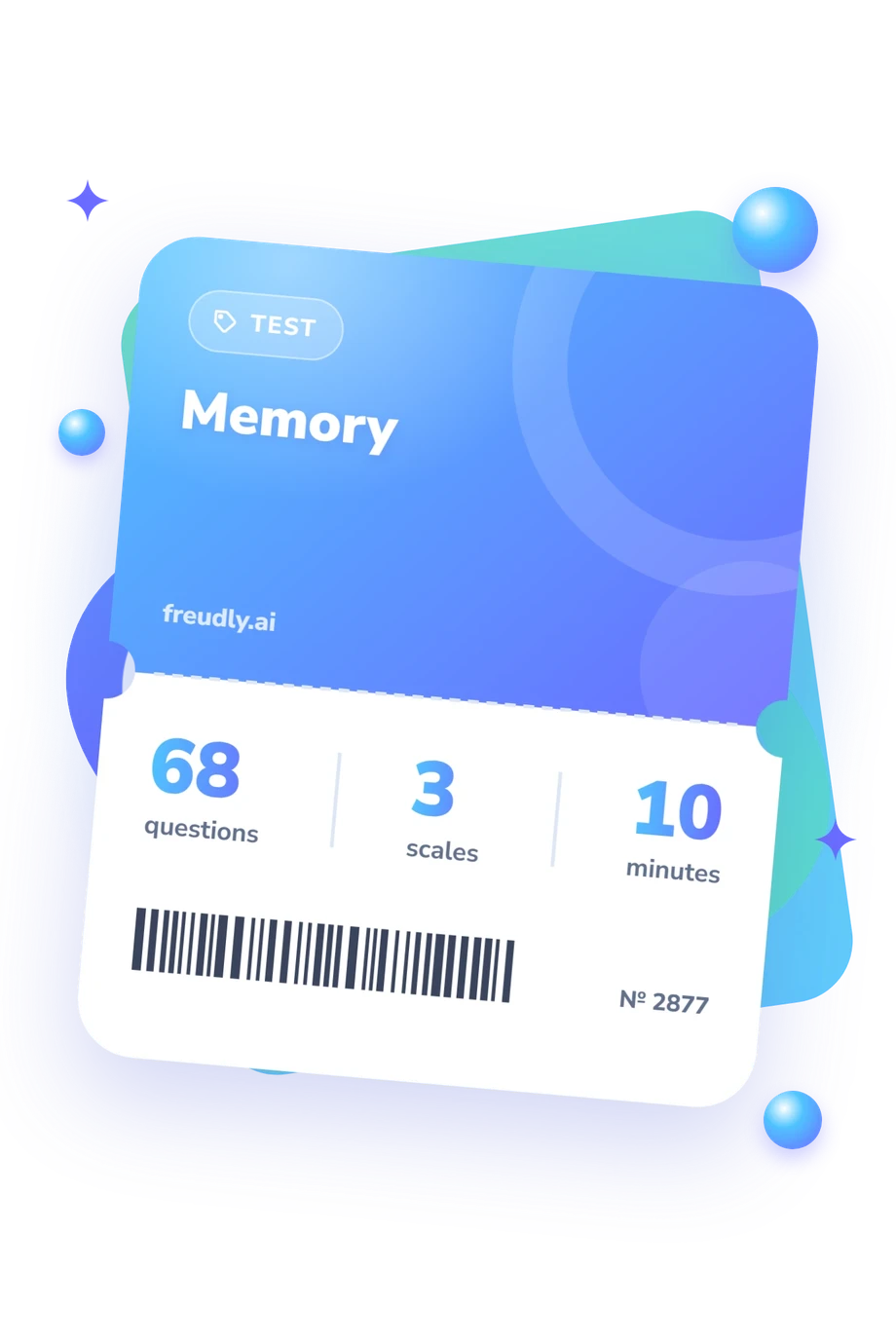
Results compare the processes within one profile, showing where reported recall, later retrieval, or mental updating seems more consistent. The displayed dimensions are:
- Delayed Retention (0-20) shows how well information is retrieved after a delay; Lower retention (0-7), Moderate retention (8-14), and Stronger retention (15-20).
- Short-Term Recall (0-20) shows immediate reproduction with fewer omissions or order errors; Developing (0-8), Typical (9-14), or Strong (15-20).
- Working Memory (0-20) shows how information is held and mentally manipulated under interference; Low (0-7), Moderate (8-14), or High (15-20).
Methodology and Scientific Basis
Items are first-person statements about recall and mental updating. Response choices run from disagreement to agreement; Not sure appears in some examples. This ordered format captures perceived confidence rather than timed laboratory performance and does not show how quickly information is recalled under controlled conditions.
Scoring is presented through three displayed dimensions, not a population ranking or a point-by-point account of answer weights. The working-memory assessment concerns keeping information active while changing, reversing, or tracking it. Attention and distraction can affect how these situations are experienced.
Evidence is conceptual, not a claim that the online questionnaire reproduces a published instrument. It is conceptually consistent with the Memory Functioning Questionnaire (Gilewski et al., 1990), not presented as its adaptation. WMS-IV and Peterson and Peterson’s 1959 study provide relevant comparison points for recall and retention, while Baddeley’s episodic-buffer model offers a compatible account of temporary information integration.
Because responses are self-reported, this is not an assessment of short-term memory loss: stress, fatigue, attention, familiarity, and self-awareness can shape them. Interpret the profile alongside concrete examples and broader assessment.
- Gilewski, M. J., Zelinski, E. M., & Schaie, K. W. (1990). The Memory Functioning Questionnaire for assessment of memory complaints in adulthood and old age. Psychology and Aging, 5(4), 482-490. 10.1037/0882-7974.5.4.482
- Wechsler, D. (2009). Wechsler Memory Scale-Fourth Edition (WMS-IV): Technical and Interpretive Manual. San Antonio, TX: Pearson.
- Baddeley, A. (2000). The episodic buffer: a new component of working memory? Trends in Cognitive Sciences, 4(11), 417-423. 10.1016/S1364-6613(00)01538-2
- Peterson, L. R., & Peterson, M. J. (1959). Short-term retention of individual verbal items. Journal of Experimental Psychology, 58(3), 193-198. 10.1037/h0049234
Updated: