
Relationship Compatibility Test

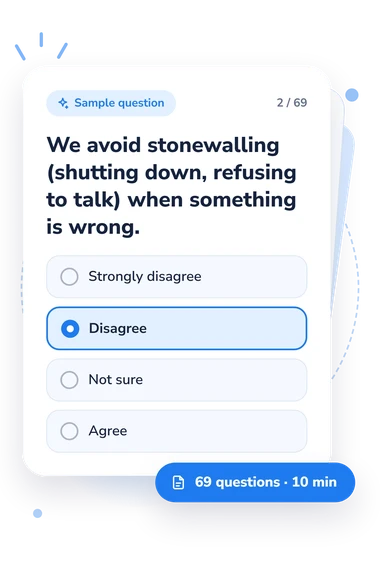
Curious how well you and your partner really match? Take this Relationship Compatibility Test to see your fit across communication, conflict style, emotional needs, values, lifestyle preferences, intimacy expectations, and long-term goals.
Start Online Test
Questions6910 minutes
Hi! My name is Freudly, i am an AI therapist, I will give you an interpretation of the test after you complete it.
08:30
March 25, 2026
March 25, 2026
Material has been updated
99 views
247 completions
8 likes
Verified by Daniel Hall
Psychologist with 25 years of experience
Share
Scale Explorer

How the Scales are Structured

example score
34/40
Communication & Conflict Fit (C&CF)
Measures how effectively partners communicate, manage disagreements, and repair after conflict through skills like listening, clarity, emotional regulation, and compromise.
Needs Work
Mixed Fit
Strong Fit
0NaNNeeds Work20NaNMixed Fit31NaNStrong Fit
A score of 34 suggests a strong communication and conflict fit, with generally constructive discussions and reliable repair after disagreements.
example score
47/100
Overall Compatibility (OC)
Measures overall perceived fit between partners across communication, values, lifestyle, intimacy expectations, and future goals.
Lower alignment
Mixed alignment
Higher alignment
0NaNLower alignment40NaNMixed alignment70NaNHigher alignment
A score of 47 suggests mixed alignment, with some strong matches alongside a few areas that may benefit from clearer discussion and negotiation.
example score
28/40
Values & Future Alignment (V&FA)
Measures how closely you and your partner align on core values and long-term expectations such as commitment, family plans, finances, lifestyle, and life goals.
Misaligned
Partly aligned
Well aligned
0NaNMisaligned20NaNPartly aligned30NaNWell aligned
A score of 28 suggests you share several important priorities but still have a few future-focused areas that may benefit from clearer conversations and planning.
Start Online Test
just completed the test
DATA-BASED USER COHORTS

Who Usually Takes This Test?

Committed couples checking in
41%OF USERS
Partners in a steady relationship take it to spot strengths, compare expectations, and start calmer conversations about daily life and the future.
New couples building trust
34%OF USERS
People early in dating use it to learn each other’s communication style, emotional needs, and deal-breakers before things get more serious.
Couples in a rough patch
25%OF USERS
Partners feeling stuck or arguing more take it to identify likely friction points and get practical prompts for discussing conflict, intimacy, and values.
BASED ON AGGREGATED, ANONYMIZED DATA FROM TENS OF THOUSANDS OF FREUDLY USERS.
Benchmarking

See How You Compare

Once you complete the test, your results are compared with real-world data from people in your country.
Below is a preview of how scores are typically distributed across each scale.
Communication & Conflict Fit (C&CF)
Average
16.8
Normal range
9.624
min.
0
max.
40
Majority
This curve shows how scores are typically distributed.
Once you complete the test, your result will appear on the scale so you can see how you compare.
Overall Compatibility (OC)
Average
67.6
Normal range
5283.2
min.
0
max.
100
Majority
This curve shows how scores are typically distributed.
Once you complete the test, your result will appear on the scale so you can see how you compare.
Values & Future Alignment (V&FA)
Average
29.9
Normal range
23.935.8
min.
0
max.
40
Majority
This curve shows how scores are typically distributed.
Once you complete the test, your result will appear on the scale so you can see how you compare.
Featured On
CLEAR ANSWERS TO COMMON QUESTIONS

Frequently Asked Questions

What does this Relationship Compatibility Test measure?
It measures fit across communication and conflict style, emotional needs and values, lifestyle and intimacy expectations, and long-term goals. Results highlight strengths, likely friction points, and suggested topics for discussion between partners.
Should both partners take this couple compatibility test?
Yes, this is the recommended approach. Best use involves both partners answering independently and then reviewing the comparison together — differences in perception often reveal exactly the topics worth a direct conversation. If only one partner responds, results reflect just that one perspective.
Is this compatibility quiz only for established couples?
No. It's useful for people early in dating who want to learn each other's communication style and potential deal-breakers before things get more serious, as well as for partners in steady relationships or those feeling stuck and arguing more.
How long does it take and how many items are included?
Completion time is about 10 minutes. The quiz includes 69 questions. Select the option that best matches typical behavior or preferences, not rare situations, and if uncertain, choose the response that most often applies.
Can this free compatibility test for couples predict whether we'll stay together?
No. This is a reflective tool to support conversation, not a predictive or diagnostic instrument. It highlights current areas of alignment and friction to help guide discussion, but relationship outcomes depend on ongoing communication and effort, not a single quiz result.
What if we get different results on this compatibility quiz for couples?
Different results between partners are common and genuinely useful information — they point to exactly where perceptions diverge and where a direct conversation would help. Use these differences as a starting point for discussion rather than a sign of incompatibility.
Are we compatible? How should we use our results to find out?
Review your results together, paying particular attention to any flagged friction points and suggested discussion topics. Talking openly about specific areas — like conflict style or long-term goals — tends to be more productive than focusing only on the overall compatibility score.
WHAT THE TEST MEASURES
About This Assessment
Relationship Compatibility Test
relationships
compatibility

This measure summarizes reported fit across communication, conflict style, emotional needs, values, lifestyle preferences, intimacy expectations, and long-term goals. The Relationship Compatibility Test includes 69 questions and typically takes about 10 minutes to complete. Results highlight strengths, likely friction points, and suggested topics for discussion.

Why Take a Relationship Compatibility Test

Whether a relationship is brand new or well established, it's genuinely hard to know from the inside how well you and a partner actually align across the areas that matter most — not just how you feel about each other, but how you communicate, handle conflict, and picture the future. A structured couple compatibility test replaces vague impressions with something concrete: specific areas of strong alignment and specific friction points worth a real conversation.

This relationship compatibility test is designed to be most useful when both partners answer independently before comparing results — differences in perception often reveal exactly the topics that deserve a direct conversation, rather than staying as unspoken assumptions. If only one partner responds, results simply reflect that one perspective, which is still useful but less complete.

This assessment is especially useful for people early in dating who want to learn each other's communication style, emotional needs, and potential deal-breakers before things get more serious, for partners in a steady relationship comparing expectations and starting calmer conversations about daily life and the future, and for couples feeling stuck or arguing more who want to identify likely friction points.

What the Assessment Measures

The quiz explores relationship fit across several core dimensions:

  • Communication and conflict style — how well communication habits and conflict-resolution approaches align between partners
  • Emotional needs and values — alignment on emotional support needs, core values, and what each partner considers important
  • Lifestyle and intimacy expectations — fit across daily lifestyle preferences and expectations around intimacy and closeness
  • Long-term goals — alignment on future plans, commitment, and shared direction

Results summarize reported fit across these areas, highlighting strengths, likely friction points, and suggested topics for discussion between partners.

Who This Assessment Is For

This Relationship Compatibility Test is appropriate for any couple wanting a clearer picture of how they align. It's especially useful for people early in dating who want to learn each other's communication style and potential deal-breakers before things get more serious, for partners in steady relationships comparing expectations, and for couples feeling stuck or arguing more who want practical prompts for discussing conflict, intimacy, and values.

How to Use This Assessment

Best use involves both partners answering independently and then reviewing the comparison together. If only one partner responds, results reflect one perspective. Select the option that best matches typical behavior or preferences, not rare situations, and if uncertain, choose the response that most often applies. This is a reflective tool to support conversation, not a clinical or diagnostic instrument.

Popular tests
Narcissistic Personality Inventory (NPI)
This self-report measure is used to assess narcissism as a personality trai…
Start Test
Yale-Brown Obsessive Compulsive Scale (Y-BOCS)
This measure is used to rapidly quantify the current severity of obsessive…
Start Test
CRAFFT Screening Test (CRAFFT 2.1)
This brief screening measure is designed to identify potential alcohol and…
Start Test
Patient Health Questionnaire-9 (PHQ-9)
This measure is commonly used to quickly screen for the presence and severi…
Start Test
Maslach Burnout Inventory (MBI)
This self-report measure is used to assess occupational burnout symptoms in…
Start Test
Adolescent Anxiety Questionnaire
This measure is designed to support a brief appraisal of anxiety symptoms a…
Start Test
Emotional Creativity Inventory (ECI)
This self-report measure assesses individual differences in the originality…
Start Test
Horne–Ostberg Morningness–Eveningness Questionnaire (MEQ)
Circadian preferences influence typical patterns of alertness and sleep tim…
Start Test
Ambivalent Sexism Inventory (ASI)
This measure is designed to assess attitudes toward women, including both o…
Start Test
Internalized Misogyny Scale (IMS)
This measure is designed to assess internalized negative beliefs and stereo…
Start Test
Perceived Stress Scale (PSS-10)
This self-report measure assesses the degree to which individuals appraise…
Start Test
Impulsive Behavior Scale (SUPPS-P)
Impulsivity is a multidimensional construct that is often assessed with bri…
Start Test
Clinical Institute Withdrawal Assessment for Alcohol, Revised (CIWA-Ar)
This rating scale is used to rapidly assess the severity of alcohol withdra…
Start Test
Positive and Negative Affect Schedule (PANAS)
This measure provides a brief self-report assessment of current or typical…
Start Test
Light Triad Scale (LTS)
This self-report measure assesses prosocial personality tendencies and orie…
Start Test
Suicidal Ideation Scale
In clinical settings, the Suicidal Ideation Scale is used to structure an i…
Start Test
Body Dysmorphic Disorder Scale (BDD-D)
This brief self-report measure is designed to screen for and quantify distr…
Start Test
Beck Anxiety Inventory (BAI)
This measure is a brief self-report inventory used to screen for anxiety sy…
Start Test
Differential Test of Perfectionism
This instrument is used to screen for perfectionism-related attitudes and t…
Start Test
Locus of Control Scale
This measure assesses generalized expectancies regarding the degree to whic…
Start Test
New Apathy Scale
This brief self-report measure is used to screen for apathy-related symptom…
Start Test
Perth Alexithymia Questionnaire (PAQ)
This measure assesses individual differences in alexithymia, including diff…
Start Test
Social Intelligence Scale
This brief self-report measure is designed to support rapid screening of in…
Start Test
Fear Test
This measure is designed to evaluate individual differences in fear-related…
Start Test
Neuroticism Level Scale
The measure is intended for brief screening of an individual’s propensity t…
Start Test
Aggressiveness Indicators Screening Questionnaire
This screening tool is designed to quickly identify behavioral indicators a…
Start Test
Comments
Leave a Comment