
Sigma Test

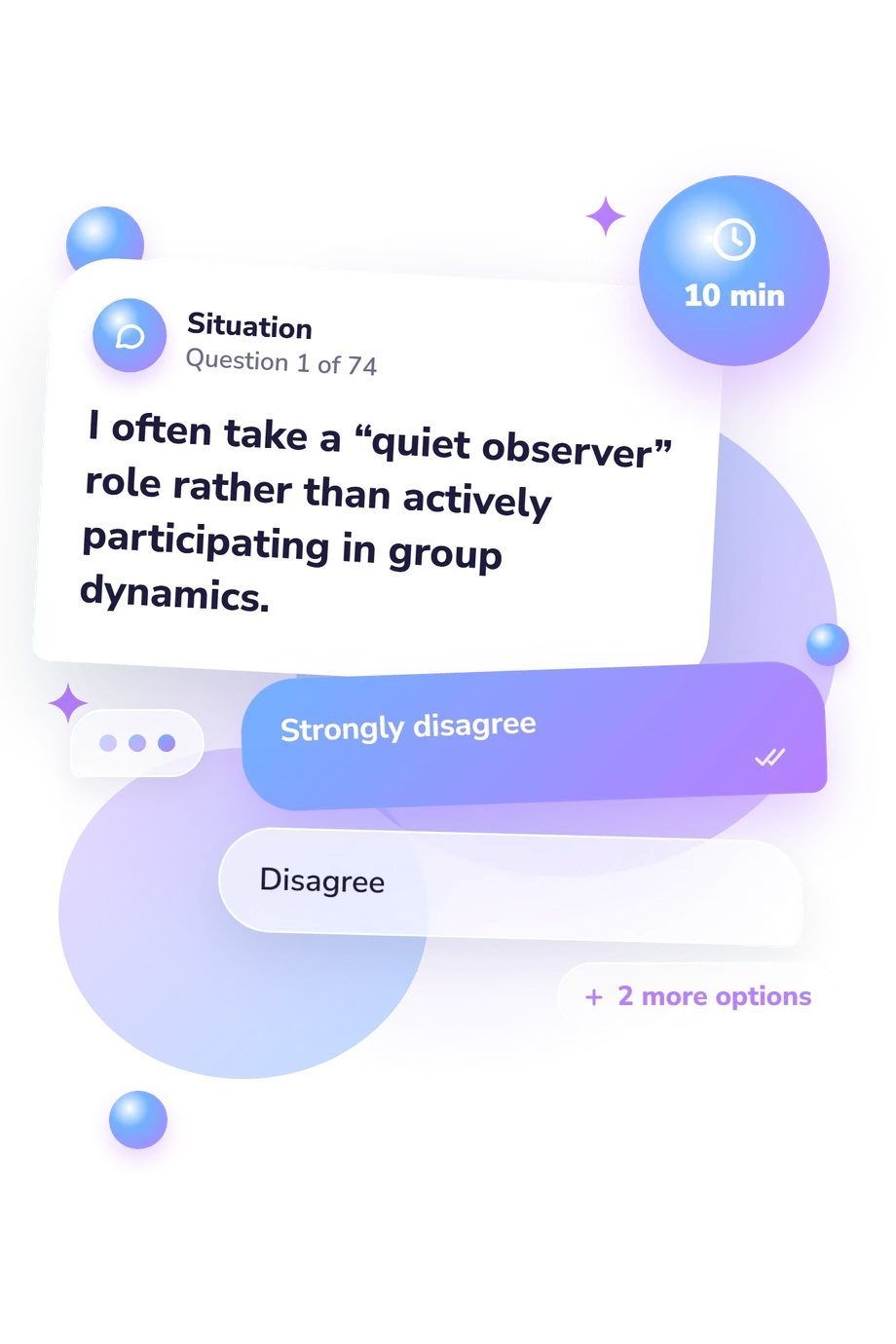
Learn which social archetype fits you best and what drives your style in about 10 minutes. Take this Sigma Test to get a quick profile of strengths, blind spots, and practical tips for better boundaries and social energy.
Start Online Test
Questions7410 minutes
Hi! My name is Freudly, i am an AI therapist, I will give you an interpretation of the test after you complete it.
08:30
March 25, 2026
March 25, 2026
Material has been updated
410 views
337 completions
31 likes
Verified by Daniel Hall
Psychologist with 25 years of experience
Share
Scale Explorer

How the Scales are Structured

example score
9/40
Dominance vs. Cooperation (DvC)
Measures whether your social and leadership style leans more toward assertive dominance or toward cooperative, consensus-focused participation.
Cooperative
Balanced
Dominant
013Cooperative1426Balanced2740Dominant
A score of 9 falls in the Cooperative range, suggesting you tend to prioritize harmony, shared decision-making, and accommodating others over taking charge or competing for control.
example score
20/40
Sigma Orientation (SO)
Measures how strongly you align with the pop-culture “sigma” archetype, emphasizing autonomy, self-direction, and comfort outside hierarchies.
Low sigma orientation
Moderate sigma orientation
High sigma orientation
013Low sigma orientation1426Moderate sigma orientation2740High sigma orientation
A score of 20 indicates a moderate sigma orientation, suggesting a balanced preference for independence while still engaging with group structures when useful.
example score
11/40
Social Energy & Distance (SE&D)
Measures whether social interaction tends to energize you or whether you prefer distance and solitude to recharge.
Socially Energized
Balanced
Socially Detached
0NaNSocially Energized14NaNBalanced27NaNSocially Detached
A score of 11 suggests you generally gain energy from connection and group engagement, with less emphasis on social distance and strict boundaries.
Start Online Test
just completed the test
DATA-BASED USER COHORTS

Who Usually Takes This Test?

Meme-culture personality explorers
41%OF USERS
They’ve seen sigma/alpha/beta talk online and want a fun, low-stakes result to see which label fits their vibe.
Independent, low-social-energy types
34%OF USERS
They relate to doing things solo and keeping strong boundaries, and they want language for their strengths and blind spots.
Self-improvement and mindset seekers
25%OF USERS
They like quick quizzes that turn habits, motivation, and leadership style into practical tips they can try right away.
BASED ON AGGREGATED, ANONYMIZED DATA FROM TENS OF THOUSANDS OF FREUDLY USERS.
Benchmarking

See How You Compare

Once you complete the test, your results are compared with real-world data from people in your country.
Below is a preview of how scores are typically distributed across each scale.
Dominance vs. Cooperation (DvC)
Average
14
Normal range
820
min.
0
max.
40
Majority
This curve shows how scores are typically distributed.
Once you complete the test, your result will appear on the scale so you can see how you compare.
Sigma Orientation (SO)
Average
26.8
Normal range
21.931.8
min.
0
max.
40
Majority
This curve shows how scores are typically distributed.
Once you complete the test, your result will appear on the scale so you can see how you compare.
Social Energy & Distance (SE&D)
Average
19.8
Normal range
13.526.1
min.
0
max.
40
Majority
This curve shows how scores are typically distributed.
Once you complete the test, your result will appear on the scale so you can see how you compare.
Featured On
CLEAR ANSWERS TO COMMON QUESTIONS

Frequently Asked Questions

What does this Sigma Test measure?
It provides a pop-culture archetype result based on responses about independence, motivation, leadership style, boundaries, and social energy, across dominance vs. cooperation, sigma orientation, and social energy and distance.
Am I sigma? Can this quiz tell me?
This am I sigma quiz doesn't provide a scientific label, but it can help you see specifically how strongly your independence, leadership style, and social energy align with the pop-culture sigma archetype, rather than a vague yes-or-no answer.
How long does it take to complete?
Estimated completion time is about 10 minutes. Time may vary based on reading speed and response pace. The quiz includes 74 questions, and all items contribute to the final archetype result.
Is this sigma male test only for men?
While the 'sigma male' term originated in online male-focused discussions, the underlying traits this quiz measures — independence, leadership style, and social energy — apply to anyone curious about where they fall on these dimensions, regardless of gender.
Can the results be used for diagnosis or clinical decisions?
No; results are not a diagnosis and do not assess mental health conditions. For clinical concerns, consult a qualified professional.
Can my Sigma Test result change if I retake it?
Yes. Since the result reflects your current leadership style, independence, and social energy, retaking the quiz after a shift in circumstances or mindset could produce a different archetype result.
How should I use my Sigma Test results?
Use the strengths, blind spots, and practical tips included with your results to reflect on your boundaries and social energy — for example, working on cooperative communication if your style leans strongly dominant, or building in more social connection if your results lean heavily toward solitude.
WHAT THE TEST MEASURES
About This Assessment
Sigma Test
archetypes
independence

Curious whether you fit the "sigma" vibe — or if another social archetype describes you better? This Sigma Personality Test is a pop-culture personality quiz inspired by online discussions about sigma, alpha, beta, and related labels. Answer questions about independence, motivation, leadership style, boundaries, and social energy to get an archetype result plus a short profile of strengths, blind spots, and practical tips.

Why Take a Sigma Test

The sigma archetype became popular online as a way to describe independence and self-direction outside typical social hierarchies — but the label gets used loosely, and it's genuinely useful to see specifically where your own leadership style, social energy, and preference for autonomy actually fall. This am I sigma quiz breaks the concept down into distinct, measurable dimensions rather than a single vague vibe.

This sigma male test is especially useful because it separates leadership style from social energy — someone can lean strongly independent while still being socially energized by others, or the reverse, preferring solitude while still engaging cooperatively in group settings. Seeing these as distinct patterns gives a more specific, personally relevant result than a single sigma-or-not label.

This assessment is especially popular with meme-culture personality explorers who've seen sigma, alpha, and beta talk online and want a fun, low-stakes result, independent and low-social-energy types who relate to doing things solo and want language for their strengths, and self-improvement seekers who like turning habits and leadership style into practical tips.

What the Assessment Measures

The quiz explores your patterns across three core dimensions:

  • Dominance vs. cooperation — whether your social and leadership style leans more toward assertive dominance or toward cooperative, consensus-focused participation
  • Sigma orientation — how strongly you align with the pop-culture "sigma" archetype, emphasizing autonomy, self-direction, and comfort outside hierarchies
  • Social energy and distance — whether social interaction tends to energize you or whether you prefer distance and solitude to recharge

Based on your combined responses, results provide an archetype result plus a brief profile of strengths, blind spots, and practical tips.

Who This Assessment Is For

This Sigma Test is appropriate for anyone curious whether they fit the "sigma" vibe or another social archetype describes them better. It's especially popular with meme-culture personality explorers, independent and low-social-energy types wanting language for their strengths, and self-improvement seekers wanting practical tips.

How to Use This Assessment

Select the option that best matches typical behavior rather than an ideal response. Use first impressions and keep answers consistent across similar items. This is for entertainment and self-reflection only — not a diagnosis or scientific measure.

Popular tests
Narcissistic Personality Inventory (NPI)
This self-report measure is used to assess narcissism as a personality trai…
Start Test
Yale-Brown Obsessive Compulsive Scale (Y-BOCS)
This measure is used to rapidly quantify the current severity of obsessive…
Start Test
CRAFFT Screening Test (CRAFFT 2.1)
This brief screening measure is designed to identify potential alcohol and…
Start Test
Patient Health Questionnaire-9 (PHQ-9)
This measure is commonly used to quickly screen for the presence and severi…
Start Test
Maslach Burnout Inventory (MBI)
This self-report measure is used to assess occupational burnout symptoms in…
Start Test
Adolescent Anxiety Questionnaire
This measure is designed to support a brief appraisal of anxiety symptoms a…
Start Test
Emotional Creativity Inventory (ECI)
This self-report measure assesses individual differences in the originality…
Start Test
Horne–Ostberg Morningness–Eveningness Questionnaire (MEQ)
Circadian preferences influence typical patterns of alertness and sleep tim…
Start Test
Ambivalent Sexism Inventory (ASI)
This measure is designed to assess attitudes toward women, including both o…
Start Test
Internalized Misogyny Scale (IMS)
This measure is designed to assess internalized negative beliefs and stereo…
Start Test
Perceived Stress Scale (PSS-10)
This self-report measure assesses the degree to which individuals appraise…
Start Test
Impulsive Behavior Scale (SUPPS-P)
Impulsivity is a multidimensional construct that is often assessed with bri…
Start Test
Clinical Institute Withdrawal Assessment for Alcohol, Revised (CIWA-Ar)
This rating scale is used to rapidly assess the severity of alcohol withdra…
Start Test
Positive and Negative Affect Schedule (PANAS)
This measure provides a brief self-report assessment of current or typical…
Start Test
Light Triad Scale (LTS)
This self-report measure assesses prosocial personality tendencies and orie…
Start Test
Suicidal Ideation Scale
In clinical settings, the Suicidal Ideation Scale is used to structure an i…
Start Test
Body Dysmorphic Disorder Scale (BDD-D)
This brief self-report measure is designed to screen for and quantify distr…
Start Test
Beck Anxiety Inventory (BAI)
This measure is a brief self-report inventory used to screen for anxiety sy…
Start Test
Differential Test of Perfectionism
This instrument is used to screen for perfectionism-related attitudes and t…
Start Test
Locus of Control Scale
This measure assesses generalized expectancies regarding the degree to whic…
Start Test
New Apathy Scale
This brief self-report measure is used to screen for apathy-related symptom…
Start Test
Perth Alexithymia Questionnaire (PAQ)
This measure assesses individual differences in alexithymia, including diff…
Start Test
Social Intelligence Scale
This brief self-report measure is designed to support rapid screening of in…
Start Test
Fear Test
This measure is designed to evaluate individual differences in fear-related…
Start Test
Neuroticism Level Scale
The measure is intended for brief screening of an individual’s propensity t…
Start Test
Aggressiveness Indicators Screening Questionnaire
This screening tool is designed to quickly identify behavioral indicators a…
Start Test
Comments
Leave a Comment