
Freudly+971 508685814hello@freudly.ai
Freudly
career growth

Career Orientations Questionnaire Test
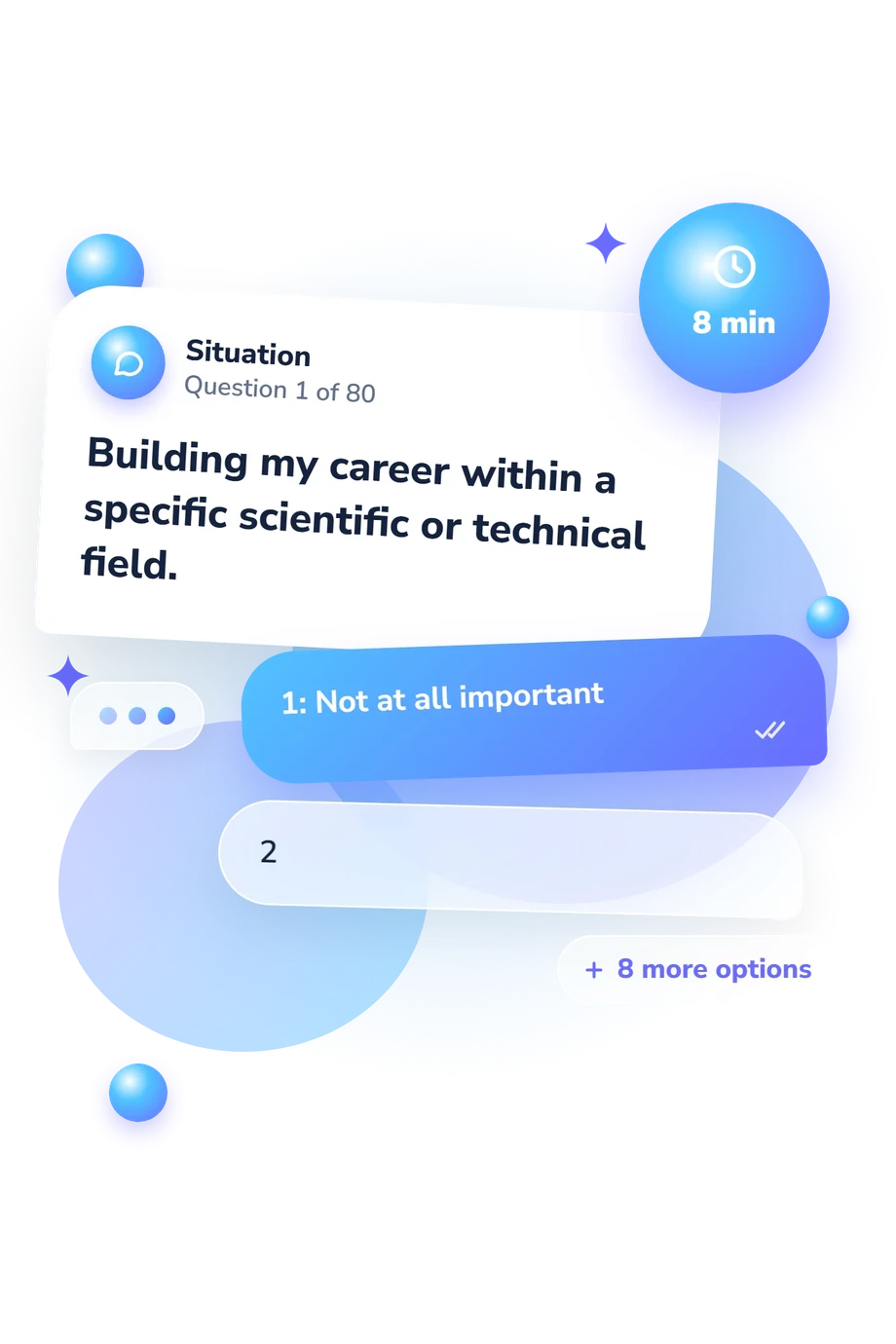
Take the online Career Orientations Questionnaire Test - AI psychologist FreudlyYou can take Career Orientations Questionnaire Testhere. Online version of a simple and accurate psychological test with interpretation.en
Understand what truly drives your career choices in about 8 minutes. Get clear insight to choose roles and workplaces that fit your values and keep you motivated.
Start Online Test
Questions: 408 minutes
08:30
October 2, 2025
October 2, 2025
Material has been updated
October 2, 2025
Material has been published
14,721 view
1,124 completions
921 likes
Verified by Daniel Hall
Psychologist with 25 years of experience
Share
Scale Explorer

How the Scales are Structured

example score
33/50
Lifestyle Integration (LI)
Measures how strongly a person seeks balance and flexibility between work demands and personal life priorities.
Work-first
Balanced
Lifestyle-first
520: Work-first | 2135: Balanced | 3650: Lifestyle-first
A score of 33 falls in the Balanced range, suggesting you value work–life balance and prefer roles that allow flexibility without making either area consistently dominate.
example score
31/50
Service (S)
Measures how strongly a person is motivated by helping others and contributing to socially meaningful goals in their career.
Lower service focus
Moderate service focus
High service focus
519: Lower service focus | 2034: Moderate service focus | 3550: High service focus
A score of 31 indicates a moderate service orientation, suggesting you often value work that benefits others, while also weighing other career priorities.
example score
40/50
Entrepreneurship (E)
Measures the extent to which you are motivated to create new ventures, take calculated risks, and pursue independent initiatives.
Lower
Moderate
High
521: Lower | 2236: Moderate | 3750: High
A score of 40 falls in the High range, suggesting a strong preference for autonomy, initiating new projects, and building something of your own.
example score
30/50
Professional Competence (PC)
Measures the extent to which a person is motivated to build expertise, improve skills, and gain recognition for professional mastery.
Lower focus
Balanced focus
Strong focus
521: Lower focus | 2237: Balanced focus | 3850: Strong focus
A score of 30 suggests a balanced emphasis on developing professional skills and seeking recognition, alongside other career motives.
example score
19/50
Challenge (C)
Measures how strongly a person is motivated by tackling difficult tasks, competition, and novelty as a source of professional satisfaction.
Lower Challenge focus
Moderate Challenge focus
High Challenge focus
521: Lower Challenge focus | 2236: Moderate Challenge focus | 3750: High Challenge focus
A score of 19 suggests that seeking challenge and competition is a less central career driver, with motivation more likely coming from other anchors than constant problem-solving intensity.
example score
33/50
Stability (S)
Measures how strongly a person prioritizes predictable, secure working conditions and long-term stability in their career choices.
Low stability focus
Moderate stability focus
High stability focus
519: Low stability focus | 2034: Moderate stability focus | 3550: High stability focus
A score of 33 suggests a moderate preference for stable and predictable work conditions, valuing security while remaining open to some change.
example score
19/50
Autonomy (A)
Autonomy measures how strongly a person prefers independence and freedom in setting tasks and choosing how to work, with minimal organizational constraints.
Low autonomy need
Moderate autonomy need
High autonomy need
519: Low autonomy need | 2034: Moderate autonomy need | 3550: High autonomy need
A score of 19 suggests a low autonomy need, indicating you may be more comfortable with clear structures and guidance than with fully self-directed work.
example score
16/50
Managerial Competence (MC)
Measures motivation to take managerial responsibility by leading people, integrating efforts, and making key decisions.
Low
Moderate
High
520: Low | 2135: Moderate | 3650: High
A score of 16 falls in the Low range, suggesting management and leadership responsibility are not a primary career driver compared with other motivations.
example score
24/100
Vertical Career Orientation (VCO)
This scale measures how strongly a person is motivated by upward advancement into higher-status managerial roles.
Low
Moderate
High
033: Low | 3466: Moderate | 67100: High
A score of 24 falls in the Low range, suggesting limited emphasis on climbing the corporate ladder or seeking higher-status leadership positions as a primary career driver.
example score
77/100
Horizontal Career Orientation (HCO)
Measures the degree to which a person is motivated by deepening expertise and growing through professional specialization rather than moving up the hierarchy.
Low focus on specialization
Balanced orientation
Strong lateral-career orientation
033: Low focus on specialization | 3466: Balanced orientation | 67100: Strong lateral-career orientation
A score of 77 suggests a strong preference for building a career through developing mastery and specialized skills, with satisfaction coming from expert work and professional growth.
example score
123/150
Orientation Toward Conditions (OTC)
This scale measures how strongly a person prefers career choices that provide stability, security, predictable conditions, and work–life balance.
Low
Moderate
High
1559: Low | 60104: Moderate | 105150: High
A score of 123 indicates a high orientation to conditions, suggesting you are most satisfied in roles with clear expectations, reliable security, and a comfortable, predictable work environment.
Start Online Test
just completed the test
DATA-BASED USER COHORTS

Who Usually Takes This Test?

Career changers and seekers
41%OF USERS
People considering a new role or field take it to understand what truly motivates them and which work environments will fit.
Students and early professionals
34%OF USERS
Students and recent graduates use it to choose a direction, first job, or internship that matches their values and preferred tasks.
Managers and HR specialists
25%OF USERS
Team leads, coaches, and HR professionals take it to better align roles, development plans, and motivation within teams.
BASED ON AGGREGATED, ANONYMIZED DATA FROM TENS OF THOUSANDS OF FREUDLY USERS.
Benchmarking

See How You Compare

Once you complete the test, your results are compared with real-world data from people in your country.
Below is a preview of how scores are typically distributed across each scale.
Integration of Lifestyles (IoL)
Average
18
Normal range
10.225.8
min.
5
max.
50
This curve shows how scores are typically distributed.
Once you complete the test, your result will appear on the scale so you can see how you compare.
Service (S)
Service (S)
Average
24.3
Normal range
18.230.5
min.
5
max.
50
This curve shows how scores are typically distributed.
Once you complete the test, your result will appear on the scale so you can see how you compare.
Entrepreneurship (E)
Average
31
Normal range
23.538.6
min.
5
max.
50
This curve shows how scores are typically distributed.
Once you complete the test, your result will appear on the scale so you can see how you compare.
Professional competence (Pc)
Average
22.6
Normal range
15.729.4
min.
5
max.
50
This curve shows how scores are typically distributed.
Once you complete the test, your result will appear on the scale so you can see how you compare.
Call (C)
Call (C)
Average
28.8
Normal range
21.136.5
min.
5
max.
50
This curve shows how scores are typically distributed.
Once you complete the test, your result will appear on the scale so you can see how you compare.
Stability (S)
Stability (S)
Average
28.4
Normal range
22.734.2
min.
5
max.
50
This curve shows how scores are typically distributed.
Once you complete the test, your result will appear on the scale so you can see how you compare.
Autonomy (A)
Autonomy (A)
Average
23.6
Normal range
15.331.8
min.
5
max.
50
This curve shows how scores are typically distributed.
Once you complete the test, your result will appear on the scale so you can see how you compare.
Org. competence (Oc)
Average
23
Normal range
15.330.8
min.
5
max.
50
This curve shows how scores are typically distributed.
Once you complete the test, your result will appear on the scale so you can see how you compare.
Focus on a vertical career (Foavc)
Average
52.7
Normal range
38.966.5
min.
0
max.
100
This curve shows how scores are typically distributed.
Once you complete the test, your result will appear on the scale so you can see how you compare.
Orientation towards a lateral career (Otalc)
Average
60
Normal range
42.577.4
min.
0
max.
100
This curve shows how scores are typically distributed.
Once you complete the test, your result will appear on the scale so you can see how you compare.
Orientation to Conditions (OtC)
Average
105.6
Normal range
88.6122.5
min.
15
max.
150
This curve shows how scores are typically distributed.
Once you complete the test, your result will appear on the scale so you can see how you compare.
Featured On
SAMPLE QUESTIONS

Example Questions From the Test

    • 1: Not at all important
    • 2
    • 3
    • 4
    • 5
    • 6
    • 7
    • 8
    • 9
    • 10: Extremely important
    • 1: Not at all important
    • 2
    • 3
    • 4
    • 5
    • 6
    • 7
    • 8
    • 9
    • 10: Extremely important
    • 1: Not at all important
    • 2
    • 3
    • 4
    • 5
    • 6
    • 7
    • 8
    • 9
    • 10: Extremely important
WHAT THE TEST MEASURES
About This Assessment
Career Orientations Test

Career Orientations Questionnaire Test - Symptoms and Signs

career growth
pedagogy

This self-report measure is designed to clarify the work-related motives and values that influence occupational preferences and career decision-making. The Career Orientations Questionnaire is commonly used to support career counseling and related guidance by identifying an individual’s dominant career anchors.

The instrument includes 40 items and typically requires about 8 minutes to complete. Items ask respondents to rate statements reflecting themes such as autonomy, security, managerial responsibility, and other value-based drivers of career satisfaction.

Results from the Career Orientations Questionnaire are generally interpreted to summarize relative strengths across key orientation domains, which can inform discussions about person-role fit, job choice, and longer-term career planning. Interpretation should be integrated with other clinical or career assessment information and considered in the context of the respondent’s background and current work circumstances.

Author: Edgar H. Schein
Literature: Schein, E. H. Career anchors: Discovering your real values. Jossey-Bass. 1990.; Greenhaus, J. H., Callanan, G. A., & Godshalk, V. M. Career management. Sage. 2010.; Savickas, M. L. Career construction theory and practice. In S. D. Brown & R. W. Lent (Eds.), Career development and counseling: Putting theory and research to work. Wiley. 2005.
Popular tests
Comments
Leave a Comment