
Freudly+971 508685814hello@freudly.ai
Freudly
impulsivity

Pathological Liar Test
Pathological Liar Test: Am I a Compulsive Liar? - FreudlyPathological Liar Test: Evaluate compulsive lying patterns. Free screening with behavioral analysis. Not diagnostic – seek professional help.en
Understand whether lying feels automatic or hard to control. Take this Pathological Liar Test to get a clear summary of triggers and impacts, plus practical next steps for healthier choices.
Start Online Test
Questions: 7710 minutes
08:30
March 25, 2026
March 25, 2026
Material has been updated
March 25, 2026
Material has been published
3,045 views
503 completions
248 likes
Share
Scale Explorer

How the Scales are Structured

example score
5/30
Compulsion & Control (C&C)
Measures how automatic, impulsive, or difficult to resist lying feels, including how hard it is to stop once it begins.
Low compulsion
Moderate compulsion
High compulsion
010: Low compulsion | 1120: Moderate compulsion | 2130: High compulsion
A score of 5 suggests lying usually feels more voluntary than automatic, with relatively strong perceived control and ability to stop.
example score
26/30
Impact & Consequences (I&C)
Assesses the emotional and relationship costs associated with lying, such as guilt, anxiety about being caught, conflict, and loss of trust.
Low impact
Moderate impact
High impact
010: Low impact | 1120: Moderate impact | 2130: High impact
A score of 26 falls in the High impact range, suggesting lying is linked to substantial guilt/anxiety and noticeable strain on trust and relationships.
example score
35/40
Lying Frequency (LF)
Measures how often you report lying across everyday situations, from small omissions to significant falsehoods.
Low frequency
Moderate frequency
High frequency
013: Low frequency | 1427: Moderate frequency | 2840: High frequency
A score of 35 falls in the High frequency range, suggesting you report lying in many day-to-day situations and that it may feel like a well-established habit.
Start Online Test
just completed the test
DATA-BASED USER COHORTS

Who Usually Takes This Test?

Worried About Habitual Lying
41%OF USERS
People who notice they lie often (even about small things) and want to understand triggers, guilt, and whether it feels hard to stop.
Relationship Trust Repair
34%OF USERS
People dealing with conflict after being caught in lies who want clarity on patterns, consequences, and steps to rebuild honesty.
Image and Anxiety Managers
25%OF USERS
People who lie to avoid embarrassment, rejection, or punishment and want to see how fear, self-esteem, and impulse control play a role.
BASED ON AGGREGATED, ANONYMIZED DATA FROM TENS OF THOUSANDS OF FREUDLY USERS.
Benchmarking

See How You Compare

Once you complete the test, your results are compared with real-world data from people in your country.
Below is a preview of how scores are typically distributed across each scale.
Compulsion & Control (C&C)
Average
21.6
Normal range
1726.3
min.
0
max.
30
This curve shows how scores are typically distributed.
Once you complete the test, your result will appear on the scale so you can see how you compare.
Impact & Consequences (I&C)
Average
19.5
Normal range
14.624.4
min.
0
max.
30
This curve shows how scores are typically distributed.
Once you complete the test, your result will appear on the scale so you can see how you compare.
Lying Frequency (LF)
Average
27.6
Normal range
20.235
min.
0
max.
40
This curve shows how scores are typically distributed.
Once you complete the test, your result will appear on the scale so you can see how you compare.
Featured On
SAMPLE QUESTIONS

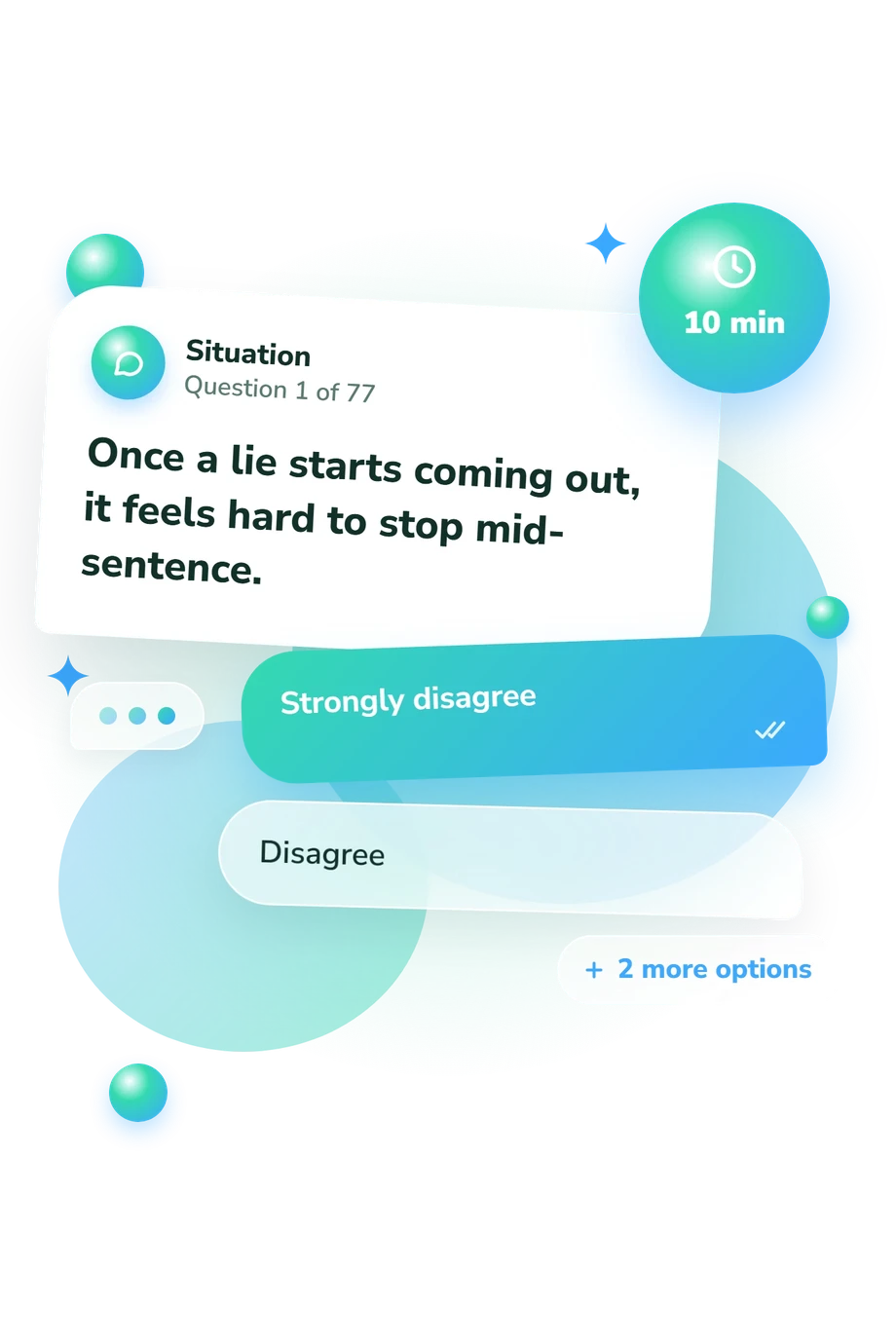
Example Questions From the Test

    • Strongly disagree
    • Disagree
    • Not sure
    • Agree
    • Strongly disagree
    • Disagree
    • Not sure
    • Agree
    • Strongly disagree
    • Disagree
    • Not sure
    • Agree
WHAT THE TEST MEASURES
About This Assessment
Pathological Liar Test
impulsivity

Wondering if your lying feels automatic or hard to control? This Pathological Liar Test is a self-reflection quiz that looks at common patterns linked to frequent or compulsive lying — such as impulse control, fear of consequences, image management, and relationship impact. You'll answer questions about how often you lie, what triggers it, and how you feel afterward, then get an easy-to-read summary and practical next steps.

Why Take a Pathological Liar Test

Most people lie occasionally without it feeling like a pattern worth examining, but for some, lying starts to feel automatic — happening before there's time to consciously decide, or continuing even when the risk of getting caught feels higher than the payoff. A structured compulsive liar test replaces vague self-judgment ("I'm just a liar") with something more specific: how much control actually feels available in the moment, how often it's happening across everyday situations, and what the real emotional and relational cost has been.

This am I a pathological liar test is especially useful because it separates frequency from compulsion and from impact — someone might lie often but feel they could stop easily, or lie rarely but feel intensely out of control when it happens, or lie in ways that carry serious guilt and relationship damage regardless of frequency. Seeing these as distinct patterns gives a much clearer, less self-judgmental picture of what's actually happening.

This assessment is especially useful for people who notice they lie often, even about small things, and want to understand triggers and whether it feels hard to stop, those dealing with relationship conflict after being caught in lies who want clarity on patterns and steps to rebuild honesty, and people who lie to avoid embarrassment, rejection, or punishment and want to see how fear and self-esteem play a role.

What the Assessment Measures

The quiz explores your patterns across three core dimensions:

  • Compulsion and control — how automatic, impulsive, or difficult to resist lying feels, including how hard it is to stop once it begins
  • Impact and consequences — the emotional and relationship costs associated with lying, such as guilt, anxiety about being caught, conflict, and loss of trust
  • Lying frequency — how often you report lying across everyday situations, from small omissions to significant falsehoods

Results provide a brief summary across these areas along with suggested next steps for reflection, rather than a single label.

Who This Assessment Is For

This Pathological Liar Test is appropriate for anyone wondering if their lying feels automatic or hard to control. It's especially useful for people who notice frequent lying and want to understand what's driving it, those working to rebuild trust after being caught in lies, and people who lie primarily to manage image, embarrassment, or fear of rejection.

How to Use This Assessment

This is for insight only, not a diagnosis, and does not diagnose any mental health condition — a qualified professional is required for diagnosis and treatment planning. Answer based on typical behavior over the recent past, not a single unusual event. Consider discussing concerns with a qualified mental health professional, especially if lying affects safety, work, or close relationships. Seek urgent help if there is risk of self-harm, harm to others, or inability to stay safe.

Popular tests
Comments
Leave a Comment