
Expert Assessment of Sociocultural Adaptation Test
How the Scales are Structured
Who Usually Takes This Test?
See How You Compare
Below is a preview of how scores are typically distributed across each scale.
Example Questions From the Test
- 1: Never
- 2: From time to time
- 3: Fairly often
- 4: Almost all of the time
- 1: Never
- 2: From time to time
- 3: Fairly often
- 4: Almost all of the time
- 1: Never
- 2: From time to time
- 3: Quite often
- 4: Almost all of the time
Expert Assessment of Sociocultural Adaptation Test - Description and methodology of the test
Evaluators who rate a student or another individual in a new college, town, or cultural setting can use this assessment to organize observations of that person’s academic, sociocultural, and psychological adaptation. The Expert Assessment of Sociocultural Adaptation Test structures a view of daily functioning, relationships, emotional state, and study habits rather than relying on an impression. This sociocultural adaptation assessment can show which areas appear stronger or need attention.
What This Assessment Explores
Adjustment is multidimensional. Items cover study habits, participation, peer contact, local navigation, emotional tone, conduct, physical complaints, and communication. For an evaluator, academic adaptation is considered alongside social and emotional adjustment. The profile separates three areas:
- Psychological (0-100) reflects emotional state, stress level, and internal readiness for living and studying in a new sociocultural environment; Low 0-41, Moderate 42-60, High 61-100.
- Sociocultural (0-100) measures adoption of new norms, values, and behavioral rules plus effective interaction with the surrounding community; Low 0-40, Moderate 41-59, High 60-100.
- Academic (0-100) reflects integration into education and the ability to meet academic demands in a new sociocultural environment; Low 0-41, Moderate 42-60, High 61-100.
Together, the profile shows stronger adjustment and areas needing attention.
Methodology and Evidence Base
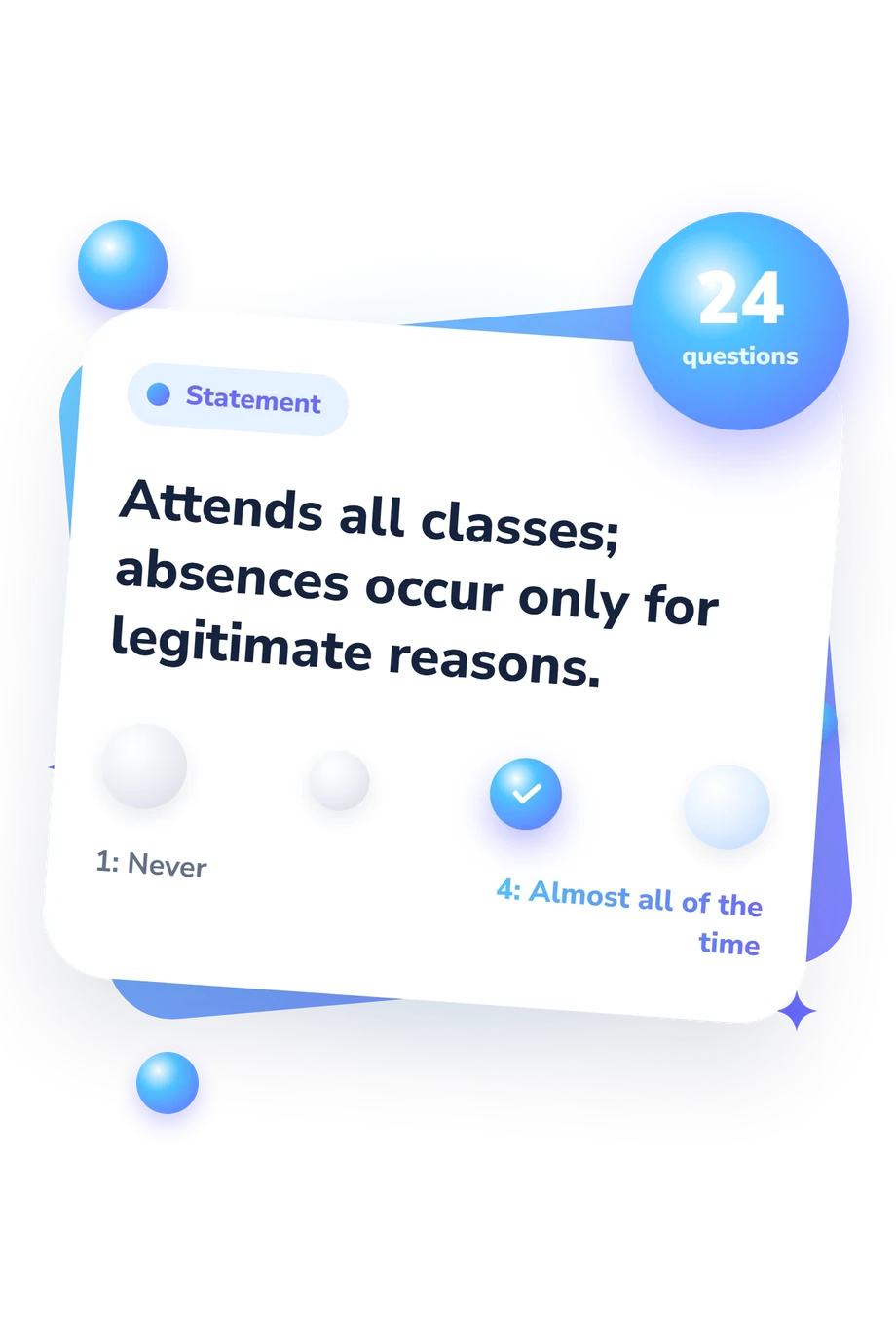
Third-person statements cover academic engagement, social and cultural participation, and psychological indicators; an evaluator rates how often each describes the assessed person. Themes include attendance, effort, help-seeking, friendship, group work, local orientation, conduct, emotional tone, tension, aggression, physical complaints, and communication. Four ordered options-Never, From time to time, Fairly or Quite often, and Almost all of the time-rate frequency rather than agreement.
Responses become three scale scores, but no standardized point-by-point formula is stated; an individual answer’s contribution cannot be inferred.
Sheng, Dai, and Lei (2022) offer the closest conceptual match, linking academic, psychological, and sociocultural adaptation with friendship; this questionnaire is not an adaptation of their measure. Berry (1997) supplies the acculturation-and-adaptation framework. Ward, Bochner, and Furnham (2001) distinguish psychological from sociocultural adjustment, and Ward and Kennedy (1999) support a separate sociocultural domain.
Overall, this observer-rated adaptation questionnaire is best read as a structured rating snapshot. No standardized norms or reliability information are stated for this online version, so displayed bands should not be interpreted clinically without supporting evidence; the evaluator’s knowledge, perspective, and interpretation may influence ratings.
- Sheng, L., Dai, J., & Lei, J. (2022). The impacts of academic adaptation on psychological and sociocultural adaptation among international students in China: The moderating role of friendship. International Journal of Intercultural Relations, 89, 79-89. 10.1016/j.ijintrel.2022.06.001
- Ward, C., Bochner, S., & Furnham, A. (2001). The Psychology of Culture Shock. Routledge.
- Berry, J. W. (1997). Immigration, Acculturation, and Adaptation. Applied Psychology: An International Review, 46(1), 5-34. 10.1111/j.1464-0597.1997.tb01087.x
- Ward, C., & Kennedy, A. (1999). The measurement of sociocultural adaptation. International Journal of Intercultural Relations, 23(4), 659-677. 10.1016/S0147-1767(99)00014-0
Updated: