
Am I Toxic Quiz
How the Scales are Structured
Who Usually Takes This Test?
See How You Compare
Below is a preview of how scores are typically distributed across each scale.
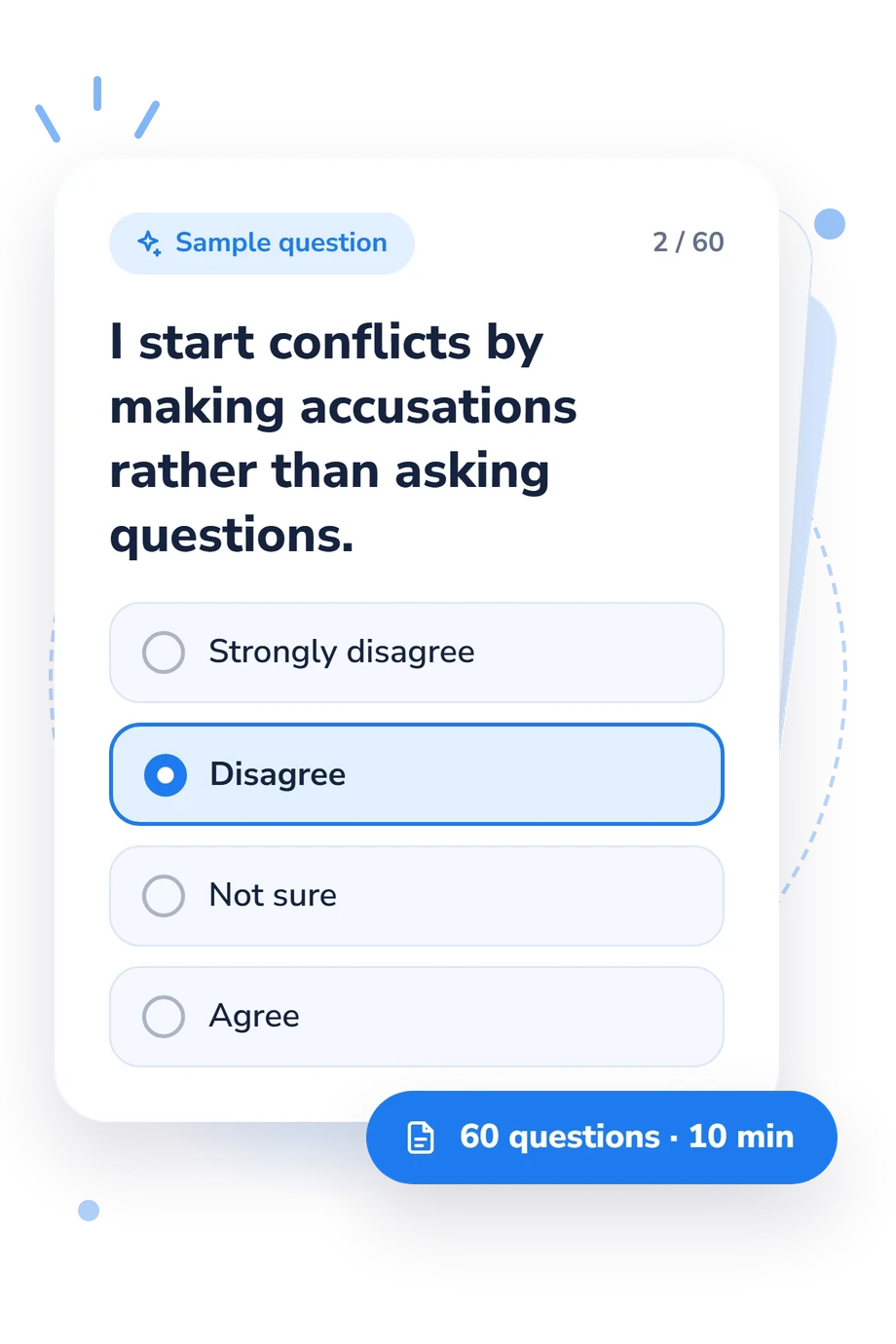
Example Questions From the Test
- Strongly disagree
- Disagree
- Not sure
- Agree
- Strongly disagree
- Disagree
- Not sure
- Agree
- Strongly disagree
- Disagree
- Not sure
- Agree
Am I Toxic Quiz - Description and methodology of the test
For readers who want to understand how their behavior affects close relationships, the Am I Toxic Quiz organizes responses around accountability, boundaries, and harmful interaction patterns, showing where strengths and recurring difficulties cluster. This toxic test assesses potentially harmful interpersonal habits through questions about responsibility, respect, and conflict behavior. Its resulting dimensions allow comparison across conflicts and relationships.
What This Assessment Explores
The questionnaire asks whether someone can accept limits, state needs directly, respond to criticism, and repair harm without shifting blame. It also covers control, guilt-tripping, silent treatment, jealousy, retaliation, harsh criticism, and minimizing feelings. The questionnaire serves as a toxic person test by examining behaviors that can make close relationships toxic, showing whether difficulties cluster around repair, respect for autonomy, or broader habits across relationships and conflicts.
The three result dimensions are:
- Accountability & Repair (0-20) measures responsibility, effective apology, and follow-through; higher scores indicate stronger repair. Low repair: 0-7; Developing repair: 8-14; Strong repair: 15-20.
- Boundaries & Respect (0-20) measures clear limits and respect for autonomy; higher scores indicate healthier respect. Boundary Strain: 0-9; Mixed Consistency: 10-14; Healthy Boundaries: 15-20.
- Toxic Pattern Intensity (0-40) measures frequency and strength of harmful habits; higher scores indicate greater intensity. Low: 0-13; Moderate: 14-26; High: 27-40.
Methodology and Scientific Basis
Each item is a statement, and the respondent chooses Strongly disagree, Disagree, Not sure, or Agree. This self-report format does not observe conduct or verify another person's account. Responses combine into the displayed dimensions, but point allocation, reverse-keying, and the item-to-scale map are not documented, so no extra scoring rule should be inferred.
The closest conceptual anchor is the Multidimensional Measure of Emotional Abuse (Murphy & Hoover, 1999), a multifactorial approach relevant to control, punishment, belittling, and emotional pressure. This questionnaire is conceptually consistent with that work, not an adaptation. Its focus on autonomy and power also overlaps with PICS (Neilands et al., 2019), while conflict behaviors are comparable with CTS2 (Straus et al., 1996).
The questionnaire is an online self-report tool without established standardization or population norms. Current conflict, self-awareness, defensiveness, and impression management may affect responses, so the displayed bands describe the pattern captured by this questionnaire rather than universal thresholds. The result from this toxic trait test can identify specific toxic traits or habits to examine, giving the reader concrete behaviors to change.
- Christopher M. Murphy and Sharon A. Hoover. (1999). Measuring Emotional Abuse in Dating Relationships as a Multifactorial Construct. Violence and Victims, 14(1), 39-53. 10.1891/0886-6708.14.1.39
- Torsten B. Neilands, Shari L. Dworkin, Deepalika Chakravarty, Chadwick K. Campbell, Patrick A. Wilson, Anu Manchikanti Gomez, Kirk K. Grisham, and Colleen C. Hoff. (2019). Development and Validation of the Power Imbalance in Couples Scale (PICS). Archives of Sexual Behavior, 48(3), 763-779. 10.1007/s10508-018-1190-y
- Murray A. Straus, Sherry L. Hamby, Sue Boney-McCoy, and David B. Sugarman. (1996). The Revised Conflict Tactics Scales (CTS2): Development and Preliminary Psychometric Data. Journal of Family Issues, 17(3), 283-316. 10.1177/019251396017003001
Updated: