
Expert Assessment of a Child's School Adjustment Test
How the Scales are Structured
Who Usually Takes This Test?
See How You Compare
Below is a preview of how scores are typically distributed across each scale.
Example Questions From the Test
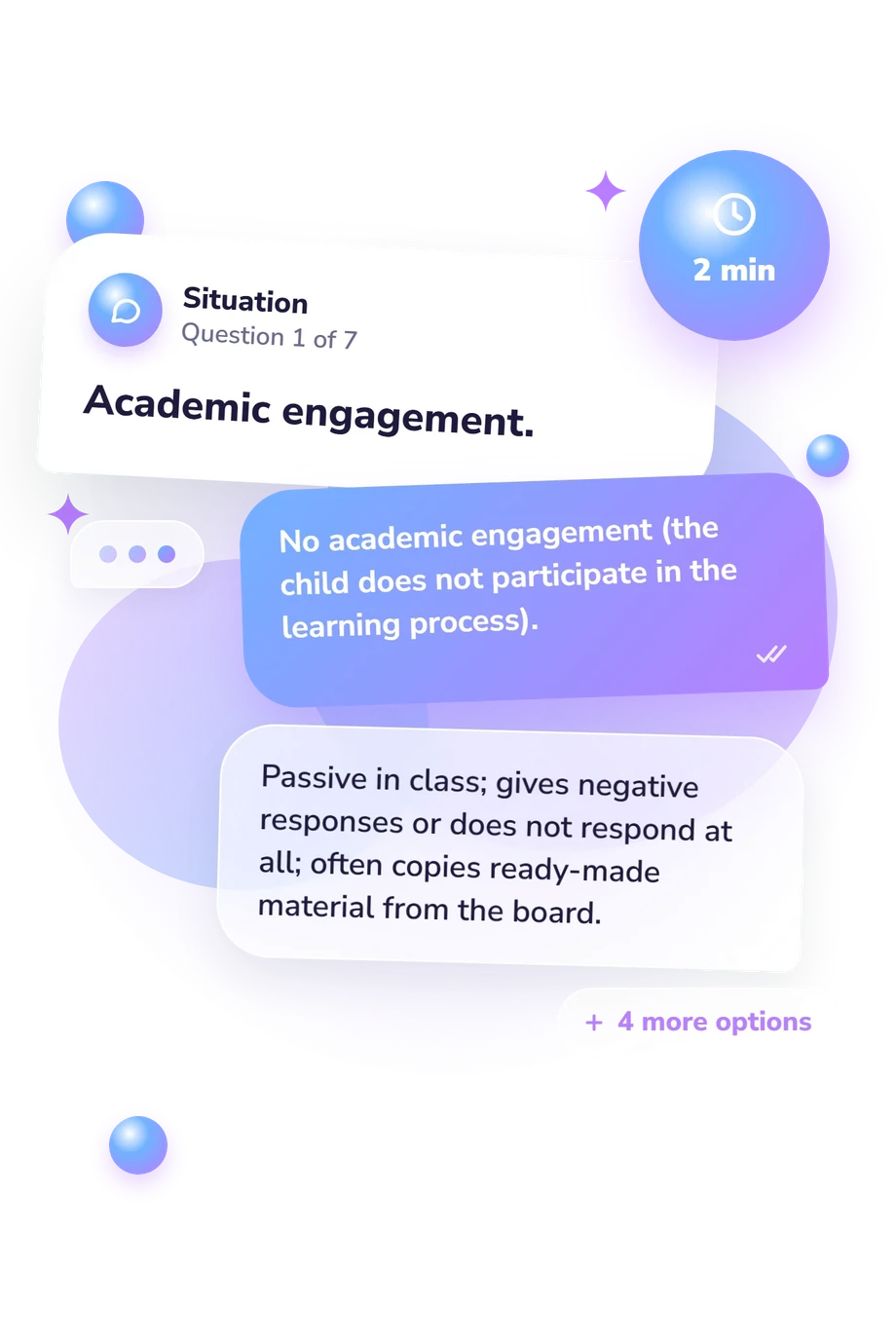
- No academic engagement (the child does not participate in the learning process).
- Passive in class; gives negative responses or does not respond at all; often copies ready-made material from the board.
- Academic engagement in class is short-lived; often distracted and does not hear the question.
- Rarely raises a hand but answers correctly.
- Works in class; correct and incorrect answers alternate.
- Actively participates in class; often raises a hand and answers correctly.
- Poor mastery of the curriculum across all subjects; major errors and many of them (low achievement in all subjects; average grade below 3.3).
- Frequent errors; careless work; many corrections and cross-outs (inconsistent grades; average grade 3.5 or below).
- Poor mastery of the material in one core subject; numerous errors (average grade in that subject 3.5 or below).
- Occasional errors involving omitted letters or letter substitutions (average grade 3.9–3.6).
- Minor blemishes; isolated errors (average grade 4.5–4.0).
- Correct, error-free completion of school assignments (average grade 5.0–4.6).
- Does not follow the teacher’s instructions; spends most of the lesson on unrelated activities.
- Partially follows the teacher’s instructions; is distracted by other activities, fidgets, or talks continuously.
- Stiff or constrained posture and movements are often observed; responses appear tense.
- Occasionally turns around and exchanges brief remarks with classmates.
- Follows the teacher’s instructions, but sometimes becomes briefly distracted from the lesson.
- Sits calmly and conscientiously follows all of the teacher’s instructions.
Expert Assessment of a Child's School Adjustment Test - Description and methodology of the test
For adults seeking a structured view of how a child is managing school life, the Expert Assessment of a Child's School Adjustment Test organizes observations into a practical profile. As a school adjustment assessment for children, it shows whether concern is concentrated in emotional well-being, relationships, behavior, learning, or overall adaptation. The pattern can guide discussion and targeted encouragement.
What This Assessment Measures
School adjustment spans emotional, social, behavioral, and academic functioning. Across its items, this child school adjustment test covers emotions, teacher relations, peers, conduct, learning, and engagement, helping adults locate support needs.
These scales and bands define the profile:
- Emotional Well-Being (0-5) measures emotional tone at school: Low 0-1, Moderate 2-3, High 4-5; Attitude Toward the Teacher (0-5) measures teacher relations: Tension/Conflict 0-1, Generally Neutral 2-3, Trust/Respect 4-5.
- Relationships With Classmates (0-5) measures peer socialization: Low 0-2, Moderate 3-4, High 5-5; Behavior During Breaks (0-5) measures break-time adjustment: Needs support 0-2, Developing 3-4, Well-adapted 5-5.
- Classroom Behavior (0-5) reads lesson conduct: Needs support 0-1, Generally appropriate 2-3, Well-adjusted 4-5; Knowledge Acquisition (0-5) measures mastery: Low 0-1, Moderate 2-3, High 4-5; Academic Engagement (0-5) measures participation: Low activity 0-1, Moderate activity 2-3, High activity 4-5; Socio-Psychological Adjustment Level (0-35) measures adaptation: Low adaptation 0-14, Moderate adaptation 15-21, High adaptation 22-35.
Methodology and Evidence Base
Each question presents six ordered descriptions, moving from difficulty to stronger functioning. The adult selects the description matching the child’s usual behavior, so the method depends on observation and judgment rather than a performance task. Results show domain scores and one combined level; bands describe levels within this questionnaire, not universal thresholds.
Expert Assessment of School Adjustment (Chirkov et al., 1993) supplies the closest conceptual reference for this expert-observation format. This online school adjustment evaluation is consistent with that expert-observation logic but should not be treated as a standardized reproduction of the published work. Antonova and Kostin (2023) add context for school adaptation demands, but their study does not validate this questionnaire.
Interpretation should consider age, classroom setting, recent transitions, and the observer’s familiarity with the child. Expectations, selective attention, and current stress can influence ratings. A low band identifies an area for inquiry, not its cause; the assessment is not a diagnosis and cannot explain a difficulty alone.
- Chirkov, V. I., Sokolova, O. L., & Sorokina, O. V. Schemes of Expert Assessment of a Child's School Adjustment. Yaroslavl: Psychodiagnostics Research and Production Center, 1993.
- Antonova, I. D., & Kostin, I. A. (2023). Features of School Adaptation of Pupils with Autism Spectrum Disorder in the First Year of Study. Clinical Psychology and Special Education, 12(3), 78-97. 10.17759/cpse.2023120304
Updated: