
NBA Team Picker Quiz
How the Scales are Structured
Who Usually Takes This Test?
See How You Compare
Below is a preview of how scores are typically distributed across each scale.
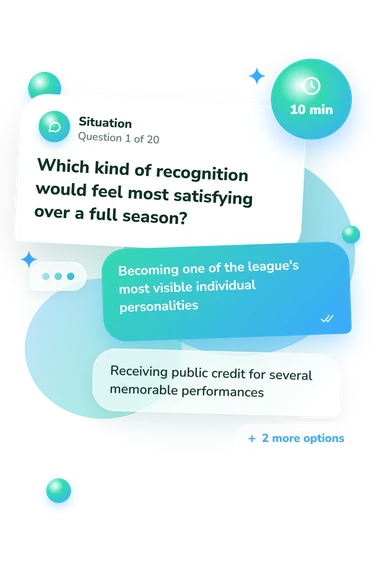
Example Questions From the Test
- Becoming one of the league's most visible individual personalities
- Receiving public credit for several memorable performances
- Earning a larger role through steady, technically sound play
- Quietly becoming the teammate the whole system can rely on
- A protected role that allows me to settle in without constant evaluation
- A stable rotation place based mainly on skills I have already demonstrated
- A competitive role where consistent effort can expand my responsibilities
- An unforgiving tryout where preparation and resilience can overturn other people's doubts
- My willingness to develop patiently outside the main spotlight
- My consistency when given a narrow, clearly defined assignment
- My ability to support prominent teammates without disappearing
- My composure and presence when the moment feels larger than life
NBA Team Picker Quiz - Description and methodology of the test
Readers choosing a first franchise, or reconsidering an old allegiance, can use this assessment to connect personal preferences with recognizable basketball cultures. The NBA Team Picker Quiz helps you decide whether tradition, visibility, creative freedom, demanding standards, or patient development feels most engaging. It also works as a what NBA team should I support quiz when several franchises seem appealing.
What the Test Measures
Questions cover recognition, roles, visibility, defense, recovery, rivalry, and improvisation, revealing which basketball environments feel motivating. Used as a what NBA team am I quiz, it maps those preferences to franchise affinities. It focuses on cultural fit rather than existing loyalty. A favorite NBA team quiz can name a choice; this one explains its appeal. These profiles show the result dimensions:
- Boston Celtics (0-12) reflects history and rivalry: Fresh-page preference (0-4); Tradition-aware fit (5-8); Banner-minded affinity (9-12).
- Golden State Warriors (0-12) reflects structure and creativity: Set-play preference (0-4); Flexible creator (5-8); Free-flowing affinity (9-12).
- Los Angeles Lakers (0-12) reflects visibility: Low-key fit (0-4); Stage-ready blend (5-8); Bright-lights affinity (9-12).
- Miami Heat (0-12) reflects intensity: Sustainable-rhythm fit (0-4); Competitive blend (5-8); Heat-culture affinity (9-12).
- San Antonio Spurs (0-12) reflects development: Accelerated path (0-4); Structured blend (5-8); Development-first affinity (9-12).
Methodology and Evidence Base
Each item presents a basketball situation with four response options. Choices contrast structure, visibility, improvisation, accountability, intensity, and patient development. Select the response closest to your instinct, not the answer that sounds most admirable. No answer is inherently better; each choice records a preference within this questionnaire.
Scoring compares response patterns across the five affinities. The highest team score is the strongest match, while teams within one point form a blended result. As a which NBA team should I support quiz, it explains the culture behind a recommendation rather than naming a team without context.
The design is conceptually consistent with the Sport Team Personality Scale (Stadler Blank et al., 2018), which treats teams as recognizable personalities beyond winning. Tsiotsou (2012) supports a multidimensional view of sport-team personality, and Wann and Branscombe (1993) add context on identification with a team. This questionnaire is not an adaptation or validation of those instruments; it applies related concepts to an original team-fit format.
Read the result as a relative preference profile. Self-report can reflect current interests, recent experiences, mood, or self-presentation, and the scoring is not normed for clinical or population-level comparison.
- Stadler Blank, Ashley, Joerg Koenigstorfer, and Hans Baumgartner. (2018). Sport team personality: It’s not all about winning! Sport Management Review, 21(2), 114-132. 10.1016/j.smr.2017.05.004
- Tsiotsou, Rodoula. (2012). Developing a scale for measuring the personality of sport teams. Journal of Services Marketing, 26(4), 238-252. 10.1108/08876041211237541
- Wann, Daniel L., and Nyla R. Branscombe. (1993). Sports fans: Measuring degree of identification with their team. International Journal of Sport Psychology, 24(1), 1-17.