
Is My Friend Gay Quiz
How the Scales are Structured
Who Usually Takes This Test?
See How You Compare
Below is a preview of how scores are typically distributed across each scale.
Example Questions From the Test
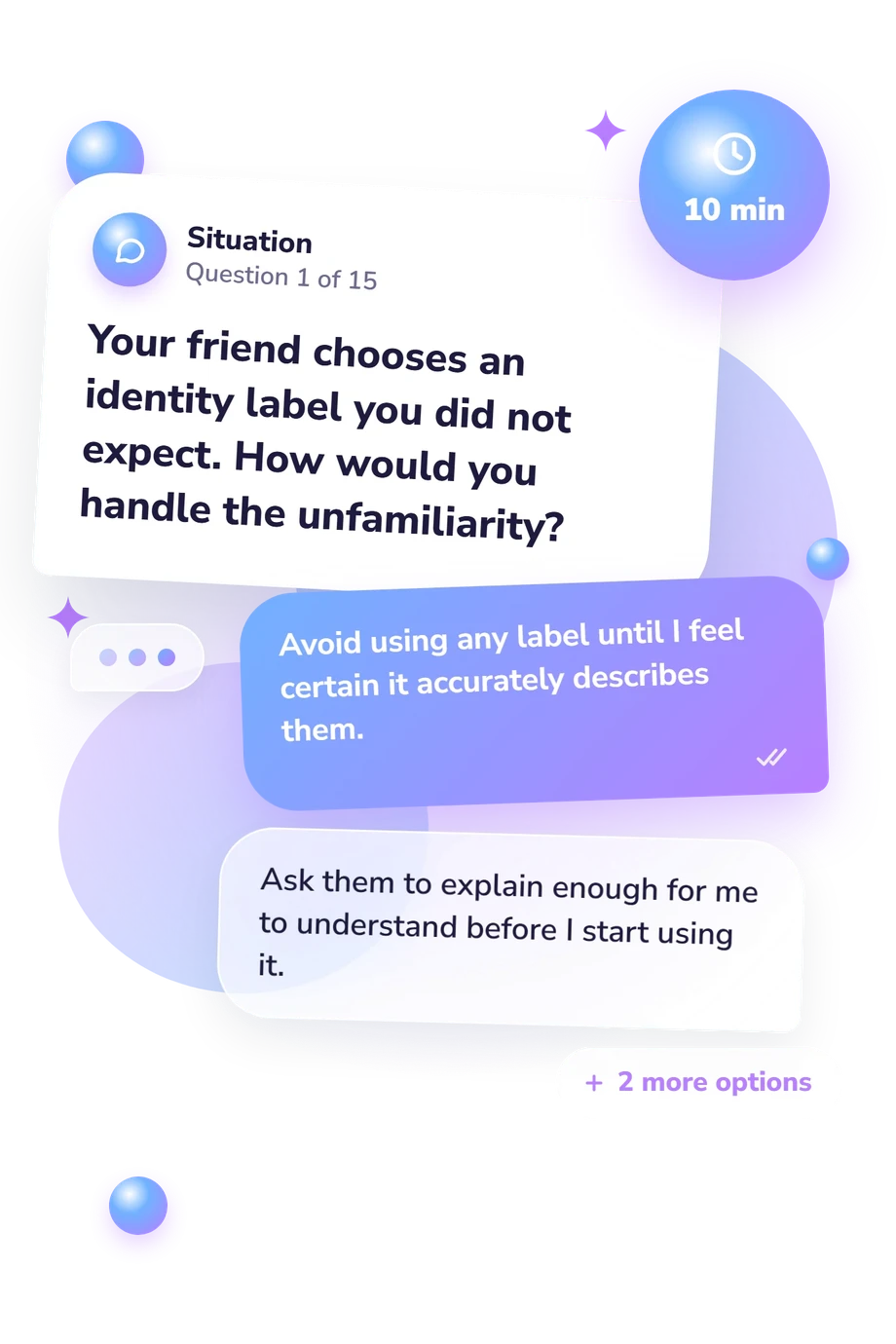
- Avoid using any label until I feel certain it accurately describes them.
- Ask them to explain enough for me to understand before I start using it.
- Mirror their language and privately check any preferences I genuinely need to know.
- Use the label they chose while allowing that their language may stay the same or evolve.
- Tell them I suspect they may be gay and promise I will not tell anyone.
- Raise a hypothetical coming-out situation to see how they respond.
- Tell them directly that they can talk to me about relationships or identity without pressure.
- Express support for LGBTQ+ people when genuinely relevant, then let them choose whether to share anything.
- Give them extra space for a while so I do not accidentally make things awkward.
- Celebrate enthusiastically because coming out deserves a memorable response.
- Respond warmly and ask what privacy or support preferences they want me to know.
- Acknowledge the trust they showed, follow their low-key tone, and continue treating them normally.
Is My Friend Gay Quiz - Description and methodology of the test
People who want to understand a friend’s identity without turning uncertainty into speculation can use the Is My Friend Gay Quiz as a prompt for examining their own assumptions and conduct. For readers asking how to tell if your friend is gay, this quiz redirects attention from inferred orientation to privacy, consent, and support a friend may welcome.
What This Assessment Explores
Rather than estimate a friend’s orientation, this questionnaire examines how a respondent handles ambiguous clues, identity language, privacy, and disclosures. As a how to tell if your best friend is gay quiz, it turns attention toward conduct. Situations include rumors, mannerisms, dating history, jokes, private notifications, and coming-out conversations. Its dimensions are:
- Evidence and Interpretation (0-15) shows whether impressions rely on assumptions, mixed clues, or what a friend has said; the bands are Assumption-led (0-5), Mixed interpretation (6-10), and Grounded perspective (11-15).
- Privacy and Boundaries (0-15) reflects whether curiosity leads to investigation or respects a friend’s control of information; the bands are Clarity-seeking (0-5), Boundary-aware (6-10), and Friend-led (11-15).
- Supportive Friendship (0-15) describes responses to sharing, from seeking solutions or creating distance to listening and adapting support; the bands are Solution-focused (0-5), Actively caring (6-10), and Steady acceptance (11-15).
Methodology and Scientific Basis
Each item presents a short interpersonal scenario with four response options. Across the choices, the questionnaire contrasts guessing, investigating, or imposing a label with acknowledging uncertainty, protecting privacy, and following the friend’s words. Answers are combined into separate perspective scores, so the outcome describes reasoning and support patterns rather than a probability about someone else’s orientation.
The evidence base is conceptually consistent with Cox et al. (2016), whose work shows how stereotypes and contextual impressions can shape inferences about sexual orientation and why gaydar is not reliable evidence. It also aligns with research on allyship, autonomy-supportive coming out, and ally identity in Chen, Joel, and Castro Lingl (2023), Legate, Ryan, and Weinstein (2012), and Jones, Brewster, and Jones (2014). This questionnaire is a self-reflection tool, not an adaptation or validation of those published instruments.
For a reader considering the is my guy friend gay quiz, this assessment redirects attention to direct communication, friend-led disclosure, and requested support. Self-report can be affected by current emotions, memory, social expectations, and the wish to appear considerate. Because the scores have no population norms or clinical cutoffs, they work best as structured prompts for examining behavior, not as a standardized judgment of character.
- Cox, William T. L., Patricia G. Devine, Alyssa A. Bischmann, and Janet S. Hyde. “Inferences About Sexual Orientation: The Roles of Stereotypes, Faces, and The Gaydar Myth.” The Journal of Sex Research, 53(2), 157-171, 2016. 10.1080/00224499.2015.1015714
- Chen, Jacqueline M., Samantha Joel, and Daphne Castro Lingl. “Antecedents and Consequences of LGBT Individuals’ Perceptions of Straight Allyship.” Journal of Personality and Social Psychology, 125(4), 827-851, 2023. 10.1037/pspi0000422
- Legate, Nicole, Richard M. Ryan, and Netta Weinstein. “Is Coming Out Always a ‘Good Thing’? Exploring the Relations of Autonomy Support, Outness, and Wellness for Lesbian, Gay, and Bisexual Individuals.” Social Psychological and Personality Science, 3(2), 145-152, 2012. 10.1177/1948550611411929
- Jones, K. Nicole, Melanie E. Brewster, and Jacob A. Jones. “The Creation and Validation of the LGBT Ally Identity Measure.” Psychology of Sexual Orientation and Gender Diversity, 1(2), 181-195, 2014. 10.1037/sgd0000033
Updated: