
Integumentary System Quiz
How the Scales are Structured
Who Usually Takes This Test?
See How You Compare
Below is a preview of how scores are typically distributed across each scale.
Example Questions From the Test
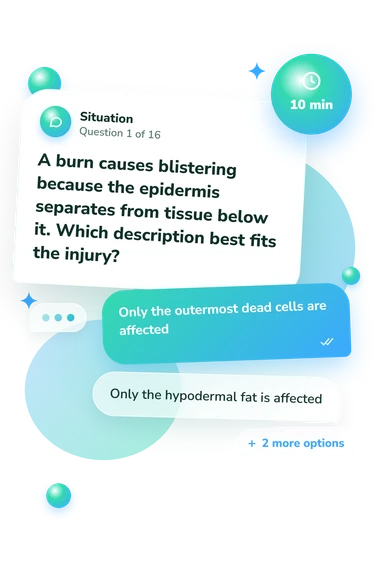
- Only the outermost dead cells are affected
- Only the hypodermal fat is affected
- The epidermis and part of the dermis are damaged
- The entire skin and all underlying muscle are destroyed
- Sebaceous gland
- Ceruminous gland
- Eccrine sweat gland
- Endocrine gland
- Undigested food particles and digestive enzymes
- Carbon dioxide and concentrated bile pigments
- Water and salts, with small amounts of urea and other solutes
- Large proteins and intact blood cells
Integumentary System Quiz - Description and methodology of the test
Students revising basic anatomy, health-science learners, and curious readers can use this skin anatomy quiz when they want to apply knowledge of skin structures and functions to short situations. It is designed for checking learned knowledge rather than personal symptoms or clinical judgment. The integumentary system quiz asks the reader to connect anatomy with explanations of injury, secretion, repair, and temperature control. Its result shows how consistently those connections were made.
What This Assessment Explores
Questions connect structure with function rather than isolated labels. They ask readers to identify injury depth, distinguish epidermal layers, match glands with secretions, and explain how hair, nails, melanocytes, sweat, and dermal blood vessels support protection or homeostasis. The questions in the integumentary quiz test whether factual knowledge transfers to short anatomical situations.
The result uses one knowledge dimension:
- Integumentary System Knowledge (0-16) reflects understanding of major structures, skin layers, glands, core functions, repair, thermoregulation, and limited waste removal; Foundation to build covers 0-6, Developing knowledge covers 7-12, and Strong knowledge covers 13-16.
These bands indicate performance on tested content. They can direct review toward basic organization, functional distinctions, or details such as diffusion, vitamin D synthesis, and excretion, but they do not measure hands-on examination skill or personal skin health.
Methodology and Scientific Basis
Each item in this quiz about integumentary system anatomy presents a situation with four answer choices. The reader selects the best anatomical or physiological explanation, such as identifying the sebum-producing gland, locating dividing cells in the nail matrix, or recognizing a heat-loss response. This format tests applied relationships, not only vocabulary recall.
The selected responses are summarized in the displayed knowledge result. Its reporting bands show the level assigned to that result and can help identify content gaps, such as confusion about skin layers, gland functions, repair, or heat regulation.
The content is conceptually consistent with McLafferty et al. (2012), and with OpenStax and Marieb and Hoehn textbooks covering these topics. It is not presented as an adaptation of those works. The evidence described here concerns content coverage: anatomy references support the quiz’s coverage of integumentary system concepts, including skin layers, glands, repair, thermoregulation, and excretion. They do not establish psychometric validation or population norms for this questionnaire.
Guessing, prior instruction, and attention can affect the score, while the questionnaire’s small range of scenarios means it reflects performance on tested content rather than complete anatomical competence.
- McLafferty, Ella, Charles Hendry, and Alistair Farley. The integumentary system: anatomy, physiology and function of skin. Nursing Standard 27, no. 3 (2012): 35-42. 10.7748/ns2012.09.27.3.35.c9299
- Betts, J. Gordon, Kelly A. Young, James A. Wise, Eddie Johnson, Brandon Poe, Dean H. Kruse, Oksana Korol, Jody E. Johnson, Mark Womble, and Peter DeSaix. Anatomy and Physiology 2e. 2nd ed., Chapter 5, The Integumentary System. Houston, TX: OpenStax, 2022.
- Marieb, Elaine N., and Katja Hoehn. Human Anatomy & Physiology. 11th ed. Pearson Education, 2019.