
Horse Quiz
How the Scales are Structured
Who Usually Takes This Test?
See How You Compare
Below is a preview of how scores are typically distributed across each scale.
Example Questions From the Test
- Belgian Draft
- Percheron
- Clydesdale
- Suffolk Punch
- Marwari
- Arabian
- Akhal-Teke
- Karabakh
- Morgan
- American Saddlebred
- Standardbred
- Tennessee Walking Horse
Horse Quiz - Description and methodology of the test
Readers who want to recognize horse and pony breeds more confidently can use this horse quiz to connect visual clues with geography, history, and function. It is intended for curious riders, owners, and anyone building general equine knowledge. An online quiz about horses offers a focused way to test recall, notice gaps, and choose useful topics for further study.
What This Assessment Explores
Breed recognition depends on clues about origin, build, markings, gaits, history, and traditional roles. It suits readers checking recall rather than riding or handling expertise; the result reflects how successfully they distinguish breeds from combined descriptions.
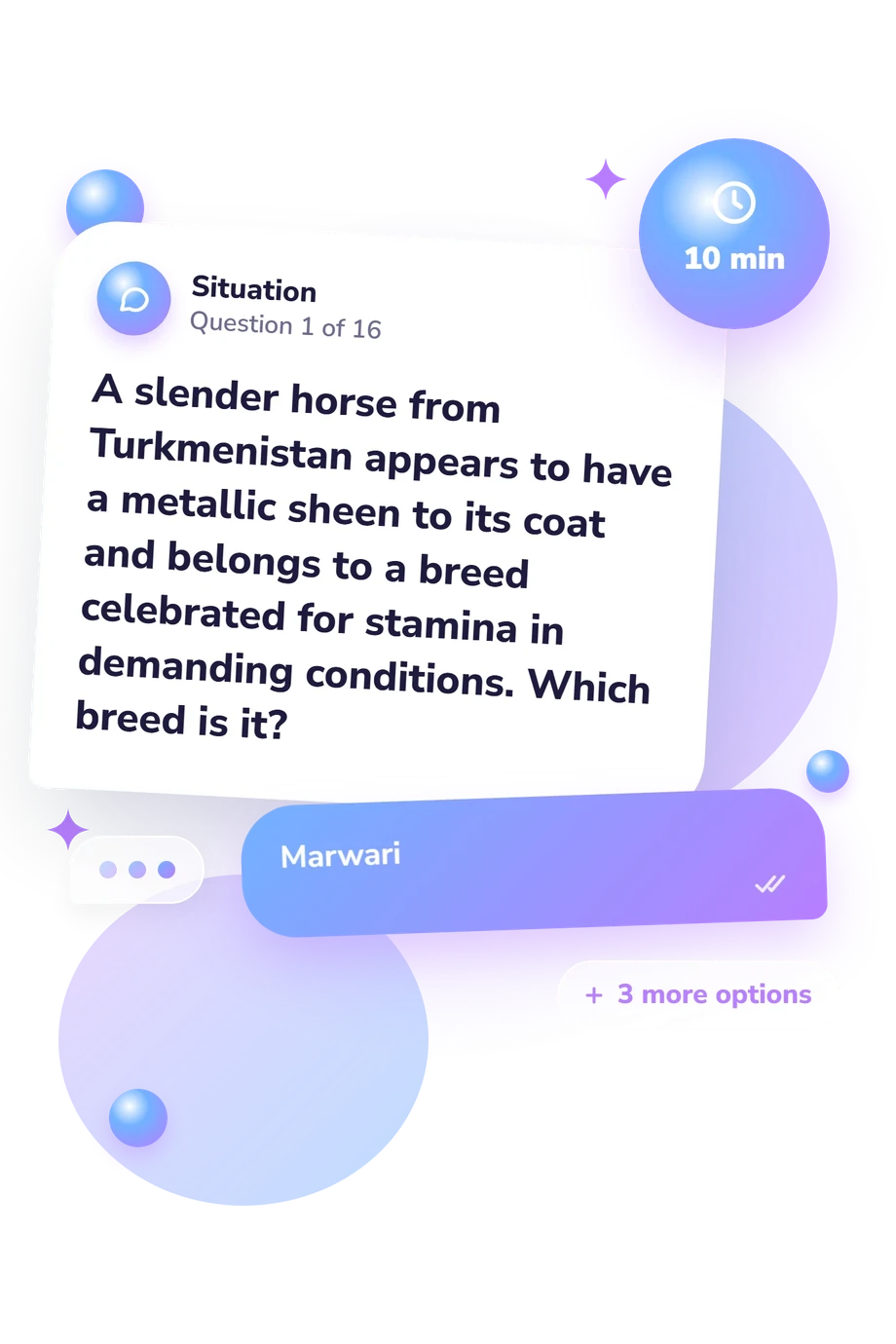
As a horse-knowledge quiz, each item pairs a short scenario with four breed choices. The best answer must fit the full combination, not one isolated detail. An easy quiz about horses can still require elimination when breeds share traits.
The result uses the Horse Breed Knowledge scale, scored 0-16, with these bands:
- Starting Stable (0-6) indicates recognition of some familiar breeds but highlights distinctions still worth reviewing.
- Developing Eye (7-12) indicates solid breed knowledge with room to refine less familiar clues.
- Breed-Savvy (13-16) indicates strong knowledge across traits, histories, gaits, and roles.
Methodology and Evidence Base
Each item presents a short scenario and four breed options. The selected answer contributes to one overall total rather than separate appearance, history, or gait subscores. Horse-quiz games can support practice, but the result describes performance on these comparisons.
The method is a structured, self-administered knowledge assessment, not a psychometric inventory. Its content is conceptually consistent with breed descriptions in Sly et al. (2018); Hendricks (2007) adds historical context, while Petersen et al. (2013) provides background on genetic diversity in modern horses. These sources support the subject matter, but this questionnaire is not an adaptation of them and they do not supply its scoring rule.
Interpretation is straightforward: a higher total means more correct breed identifications across the set. The score does not measure riding ability, stable management, visual acuity, or practical experience, and the questionnaire has not been standardised against a reference population.
Prior reading, guessing, current interest, and familiarity with particular breeds can shift performance. Similar breeds may be difficult to distinguish without visual or historical context, so use the result to set learning priorities; honest attention to each clue also matters.
- Sly, Debby, with Sarah Muir and Judith Draper. The Complete Book of Horses: Breeds, Care, Riding, Saddlery: A Comprehensive Encyclopedia of Horse Breeds and Practical Riding Techniques with 1500 Photographs. Lorenz Books, 2018.
- Hendricks, Bonnie L. International Encyclopedia of Horse Breeds. University of Oklahoma Press, 2007. Foreword by Anthony A. Dent.
- Petersen, Jessica L., James R. Mickelson, E. Gus Cothran, Lisa S. Andersson, Jeanette Axelsson, et al. “Genetic Diversity in the Modern Horse Illustrated from Genome-Wide SNP Data.” PLOS ONE 8, no. 1 (2013): e54997. 10.1371/journal.pone.0054997
Updated: