
Heritage Quiz
How the Scales are Structured
Who Usually Takes This Test?
See How You Compare
Below is a preview of how scores are typically distributed across each scale.
Example Questions From the Test
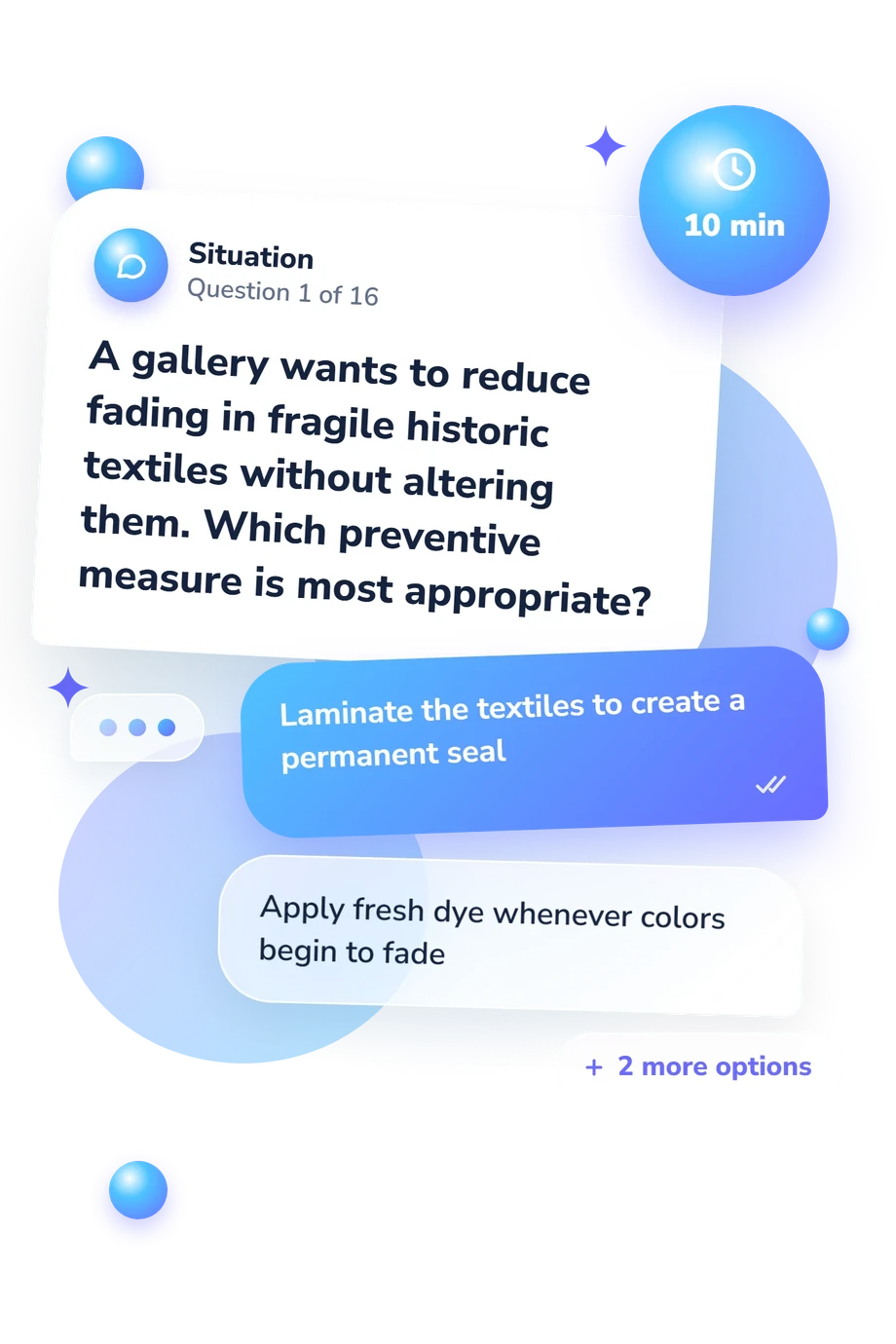
- Laminate the textiles to create a permanent seal
- Apply fresh dye whenever colors begin to fade
- Limit their exposure to strong light
- Display them outdoors to prevent indoor humidity changes
- Terraced farmland shaped by generations of community practice
- An untouched geological formation with no known human association
- A digital copy of a medieval manuscript
- A mineral specimen preserved in a laboratory cabinet
- It helps reveal the sequence and relationships of past activities
- It establishes the present financial value of each find
- It proves that every object in one layer had the same owner
- It determines which objects should be displayed first in a museum
Heritage Quiz - Description and methodology of the test
For anyone wanting to examine how well they understand the ideas and practices that shape heritage work, this heritage quiz offers a focused knowledge profile. It suits learners, museum visitors, students, and curious adults who want a cultural heritage assessment focused on concepts rather than personal identity. The result points to learning strengths and useful areas for review.
What This Assessment Explores
Heritage is treated as practical judgment rather than a list of dates. Its role as a heritage knowledge test is to show how well you recognize ways to preserve materials, support living traditions, evaluate evidence, and explain why places and objects matter. The result describes current knowledge, not ancestry or personal cultural belonging.
The questions draw on four connected areas:
- Conservation asks whether you can limit damage while retaining significant original material.
- Living and intangible heritage shows whether you understand how skills and traditions continue through teaching and community participation.
- Evidence and provenance test your use of context, sources, oral accounts, and ownership histories.
- Interpretation and significance cover how heritage is explained and why places matter historically, socially, culturally, or aesthetically.
Taken together, these themes identify concepts you already handle well and topics that may deserve further study.
Methodology and Evidence Base
Each item presents a scenario or definition with four answer choices. The respondent selects the option that best fits the heritage principle described. The displayed result condenses responses into one Heritage Knowledge scale from 0-16, with Foundation 0-6, Developing 7-12, and Strong 13-16. These bands are descriptive categories for this questionnaire, not externally normed thresholds.
This questionnaire functions as a heritage preservation quiz, emphasizing applied recognition rather than extended writing or personal narrative. Its educational orientation is conceptually consistent with Q-Herilearn (Fontal et al., 2024), especially in examining what respondents can identify and apply. This is a conceptual comparison, not a claim that the online questionnaire is an adaptation of Q-Herilearn.
The content also aligns with UNESCO’s safeguarding approach to intangible heritage, the Burra Charter’s treatment of cultural significance and conservation, and ICOMOS guidance on interpretation and presentation. These frameworks explain why the items connect objects, places, evidence, communities, and meaning.
Performance can reflect prior learning, terminology familiarity, and how a person reads brief scenarios. The result is a snapshot of knowledge in this format, not a complete account of heritage competence.
- Fontal, O., Ibañez-Etxeberria, A., Arias, V. B., & Arias, B. (2024). Q-Herilearn: Assessing heritage learning in digital environments. A mixed approach with factor and IRT models. PLOS ONE, 19(3), e0299733. 10.1371/journal.pone.0299733
- UNESCO. (2003). Convention for the Safeguarding of the Intangible Cultural Heritage. Paris: UNESCO.
- Australia ICOMOS. (2013). The Burra Charter: The Australia ICOMOS Charter for Places of Cultural Significance. Burwood, Victoria: Australia ICOMOS Incorporated.
- ICOMOS. (2008). The ICOMOS Charter for the Interpretation and Presentation of Cultural Heritage Sites. Quebec: ICOMOS.
Updated: