
Guess My Birthday Quiz
How the Scales are Structured
Who Usually Takes This Test?
See How You Compare
Below is a preview of how scores are typically distributed across each scale.
Example Questions From the Test
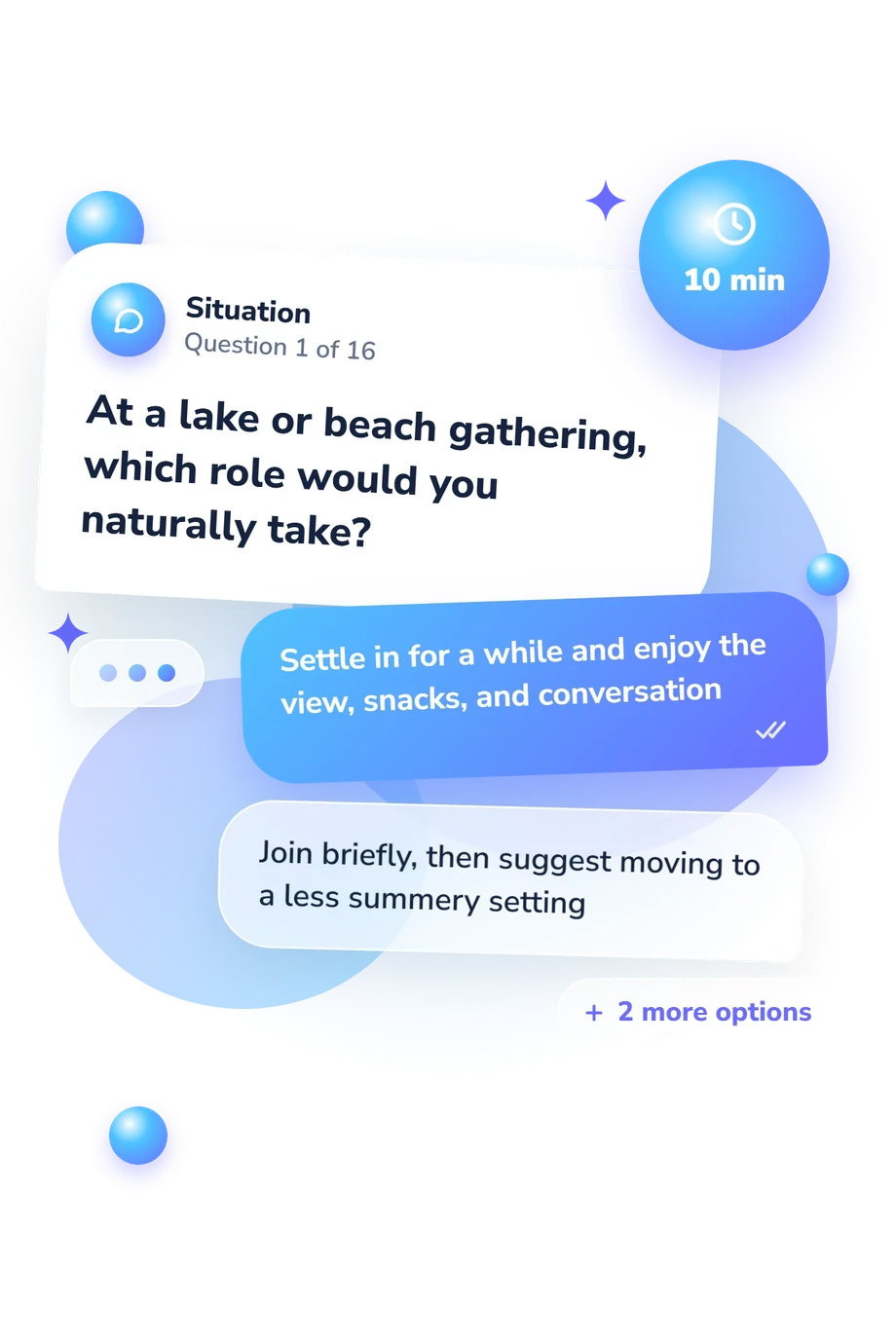
- Settle in for a while and enjoy the view, snacks, and conversation
- Join briefly, then suggest moving to a less summery setting
- Spend as much time as possible swimming, playing, or exploring the shore
- Opt out in favor of a wooded walk, indoor venue, or cool-weather activity
- They make me want to extend the day with outdoor plans or a spontaneous outing
- They are sometimes useful, although I also miss earlier, cozier evenings
- They create extra room for a meal, walk, or social plan after work
- Very little; I prefer evenings that become dark and settled sooner
- I enjoy the colors and sounds enough to slow down and take it in
- It is one of those seasonal moments I actively look forward to
- I notice it, but it does not change how I experience the walk
- I would rather the path were green, sunlit, snowy, or indoors
Guess My Birthday Quiz - Description and methodology of the test
People who want to connect celebration preferences with a likely birthday season can use the Guess My Birthday Quiz as a playful self-reflection exercise. Prompts cover weather, light, scenery, food, travel, and social settings, so the result describes an affinity rather than a literal calendar fact. Unlike a birth date quiz that seeks a calendar answer, this questionnaire uses those preferences to create one seasonal or blended profile.
What This Assessment Explores
Each dimension describes a birthday atmosphere, not a date. Autumn centers earthy comfort and changing leaves; spring emphasizes freshness and new growth; summer highlights warmth and long days; winter focuses on cold air, early darkness, and cozy indoor settings. The questionnaire works as a quiz about when your birthday feels most at home by season: autumn, spring, summer, or winter.
The four result dimensions are:
- Autumn Birthday Affinity (0-12) reflects autumn preferences; Light Autumn Affinity (0-4), Noticeable Autumn Affinity (5-8), Strong Autumn Affinity (9-12).
- Spring Birthday Affinity (0-12) reflects spring preferences; Light Spring Affinity (0-4), Noticeable Spring Affinity (5-8), Strong Spring Affinity (9-12).
- Summer Birthday Affinity (0-12) reflects summer preferences; Light Summer Affinity (0-4), Noticeable Summer Affinity (5-8), Strong Summer Affinity (9-12).
- Winter Birthday Affinity (0-12) reflects winter preferences; Light Winter Affinity (0-4), Noticeable Winter Affinity (5-8), Strong Winter Affinity (9-12).
Methodology and Evidence Base
Each prompt presents a seasonal situation with four response choices, such as selecting a beach role, reacting to early darkness, or styling a birthday table. The options represent different strengths or directions of seasonal preference. The result compares the displayed scale scores: the highest is the strongest affinity, and any scale within one point of it joins a blended result. There is no forced winner or hidden tie-breaker.
Middleton and Sumner (1953) offer the closest published precedent, linking birth season with seasonal preferences and individual characteristics. The SPAQ, introduced by Rosenthal, Bradt, and Wehr in 1987, provides related self-report context for seasonal mood patterns; its studies do not establish validity for this questionnaire. Young, Blodgett, and Reardon contributed psychometric work, while Murray conducted the prospective study. This questionnaire is conceptually consistent with self-report approaches, not an adaptation of those instruments.
Because answers can shift with mood, memories, weather associations, and self-awareness, the Whens My Birthday Quiz format turns a personal date question into structured seasonal reflection, rather than proof of a birth date.
- Middleton, Charles E., and F. C. Sumner. (1953). Season of Birth as Related to Seasonal Preference and Personality Traits. The Journal of Psychology, 36(2), 423-425. 10.1080/00223980.1953.9712909
- Rosenthal, Norman E., George H. Bradt, and Thomas A. Wehr. (1987). Seasonal Pattern Assessment Questionnaire (SPAQ). Bethesda, MD: National Institute of Mental Health.
- Young, Michael A., Christina Blodgett, and Annemarie Reardon. (2003). Measuring seasonality: psychometric properties of the Seasonal Pattern Assessment Questionnaire and the Inventory for Seasonal Variation. Psychiatry Research, 117(1), 75-83. 10.1016/S0165-1781(02)00299-8
- Murray, Greg. (2003). The Seasonal Pattern Assessment Questionnaire as a measure of mood seasonality: a prospective validation study. Psychiatry Research, 120(1), 53-59. 10.1016/S0165-1781(03)00147-1
Updated: