
Genius Quiz
How the Scales are Structured
Who Usually Takes This Test?
See How You Compare
Below is a preview of how scores are typically distributed across each scale.
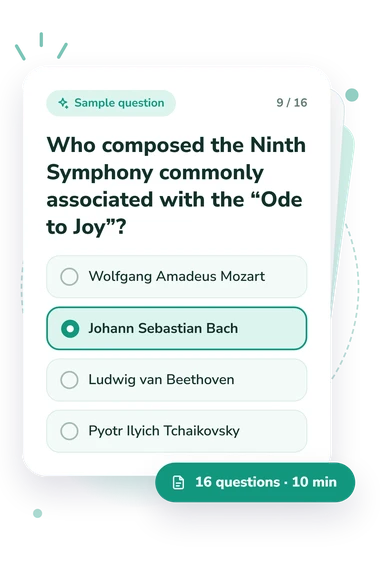
Example Questions From the Test
- $40
- $30
- $45
- $48
- A comma
- An apostrophe
- A colon in every case
- A semicolon
- A-C-G-T
- T-G-C-A
- U-G-C-A
- G-T-A-C
Genius Quiz - Description and methodology of the test
People who want a quick snapshot of broad factual knowledge can use this genius quiz for self-reflection across school and everyday subjects. It suits readers who ask am I a genius and want to see how widely they can recall information and apply basic reasoning. The result describes performance on this mixed set, not personal worth or a formal intelligence estimate.
What This Assessment Explores
The questions sample general knowledge rather than one academic specialty. They move through economics, science, arithmetic, language, genetics, history, civics, geography, music, literature, logic, probability, and earth science. Some ask for recall; others require calculation, explanation, chronology, classification, or logical implication.
Readers asking are you a genius? should treat the result as narrower than the question. The score reflects performance on this particular mixture, influenced by education, interests, memory, language, cultural exposure, and familiarity with the subjects. It is most useful for identifying strong areas and topics worth revisiting.
The catalogue reports one General Knowledge scale from 0-16, with three displayed bands:
- Foundation, 0-6, shows some core knowledge while leaving room to broaden coverage.
- Developing, 7-12, shows solid knowledge in several areas, although less familiar applications may be harder.
- Strong, 13-16, shows broad knowledge and effective reasoning across the set.
Methodology and Scientific Basis
Each item presents a short question with four answer choices, and the respondent selects the best answer. The content is mixed rather than a personality inventory: some items test recall, while others require calculation, explanation, chronology, classification, or logical implication. As a general knowledge quiz, it samples acquired information and applied reasoning rather than a single skill.
The closest content reference is the Spanish General Knowledge Database (Buades-Sitjar et al., 2021), a resource for constructing broad knowledge questions. This questionnaire is conceptually consistent with that work, but is not presented as an adaptation of it. Its interpretation also fits Cattell’s distinction between crystallized knowledge and fluid problem solving. BEFKI GC-K (Schipolowski et al., 2013) measures crystallized intelligence, but this questionnaire is not that standardized scale.
The result is presented as a performance score and one displayed band; the questionnaire does not claim a separate population norm or IQ conversion. Answers can vary with concentration, motivation, language, education, cultural exposure, guessing, and current context, so the result is best used for focused self-reflection rather than a complete assessment of cognitive ability.
- Buades-Sitjar, Francisco, Roger Boada, Marc Guasch, Pilar Ferré, José Antonio Hinojosa, Marc Brysbaert, and Jon Andoni Duñabeitia. (2021). The thousand-question Spanish general knowledge database. PSICOLOGICA, 42(1), 109-119. 10.2478/psicolj-2021-0006
- Schipolowski, Stefan, Oliver Wilhelm, Ulrich Schroeders, Anastassiya Kovaleva, Christoph J. Kemper, and Beatrice Rammstedt. (2013). BEFKI GC-K: A Short Scale for the Measurement of Crystallized Intelligence. Methods, Data, Analyses, 7(2), 153-181. 10.12758/mda.2013.010
- Cattell, Raymond B. (1963). Theory of fluid and crystallized intelligence: A critical experiment. Journal of Educational Psychology, 54(1), 1-22. 10.1037/h0046743