
ESP Test
How the Scales are Structured
Who Usually Takes This Test?
See How You Compare
Below is a preview of how scores are typically distributed across each scale.
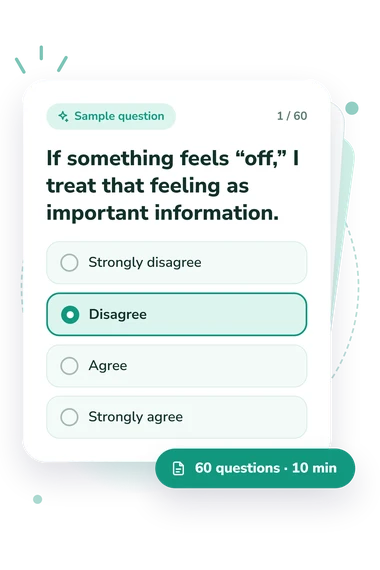
Example Questions From the Test
- Strongly disagree
- Disagree
- Agree
- Strongly agree
- Strongly disagree
- Disagree
- Not sure
- Agree
- Strongly agree
- Strongly disagree
- Disagree
- Not sure
- Agree
- Strongly agree
ESP Test - Description and methodology of the test
People who wonder whether their instincts are meaningful, or who want to examine unusual experiences without accepting every impression at face value, may find this assessment useful. The ESP Test offers a structured profile to support decisions about when to trust an impression, pause for more information, or follow up. This self-report extrasensory perception questionnaire examines how hunches are interpreted and checked rather than card-guessing accuracy.
What This Assessment Explores
These results describe how you handle hunches, coincidences, and evidence-not whether an event is paranormal. They suit readers who want a structured self-reflection profile of intuitive trust, pattern noticing, and critical checking. As an extrasensory perception test, it examines interpretive habits rather than paranormal performance. The displayed dimensions are:
- Intuitive Reliance (0-40) shows how strongly you treat gut feelings and subjective knowing as meaningful signals: Low reliance 0-13; Moderate reliance 14-26; High reliance 27-40.
- Pattern & Synchronicity Sensitivity (0-40) shows sensitivity to repetitions, coincidences, and meaningful connections: Low 0-13; Moderate 14-26; High 27-40.
- Reality-Checking Skepticism (0-40) shows how strongly you question hunches, seek alternatives, and verify impressions: Low Skepticism 0-13; Balanced Skepticism 14-26; High Skepticism 27-40.
Methodology and Evidence Base
Questions use first-person statements about instinct, coincidences, signs, dreams, predictions, and checking behavior. Examples use four- or five-choice agreement scales, with Not sure included on some items, so there is no right answer. Responses are combined into separate profile dimensions.
Scores from this ESP quiz indicate endorsed response tendencies; a high result does not demonstrate extrasensory ability.
Conceptually, the questionnaire is consistent with Gray and Gallo (2016) on cognitive differences associated with paranormal belief and skepticism, and with Hadlaczky and Westerlund (2011) on sensitivity to coincidences. Thalbourne and Delin (1993) and Tobacyk (2004) offer related approaches to measuring paranormal belief. The cited studies provide related context for paranormal belief, coincidence sensitivity, and skeptical reasoning; they do not establish that this questionnaire is adapted from or validated by those instruments.
Interpret the bands descriptively rather than as population norms or clinical cutoffs. Scores can reflect current context, memory for striking coincidences, and willingness to question yourself, so honest answers and attention to alternative explanations matter. The displayed ranges alone do not specify a fixed point value for every response.
- Gray, Stephen J., and David A. Gallo. "Paranormal psychic believers and skeptics: A large-scale test of the cognitive differences hypothesis." Memory & Cognition, vol. 44, no. 2, 2016, pp. 242-261. 10.3758/s13421-015-0563-x
- Hadlaczky, Gergö, and Joakim Westerlund. "Sensitivity to coincidences and paranormal belief." Perceptual and Motor Skills, vol. 113, no. 3, 2011, pp. 894-908. 10.2466/09.22.PMS.113.6.894-908
- Thalbourne, Michael A., and Peter S. Delin. "A new instrument for measuring the sheep-goat variable: Its psychometric properties and factor structure." Journal of the Society for Psychical Research, vol. 59, no. 832, 1993, pp. 172-186.
- Tobacyk, Jerome J. "A revised paranormal belief scale." International Journal of Transpersonal Studies, vol. 23, no. 1, 2004, pp. 94-98. 10.24972/ijts.2004.23.1.94