
Does My Ex Miss Me Quiz
How the Scales are Structured
Who Usually Takes This Test?
See How You Compare
Below is a preview of how scores are typically distributed across each scale.
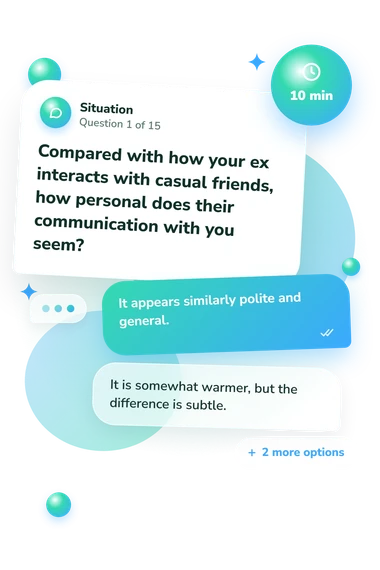
Example Questions From the Test
- It appears similarly polite and general.
- It is somewhat warmer, but the difference is subtle.
- It often includes noticeably personal attention or emotional warmth.
- It sometimes feels more personal, especially in longer conversations.
- I have started nearly all of them.
- We have started them about equally often.
- My ex has started most of them.
- I have started more, though my ex has initiated once or twice.
- They often introduce another topic or contact me again later.
- They sometimes continue, depending on the conversation.
- The exchange usually ends unless I restart it.
- They may send one more response, but rarely build on it.
Does My Ex Miss Me Quiz - Description and methodology of the test
People who are unsure how to interpret an ex-partner’s behavior can use the Does My Ex Miss Me Quiz to organize observations before drawing conclusions. It suits readers reviewing messages, conversations, and attempts to reconnect, especially when warmth and inconsistency coexist. For readers considering a Does My Ex Boyfriend Miss Me Quiz, results highlight recurring patterns in an ex’s behavior and leave meaning for the respondent to consider.
What This Assessment Explores
These items examine observable post-breakup patterns in voluntary contact, emotional engagement and nostalgia, and concrete steps toward reconnecting.
Readers considering a Does My Ex Girlfriend Miss Me Quiz can use this questionnaire to examine warmth, memories, and follow-through.
The three displayed dimensions are:
- Contact Initiative and Consistency (0-15) reflects initiation and sustained nonessential contact: Mostly responsive (0-5), Mixed signals (6-10), or Consistent initiative (11-15).
- Emotional Engagement and Nostalgia (0-15) reflects warmth, curiosity, reflection, and attention: Limited engagement (0-5), Some connection (6-10), or Strong engagement (11-15).
- Reconnection Intent and Follow-Through (0-15) reflects respectful, concrete steps toward reconnecting: Little active intent (0-5), Tentative openness (6-10), or Clear reconnection effort (11-15).
Together, the profile organizes observed behavior rather than assigning a single explanation.
Methodology and Scientific Basis
As a self-report questionnaire, each item presents a post-breakup situation with four response descriptions. The respondent chooses the option closest to the observed pattern, covering contact, emotional engagement, and reconnection behavior. For readers asking whether she misses them, the Does She Miss Me Quiz framing shows where evidence is stronger or more ambiguous than a yes-or-no verdict.
Conceptually, the closest published comparison is the 2020 study by Dailey and colleagues, which examined ambivalence, adjustment, and reconciliation after a relationship ends. Mason and colleagues’ 2012 study addresses continued contact with an ex, while Cupach and colleagues’ 2011 study examines persistence in reconciliation attempts. This questionnaire is conceptually consistent with those studies, not an adaptation of them.
The questionnaire does not document how response options are weighted or assigned to displayed ranges, and it has no established norms. Its bands are descriptive, and online scoring has not been standardized.
Scores do not establish what an ex feels or intends. Answers can reflect recall, recent conflict, hope, fear, selective attention, and uncertainty about motives. Compare repeated actions with stated intentions and your boundaries; one exchange cannot guarantee future behavior.
- Dailey, René M., Lingzi Zhong, Rudy Pett, and Sarah Varga. “Post-dissolution ambivalence, breakup adjustment, and relationship reconciliation.” Journal of Social and Personal Relationships, 37(5), 1604-1625 (2020). 10.1177/0265407520906014
- Mason, Ashley E., David A. Sbarra, Amanda E. B. Bryan, and Lauren A. Lee. “Staying connected when coming apart: The psychological correlates of contact and sex with an ex-partner.” Journal of Social and Clinical Psychology, 31(5), 488-507 (2012). 10.1521/jscp.2012.31.5.488
- Cupach, William R., Brian H. Spitzberg, Colleen M. Bolingbroke, and Bobbi Sue Tellitocci. “Persistence of attempts to reconcile a terminated romantic relationship: A partial test of relational goal pursuit theory.” Communication Reports, 24(2), 99-115 (2011). 10.1080/08934215.2011.613737