
Breathing Style Quiz
How the Scales are Structured
Who Usually Takes This Test?
See How You Compare
Below is a preview of how scores are typically distributed across each scale.
Example Questions From the Test
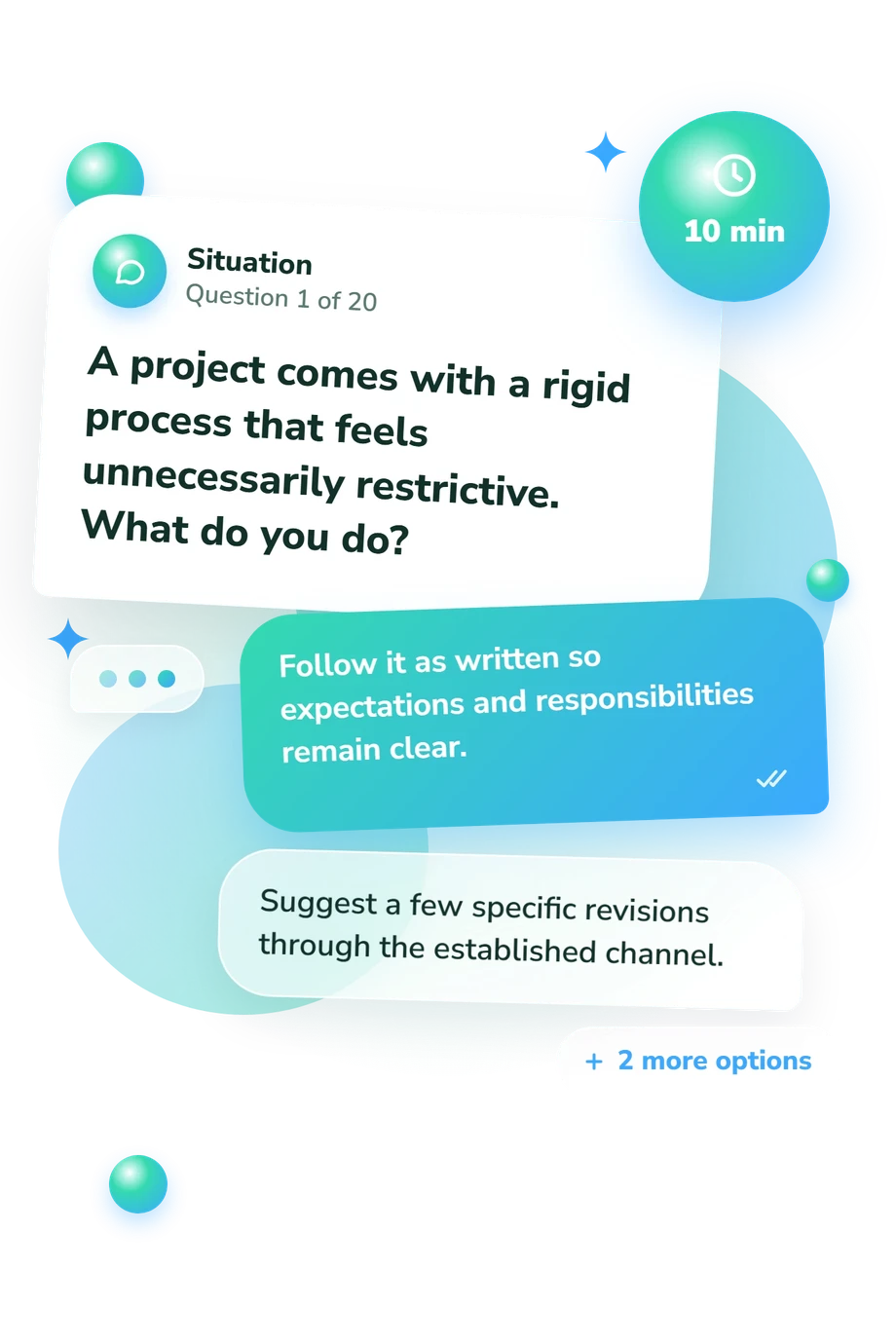
- Follow it as written so expectations and responsibilities remain clear.
- Suggest a few specific revisions through the established channel.
- Experiment around the edges while still delivering the required result.
- Forge a more effective route and defend it directly, even if it disrupts the expected process.
- Ask to complete the sequence at the original rhythm before changing it.
- Watch one full demonstration of the new rhythm before trying again.
- Keep moving and make deliberate corrections as I recognize the new pattern.
- Let the new rhythm guide my movement and reshape the sequence in real time.
- Find the most orderly alternative, even if it takes longer.
- Move cautiously while checking that each change still leads in the right direction.
- Try unconventional gaps and shortcuts as the environment shifts.
- Trust my instincts, cut through the confusion, and treat unpredictability as energizing.
Breathing Style Quiz - Description and methodology of the test
For readers curious about symbolic personality profiles, the breathing style quiz turns everyday choices into a playful comparison of five fictional styles. It suits anyone exploring how commitment, flexibility, timing, and expression appear in daily decisions. If you are asking what is your breathing style, the result offers a compact vocabulary for noticing preferences without treating a fictional affinity as a fixed identity.
What This Assessment Explores
Choices about process, change, disagreement, competition, duty, recognition, and sustained effort reveal how you handle pressure, values, and adaptation. The result names the pattern closest to those choices, offering an answer to which breathing style you are without making it a fixed type.
The result separates five thematic affinities:
- Flame Breathing (0-12) reflects conviction: Banked Ember (0-4), Growing Blaze (5-8), Radiant Spirit (9-12).
- Stone Breathing (0-12) reflects patience: Mobile Foundation (0-4), Steadfast Pillar (5-8), Immovable Resolve (9-12).
- Thunder Breathing (0-12) reflects focused action: Gathering Charge (0-4), Focused Spark (5-8), Lightning Strike (9-12).
- Water Breathing (0-12) reflects flexibility: Steady Channel (0-4), Responsive Current (5-8), Flowing Form (9-12).
- Wind Breathing (0-12) reflects independence: Directed Breeze (0-4), Restless Gale (5-8), Unbound Tempest (9-12).
It reframes what breathing style I have as a question about combinations rather than a single label.
Methodology and Scientific Basis
The 20 scenarios each offer four responses to a challenge. Choices range from structured persistence and careful adaptation to concentrated action, fluid responsiveness, and forceful expression. There is no correct answer: the signal is the reaction that feels natural. Each selected option contributes to a style affinity, and the result compares all five totals. The highest total is the strongest affinity, while any score within one point creates a blended result.
Methodologically, this is an original self-report profile, conceptually consistent with Breathing Styles (Intapirat, 2025), which connects fictional breath styles with personality portrayal; it is not an adaptation of that study. Faber and Mayer (2009) provide context for resonance with archetypal media figures. Gotouge’s fanbook supplies the fictional framework, and Jung’s archetype theory offers an interpretive lens.
For readers asking what is my breathing style, the profile is a reflective prompt rather than a fixed identity. The questionnaire has no stated standardization, clinical norms, or diagnostic scoring, so its unofficial affinity labels should not be treated as ability measures. Self-report can shift with mood, current context, response bias, and self-awareness.
- Intapirat, Patsawath. "Character Personality Reflected Through Breath Styles in Demon Slayer Mugen Train Arc." Journal of Social Science for Local Development Rajabhat Maha Sarakham University 9, no. 4 (2025): 866-876.
- Faber, Michael A., and John D. Mayer. "Resonance to archetypes in media: There's some accounting for taste." Journal of Research in Personality 43, no. 3 (2009): 307-322. 10.1016/j.jrp.2008.11.003.
- Gotouge, Koyoharu. Demon Slayer: Kimetsu no Yaiba Official Fanbook: Demon Slayer Corps Records. Tokyo: Shueisha, 2019. ISBN 978-4-08-882043-9.
- Jung, Carl Gustav. The Archetypes and the Collective Unconscious. 2nd ed. Princeton, NJ: Princeton University Press, 1969.
Updated: