
Bone Tissue Quiz
How the Scales are Structured
Who Usually Takes This Test?
See How You Compare
Below is a preview of how scores are typically distributed across each scale.
Example Questions From the Test
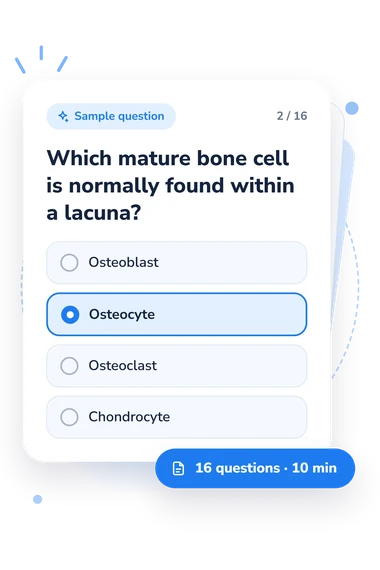
- Osteoblast
- Osteocyte
- Osteoclast
- Chondrocyte
- Trabecula
- Interstitial lamella
- Circumferential lamella
- Concentric lamella
- Osteoblasts
- Chondrocytes
- Osteoclasts
- Osteocytes
Bone Tissue Quiz - Description and methodology of the test
Students, instructors, and readers can use this bone tissue quiz to check how well they connect bone structures with their functions. It suits learners reviewing material before a class or exam, while remaining accessible to anyone exploring skeletal biology. As a bone anatomy quiz, it emphasizes recognizing structures and linking them to growth, repair, and mechanical roles. The result points to secure concepts and topics that merit another pass.
What This Assessment Explores
The questions connect named structures with microscopic landmarks and short developmental or clinical situations. As a bone and skeletal tissue quiz, it organizes the content into four themes:
- Bone cells are distinguished by roles in formation, maintenance, and resorption.
- Matrix components are linked to hardness, flexibility, and newly formed osteoid.
- Membranes and channels are identified by location and exchange functions.
- Tissue organization and ossification connect structure with growth and repair.
The displayed Bone Tissue Knowledge scale runs from 0-16. Foundation-building (0-6) signals a need to review cells, matrix, membranes, and basic landmarks; Developing knowledge (7-12) shows recognition of many core structures but room to compare terms and apply histology clues; Strong command (13-16) reflects consistent identification and links to function and formation. The score is an educational summary.
Methodology and Scientific Basis
Each item presents a brief question with four answer choices. Some require direct identification of a cell, membrane, canal, or matrix component; others apply anatomy and histology knowledge to growth, remodeling, mineral loss, or fracture repair. For a bone histology quiz, this format tests recognition alongside basic interpretation.
The result summarizes performance across the items on a 0-16 scale and assigns the displayed educational band; it is not a norm-referenced rank or measure of professional competence.
Conceptually, the content is consistent with Moreira et al. (2019) on bone histogenesis, growth, remodeling, cells, and matrix. Florencio-Silva et al. (2015) complements this with bone-cell biology; Chang and Liu (2022) supports the osteon material; and Pawlina and Ross (2020) supplies standard histology terminology. The quiz is not presented as an adaptation of any one source.
No external norms, reliability estimates, or validated diagnostic cutoffs are stated, so the result is best read as a study snapshot. Preparation, concentration, and familiarity with histology examples can influence performance.
- Moreira CA, Dempster DW, Baron R. Anatomy and Ultrastructure of Bone - Histogenesis, Growth and Remodeling. In: Feingold KR, Adler RA, Ahmed SF, et al., editors. Endotext [Internet]. South Dartmouth (MA):, Inc.; updated 2023 Mar 14.
- Florencio-Silva R, Sasso GRS, Sasso-Cerri E, Cerri PS. Biology of Bone Tissue: Structure, Function, and Factors That Influence Bone Cells. BioMed Research International. 2015;2015:421746. 10.1155/2015/421746.
- Chang B, Liu X. Osteon: Structure, Turnover, and Regeneration. Tissue Engineering Part B: Reviews. 2022;28(2):261-278. 10.1089/ten.teb.2020.0322.
- Pawlina W, Ross MH. Histology: A Text and Atlas: With Correlated Cell and Molecular Biology. 8th ed. Philadelphia, PA: Wolters Kluwer; 2020.
Updated: