
Biochemistry Quiz
How the Scales are Structured
Who Usually Takes This Test?
See How You Compare
Below is a preview of how scores are typically distributed across each scale.
Example Questions From the Test
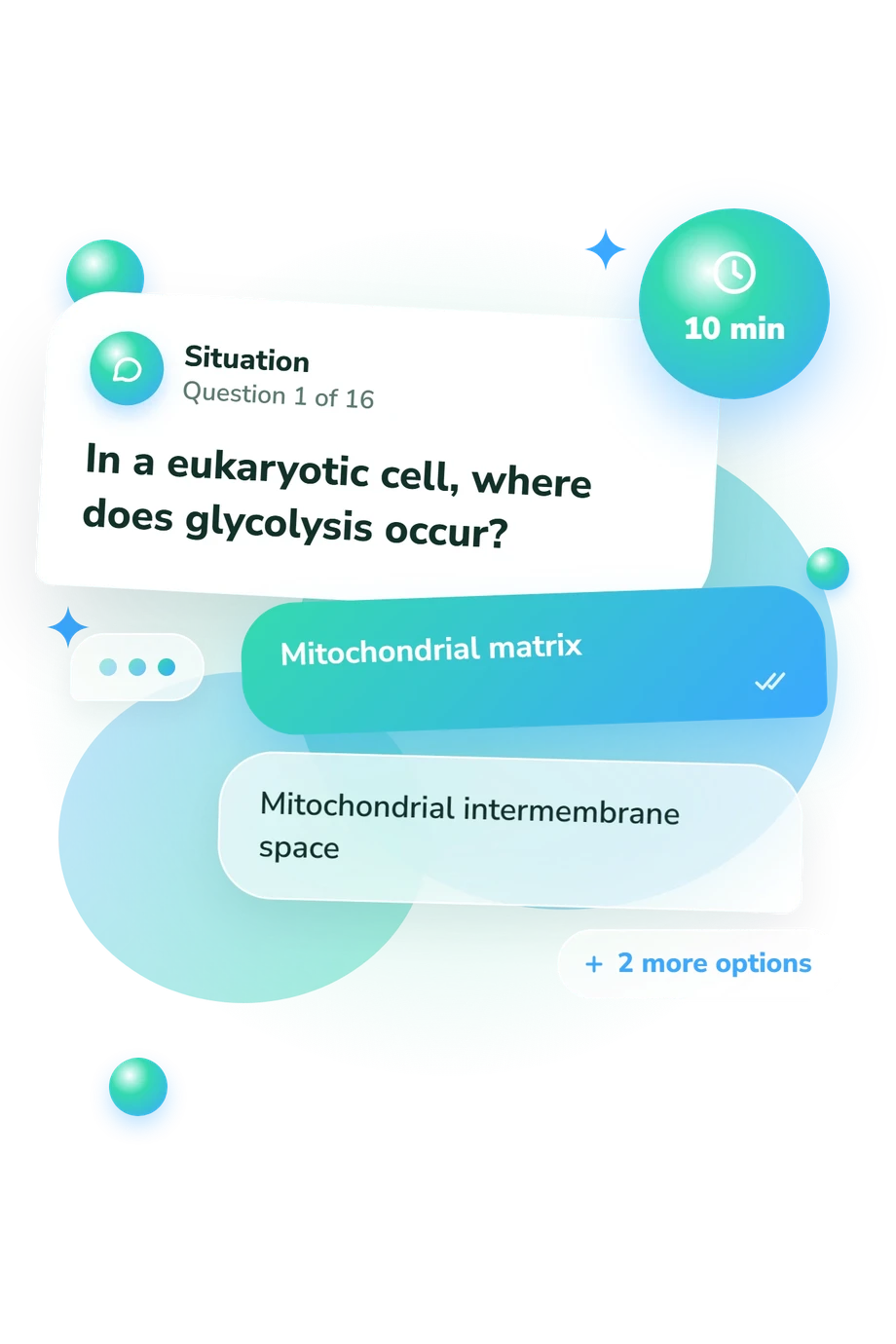
- Mitochondrial matrix
- Mitochondrial intermembrane space
- Nucleus
- Cytosol
- It increases by a factor of 10.
- It increases by a factor of 2.
- It decreases by a factor of 10.
- It remains unchanged because both values are near neutral.
- Water enters continuously, causing the cell to burst.
- Water leaves continuously, causing the cell to shrink.
- Solute movement stops because molecular motion ceases.
- Water moves in both directions with no net change in cell volume.
Biochemistry Quiz - Description and methodology of the test
Students revising core biology, preparing for coursework, or checking their grasp of molecular mechanisms can use this assessment to identify strengths and topics that deserve another pass. The biochemistry quiz focuses on classroom-level understanding of how cells, molecules, and reactions work together. A basic quiz in biochemistry gives learners a structured starting point for review without requiring an extensive study plan.
What This Assessment Explores
Core coverage connects cellular energy, internal conditions, molecular structure, reaction control, and genetic information. Across its quiz questions on biochemistry, learners apply ideas about compartments, pH, osmolarity, membrane transport, enzyme inhibition, protein folding, metabolism, and DNA-to-RNA information flow.
This suits readers checking introductory knowledge while studying independently or consolidating coursework. The emphasis is on linking structure, mechanism, and outcome rather than recalling isolated terms.
The Biochemistry Knowledge scale runs from 0-16 and reports three result bands:
- Foundational (0-6) means core ideas are emerging and several listed areas may need review.
- Developing (7-12) means the learner has a useful grasp but should strengthen links among pathways and mechanisms.
- Strong (13-16) means most sampled concepts are understood accurately.
The result identifies review priorities within this sample.
Methodology and Scientific Basis
Each item presents a biochemical problem with four answer choices. The format combines recognition with application: learners infer pathway location, membrane movement, inhibitor effects, or links between structure and function.
In this biochem quiz, each correct answer adds one point; no partial-credit rule is specified. The result is therefore a count of correct responses to the fixed set, not an estimate of broader knowledge.
The questionnaire is conceptually consistent with Nelson, Cox, and Hoskins (2021), while Kennelly et al. (2023) offers complementary coverage of cellular chemistry, metabolism, enzymes, and molecular biology. Kinetic items reflect the Michaelis-Menten tradition associated with Briggs and Haldane (1925). These sources support the subject matter and reasoning style; they do not establish that this online questionnaire is a validated adaptation of a published instrument.
Because a biochemistry online quiz samples selected educational concepts, its result provides no population norms, course grades, or measure of professional competence. Performance can vary with prior coursework, guessing, fatigue, and topic selection. Use the band to choose review priorities, then check missed concepts against textbooks or practice problems.
- Nelson, David L., Michael M. Cox, and Aaron A. Hoskins. Lehninger Principles of Biochemistry. 8th ed. Macmillan Learning, 2021. ISBN 9781319228002.
- Kennelly, Peter J., Kathleen M. Botham, Owen P. McGuinness, Victor W. Rodwell, and P. Anthony Weil. Harper's Illustrated Biochemistry. 32nd ed. McGraw Hill, 2023. ISBN 9781260469943.
- Briggs, George E., and John Burdon Sanderson Haldane. "A Note on the Kinetics of Enzyme Action." Biochemical Journal 19, no. 2 (1925): 338-339. 10.1042/bj0190338
Updated: