
Am I Creepy Quiz
How the Scales are Structured
Who Usually Takes This Test?
See How You Compare
Below is a preview of how scores are typically distributed across each scale.
Example Questions From the Test
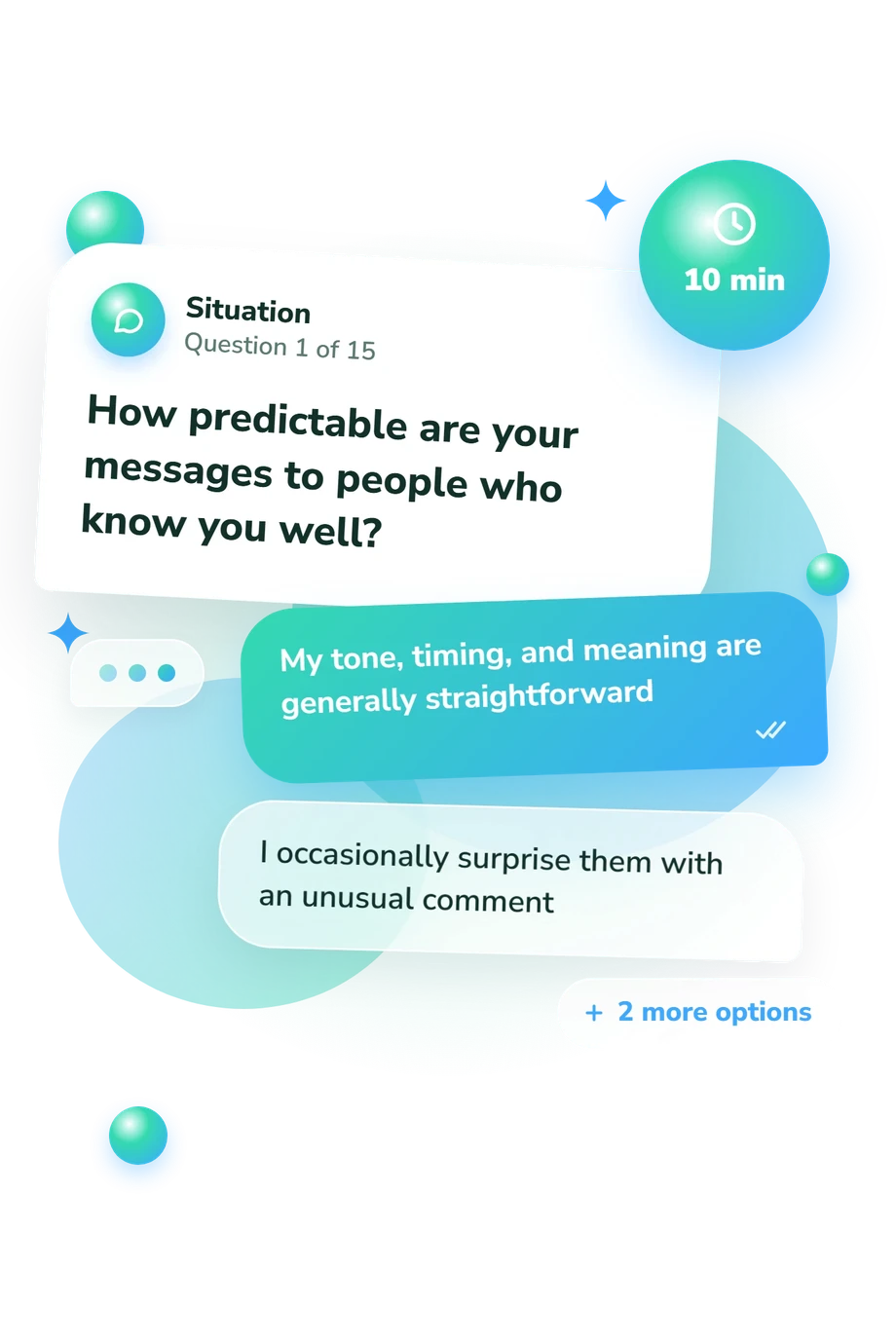
- My tone, timing, and meaning are generally straightforward
- I occasionally surprise them with an unusual comment
- I often use cryptic humor or unexpected shifts in tone
- My brief or oddly timed messages regularly leave them guessing
- I look for an ordinary cause such as a branch or animal
- I check the likely causes but briefly imagine something stranger
- I start inventing an unsettling explanation while investigating
- I savor the possibility that it could become a supernatural story
- Observations about ordinary daily life
- Dry jokes with an unexpected ending
- Surreal jokes that create a slightly uneasy mood
- Playfully macabre jokes about ghosts, monsters, or doom
Am I Creepy Quiz - Description and methodology of the test
People who want to understand how their social signals, reserve, and darkly playful interests may be perceived can use the Am I Creepy Quiz as a structured self-reflection exercise. It is suited to readers who want a how creepy am i quiz that separates interpersonal awareness from mysterious presentation and imaginative taste. Rather than delivering one label, the profile shows which aspects of your responses stand out most.
What This Assessment Explores
This assessment treats creepiness as an impression rather than a fixed identity. Scenarios cover messages, events, humor, curiosity, distance, and discomfort. Dimensions are:
- Boundary & Cue Awareness (0-15) measures responses to space, attention, privacy, and comfort: Internally Guided (0-5) relies on personal reading; Context Responsive (6-10) notices cues but may pause; Cue Attuned (11-15) adjusts to others’ signals.
- Mysterious Social Presence (0-15) measures ambiguity, reserve, and unpredictability without judging it: Open Book (0-5) is readable; Selective Mystery (6-10) mixes openness with restraint; Enigmatic Presence (11-15) reveals little.
- Spooky Style & Imagination (0-15) measures attraction to eerie stories, uncanny imagery, macabre humor, and spooky creativity, not harmful intent: Grounded Taste (0-5) favors lighter themes; Uncanny Curiosity (6-10) enjoys strange elements; Creepypasta Spirit (11-15) makes eerie ideas prominent and playful.
As a how scary are you quiz, it separates eerie style from conduct.
Methodology and Evidence Base
Each item presents four ordered options, ranging from conventional reactions toward ambiguity, reserve, cue sensitivity, or eerie engagement. This structured self-report format feeds responses into relevant dimensions rather than a single global total. The displayed result assigns each dimension to its band; because no point value is stated for every option, scoring should not be reverse-engineered from the ranges.
The framework is conceptually consistent with McAndrew and Koehnke (2016), who describe creepiness as an uncertain social impression shaped by ambiguity and discomfort. Langer and König (2018) add a situational perspective through the CRoSS, while Scrivner (2021) contextualizes curiosity about disturbing or unusual material. These sources support the questionnaire’s construct distinctions, but this online version is not presented as an adaptation or validated administration of any of them.
The result is descriptive rather than a population norm or clinical threshold. As a how creepy are you quiz, it can organize reflection on communication habits, self-presentation, and creative preferences. Self-report varies with context, self-awareness, and impression management; it cannot determine how others experience an interaction or establish harmful intent from eerie taste.
- McAndrew, Francis T., and Sara S. Koehnke. (2016). On the nature of creepiness. New Ideas in Psychology, 43, 10-15. 10.1016/j.newideapsych.2016.03.003
- Langer, Markus, and Cornelius J. König. (2018). Introducing and Testing the Creepiness of Situation Scale (CRoSS). Frontiers in Psychology, 9, Article 2220. 10.3389/fpsyg.2018.02220
- Scrivner, Coltan. (2021). The psychology of morbid curiosity: Development and initial validation of the morbid curiosity scale. Personality and Individual Differences, 183, 111139. 10.1016/j.paid.2021.111139
Updated: